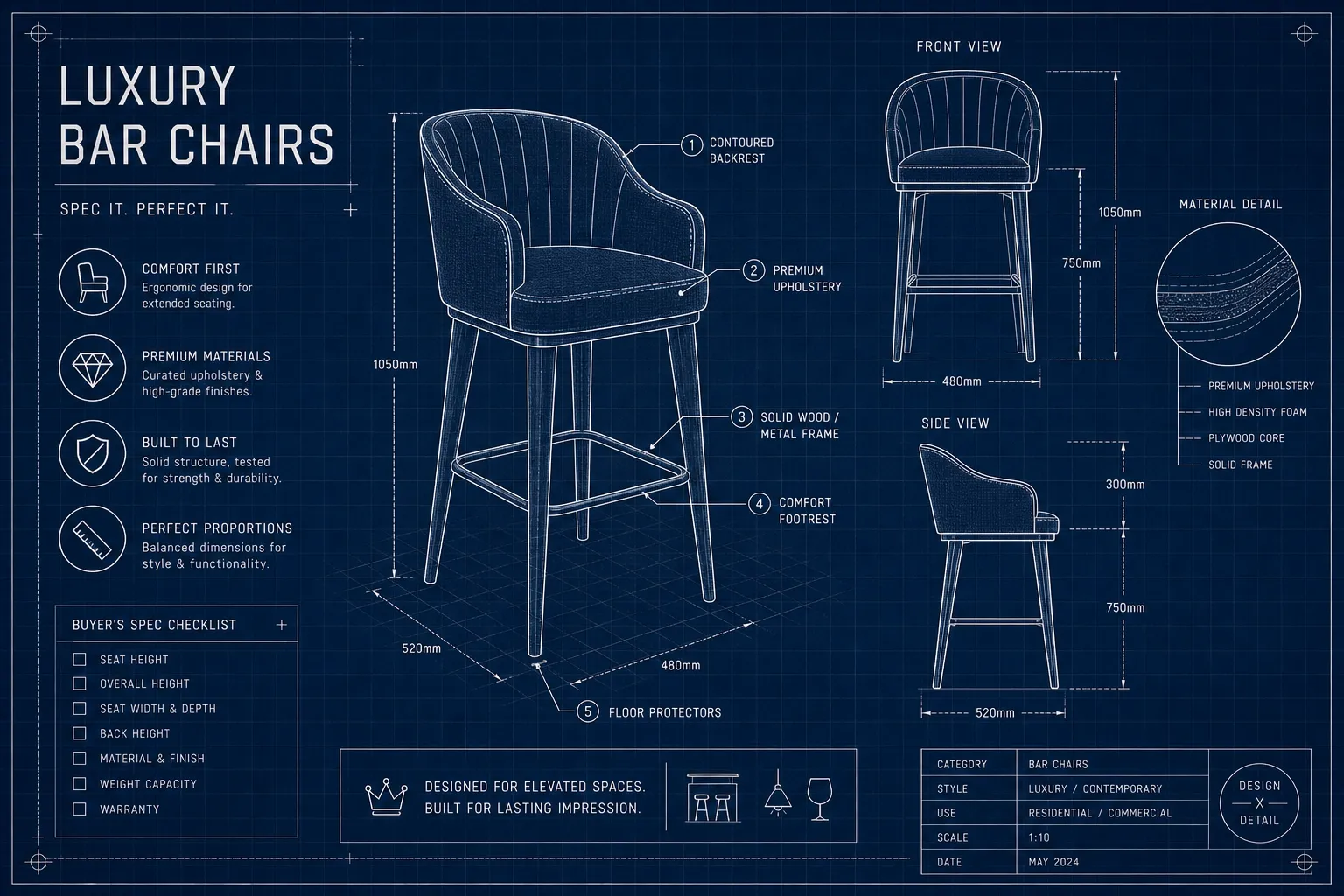
Choosing the right luxury bar chairs for a hotel bar or high-end residential wet bar involves far more than picking a seat that looks expensive. The wrong seat height makes every stool uncomfortable regardless of how well it’s upholstered. The wrong frame material can show accelerated wear in high-traffic settings, driving replacement costs well ahead of schedule.
This guide gives you the specification framework that hospitality designers and FF&E procurement teams actually use, covering seat height formulas, frame material trade-offs, upholstery performance, and when to go custom rather than retail. High-end bar stools in 2026 range from roughly $230 per chair at the entry tier to $800 and above for designer statement pieces. Across that price range, the spec decisions that determine comfort and longevity are the same. Get those decisions right first, then let aesthetics guide the final selection.
Getting the Dimensions Right Before You Pick a Style
This is the section most buyers skip, and it causes the most costly mistakes. Seat height is not a preference; it’s a calculation based on your bar or counter surface height. A mismatch of even one to two inches can noticeably reduce comfort for most users, and no amount of beautiful upholstery fixes a stool that puts guests’ knees at the wrong angle.
Bar Height vs. Counter Height: What Actually Separates Them
Two distinct categories exist, and they’re defined by hard numbers. Counter stools sit at 24 to 27.5 inches of seat height and pair with surfaces between 34 and 36 inches tall, the standard kitchen island or counter height. Bar stools sit at 28 to 32 inches and are designed for raised bar or pub surfaces between 40 and 43 inches tall. Extra-tall stools (33 to 40 inches) exist for surfaces 46 inches and above. Use these categories to immediately filter your options rather than browsing every stool on the market. For practical guidance on choosing the correct stool height for your surface, see this guide on how to choose the right bar stool height from Living Spaces: how to choose the right bar stool height.
The 9-to-12-Inch Legroom Formula
The measurement method is straightforward: take the floor-to-surface height of your bar or counter, then subtract 9 to 12 inches to find the ideal seat height range. A 36-inch counter calls for a stool between 24 and 27 inches. A 42-inch bar calls for a stool between 30 and 33 inches. That 9-to-12-inch gap represents the legroom clearance between the seat surface and the underside of the bar, less than 9 inches and guests are knees-to-chin; more than 12 inches and the stool feels too low for the surface. When evaluating any stool, always measure from the floor to the top of the seat rather than the overall stool height, since the total height includes the back or riser above the seat, which has no bearing on this calculation.
Spacing Your Seating for a Professional Layout
Allow one stool for every two feet of bar space, and leave at least 9 to 12 inches between seat edges to avoid shoulder crowding. An 8-foot island fits four stools comfortably. In hotel bar settings, tighter spacing creates a lounge atmosphere; wider spacing creates a premium, uncrowded feel that signals luxury and gives each guest a sense of personal space.
Luxury Bar Chairs: Frame Materials and Durability
The frame is the structural backbone of every bar chair. A beautifully upholstered seat on a weak frame is a liability in any commercial setting. Frame material also determines maintenance burden, finish longevity, and the visual language of the piece.
Steel and Brass Frames for Hospitality-Grade Performance
Steel frames dominate commercial bar seating for good reason. They resist repeated weight shifting, handle the demands of active service environments, and accept powder-coated or brushed finishes that resist corrosion. Commercial steel stools are typically rated for 300-plus pounds and can sustain years of heavy use with minimal maintenance. Brass-toned frames carry a more elevated aesthetic and work well in hotel bars and resort lounges where a warm, curated look is part of the design brief. It’s worth noting that brass is most commonly used as a decorative finish rather than a primary structural material in contract-grade seating, for raw structural longevity, steel is the proven leader. Both outperform solid wood in high-traffic settings, though frames in humid coastal or outdoor-adjacent environments need appropriate anti-rust treatment regardless of material.
Solid Wood Frames for Boutique and Residential Warmth
Walnut, oak, and beech frames bring warmth and craftsmanship cues that feel natural in high-end residential wet bars and boutique resort lounges. They are more susceptible to moisture and wear under heavy commercial use, which makes them better suited to lower-traffic settings or private residences where guest volume is controlled. The visual payoff, that handcrafted, maker-quality aesthetic, is genuinely hard to replicate with metal.
Mixed-Material Frames: The Design-Meets-Function Compromise
A steel base with a wood seat shell, or a brass-finished metal frame with sculpted wooden footrests, gives designers the best of both worlds. Designers increasingly specify mixed-material frames for mid-tier to high-end bar seating precisely because they balance structural integrity with material warmth. Specify this configuration when you need contract-grade performance without sacrificing residential warmth. Swivel mechanisms integrate cleanly into metal base designs, which is practical in hotel bar settings where guests frequently turn to engage with the room rather than face the bar directly.
Upholstery for Luxury Bar Chairs: Long-Term Performance by Material
Upholstery is where most buyers make emotionally driven decisions that create operational headaches later. Every material has a specific performance profile; matching that profile to your environment’s traffic level, spill frequency, and cleaning protocols is the actual specification decision.
Top-Grain Leather: The Reliable Choice for High-Use Bar Seating
Top-grain leather sits at the intersection of durability, comfort, and aesthetic sophistication. It resists punctures and surface wear better than most fabrics, handles everyday spills with a damp cloth, and develops a dignified patina over time. For long-term care, periodic conditioning and appropriate leather cleaners are recommended, particularly in high-use settings. The caveat: the PU coating on budget-grade top-grain will crack under heavy use within a few years, so the grade of leather matters as much as the type. Invest in genuine top-grain rather than bonded or bi-cast leather for hotel bars and upscale residential applications. For visual examples and discussions of genuine top-grain leather on seating, see this overview of top-grain leather bar stools.
Velvet: The Right Call in Low-Traffic Lounge Settings Only
Velvet delivers the most visually dramatic result in a luxury lounge setting: the depth of color, the light play, the tactile invitation to sit. The trade-off is real, velvet absorbs spills, is difficult to clean effectively, and wears visibly under repeated use. Specify velvet-upholstered bar stools only for hotel lobby lounges, private dining bars, or high-end residential wet bars where guest volume is low and aesthetic impact is the overriding priority. In a working bar environment, velvet seating requires a replacement budget built into the plan from day one.
Performance Faux Leather: Why the Gap Has Closed
High-quality PU and PVC faux leathers have improved significantly. The best options now feel close to genuine leather, clean with a damp cloth, handle spills without staining, and suit vegan-focused or sustainability-conscious hospitality brands. Contract vinyl grades from manufacturers like Naugahyde and Spradling publish Wyzenbeek ratings of 500,000-plus double rubs, far exceeding the 30,000-double-rub minimum typically required for commercial seating. They remain less breathable than real leather in warm settings, and visible peeling remains the failure mode when cheaper grades are specified. Use performance faux leather when budget constraints are real or when brand values make genuine leather unsuitable, see a comparison of real vs faux leather bar stools for guidance on performance and appearance trade-offs.
Design Styles Matched to Specific Bar Environments
Height and materials are specifications. Design style is the decision that determines whether the chair is a background piece or a defining feature of the room. Different bar environments call for fundamentally different aesthetic languages, and specifying the wrong style creates friction between the seating and the overall design intent.
Hotel Bars and Resort Lounges: Bold, Branded, and Hardworking
Hotel bars demand seating that holds up visually in high ambient light, reads well from a distance, and reinforces the property’s brand positioning. Contemporary styles with clean lines, sculptural metal bases, and strong upholstery colors or textured fabrics work reliably here. Among the prominent 2026 design directions, Neo-Decadence leans into plush velvets, rich marbles, and brushed brass with soft curves rather than harsh angles. Statement silhouettes, whether an architectural cutout back or an oversized swivel bar stool in a saturated fabric, photograph well and drive repeat visits in hospitality settings. The specification consideration is whether the statement piece is also functional: seat width, back support, and ease of getting on and off matter as much as visual impact.
High-End Residential Wet Bars: Personal, Curated, and Refined
A residential wet bar is a personal expression of taste in a way a hotel bar is not. This is where mid-century-inspired designs with walnut frames and dark leather, or fluted back panels with brushed brass footrests, earn their place. The specification brief here focuses less on contract-grade durability and more on craftsmanship details, material quality, and how the stool reads alongside custom millwork and bespoke cabinetry. The goal is a cohesive room, not a standout chair. Refined leather counter stools in walnut with black leather, in the $308 to $333 range, represent the kind of restrained elegance that works well in this context.
How to Spec Luxury Bar Chairs: When Retail Won’t Meet Your Brief
For hotel developments, resort projects, and residential builds with a specific design vision, the retail market is often too limited. Standard dimensions don’t always match custom bar builds. Brand-specific finishes don’t exist off the shelf. Fabric or leather specifications from a project’s finish schedule rarely align with what retailers stock. Retail roundups and reviews, such as Wirecutter’s favorite barstools and counter stools, are useful for general shopping, but they don’t replace the need for custom specification when precise dimensions, finishes, or branding matter.
What Custom Bar Seating Production Actually Involves
Bespoke bar seating starts with a design brief: your exact seat height requirements, frame finish specifications, upholstery material and color callouts, footrest placement, and quantity. A capable manufacturer works from these inputs to produce samples before committing to full production. That sample-approval process is standard practice in hospitality FF&E procurement and protects both parties from costly errors at scale. Lead times for custom orders typically run 4 to 12 weeks depending on complexity and quantity.
How Manufacturers Like YM Furniture Handle Hospitality-Scale Briefs
For projects where retail simply can’t deliver on dimension, finish, or volume, factory-direct custom manufacturing is the practical alternative. YM Furniture (Foshan Yauming Furniture & Construction Co., Ltd.) produces custom FF&E for 5-star hotels and resort properties across more than 30 countries. The team works directly from project design briefs to manufacture bespoke bar seating aligned with a property’s brand standards, finish schedules, and exact dimensional requirements. Operating factory-direct allows hospitality developers and procurement teams to access custom-quality output at meaningfully lower cost than sourcing equivalent pieces through retail or regional distributors, factory-direct sourcing reduces cost primarily by eliminating intermediary markups and enabling precise specification from the start.
For projects where volume, consistency, and design precision all matter simultaneously, this is the specification route that makes financial and logistical sense. The difference between a retail stool and a factory-direct custom stool often comes down to the elimination of middlemen and the ability to specify exactly what your project requires, not a difference in underlying quality.
What to Bring to the Table Before Production Starts
Have these details documented before engaging any custom manufacturer:
- Confirmed bar surface height and required seat height
- Frame finish specification (powder coat color, brushed or polished metal tone, wood species and stain)
- Upholstery material callout with grade and color reference
- Quantity by chair type and project delivery timeline
Having this information ready compresses lead times and eliminates misalignment at the sample-approval stage. The manufacturers who ask for these details upfront are the ones worth working with.
Your Specification Checklist Before You Buy
Selecting the right bar seating comes down to five decisions made in the right order:
- Start with seat height. Calculate it from your surface measurement using the 9-to-12-inch legroom formula, this is non-negotiable regardless of style preference.
- Choose your frame material based on your traffic volume and environment conditions. Steel for durability, wood for warmth, mixed materials when both matter.
- Select your upholstery based on maintenance reality, not just aesthetics. Match the material’s performance profile to your actual cleaning protocols and spill frequency.
- Match your design style to the specific bar environment rather than a general preference for luxury. Hotel bars and residential wet bars have fundamentally different briefs.
- Go direct to a custom manufacturer if your project has specific dimensional, finish, or branding requirements that retail cannot meet.
When sourcing luxury bar chairs for any commercial or high-end residential project, the specification decisions above determine whether the investment pays off long-term. Prices in 2026 range from roughly $230 at the entry tier to $800 and above for statement-grade pieces. For hospitality projects where consistency, custom specifications, and scalable production all matter, bespoke manufacturing partners like YM Furniture offer a route that retail simply cannot replicate. Get the specification right, and the chairs carry their weight for years. Specify without discipline, and even a premium stool can become a costly replacement problem well before its time.