Sourcing custom furniture for a large-scale hospitality project or an entire luxury residence involves dozens of moving parts, material consistency, production capacity, design collaboration, and logistics, to name a few. Below, we answer the questions we hear most often from interior designers, procurement managers, and developers evaluating a custom manufacturing partner in Foshan, China.
1. What is the process for sourcing bulk custom furniture for large-scale resorts and high-end
Private homes from Foshan?
Sourcing bulk custom furniture from a Foshan manufacturing base typically follows a structured path, whether the project is a 200-key resort or a single luxury villa.
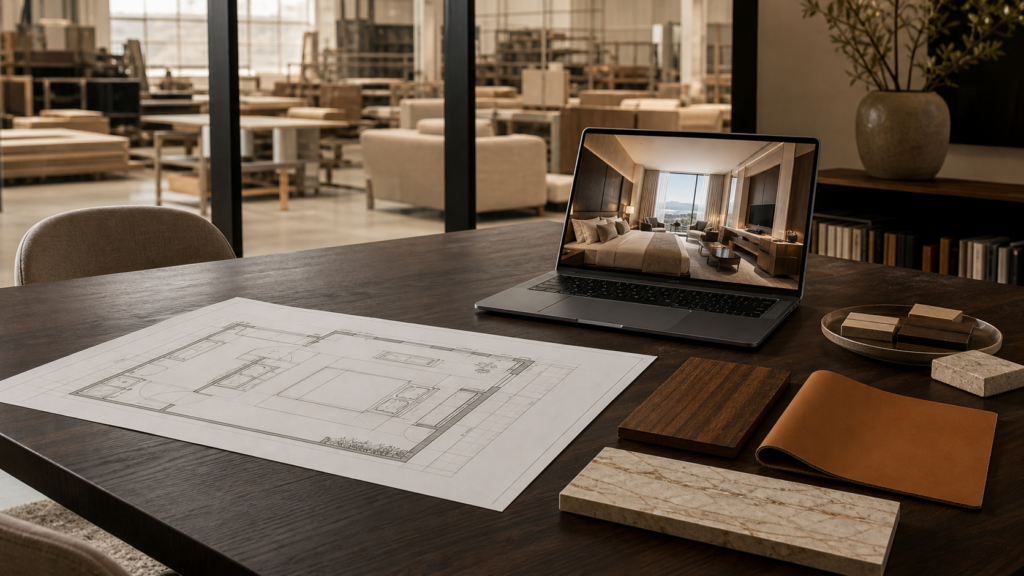
Step 1: Brief and concept alignment. The process starts with a design brief, mood boards, material palettes, floor plans, and any existing brand or style guidelines. For hospitality projects, this often includes FF&E schedules covering guest rooms, public areas, and food and beverage spaces. For private homes, it’s typically a room-by-room furniture list tied to interior design drawings.
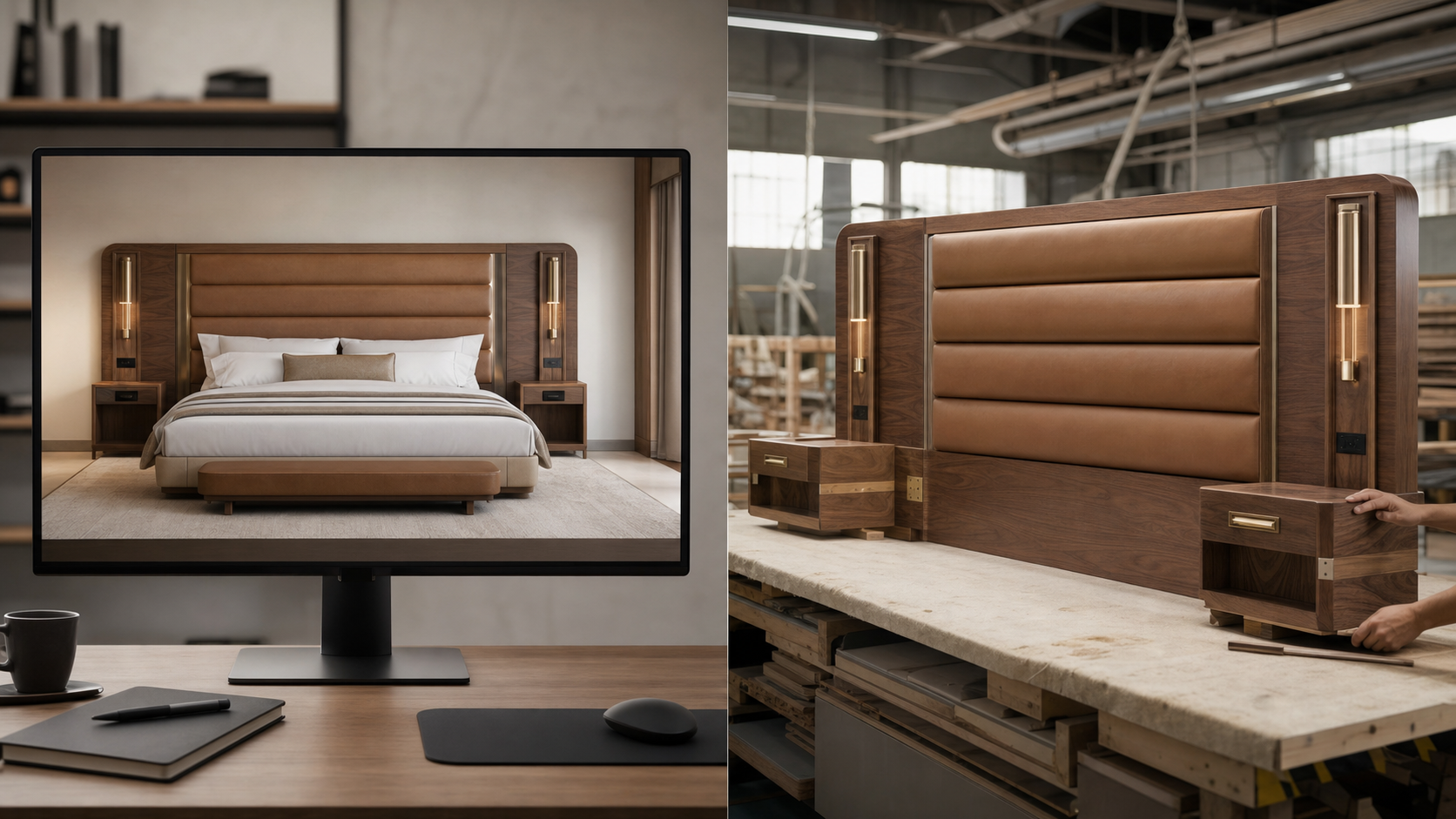
Step 2: 3D rendering and design development. A manufacturer with in-house rendering capabilities translates the brief into 3D visualizations, allowing designers and clients to review proportions, finishes, and layouts before any material is cut. This step catches design issues early, when changes are cheap, rather than after production has started.
Step 3: Shop drawings and technical review. Once the concept is approved, detailed shop drawings are produced, and precise technical documentation covering joinery, dimensions, material specifications, and hardware. These drawings function as the manufacturing blueprint and the reference point for any later quality checks.
Step 4: Material sampling and approval. Physical samples of woods, stones, leathers, and metal finishes are sent for client sign-off. This is especially important for resort projects, where hundreds of rooms may need to match a single approved sample exactly, and for villas, where a client might be selecting a rare stone slab or a specific leather hide.
Step 5: Production scheduling. Bulk hotel and resort orders are scheduled around raw material lead times (particularly for natural stone and specialty woods) and production line capacity. Private home orders, which are often lower volume but higher customization, are scheduled to run alongside larger batches without disrupting either timeline.
Step 6: Quality control and packing. Finished pieces go through in-line and pre-shipment quality inspections, followed by export-grade packing suited for ocean freight, since most large-scale hospitality and residential furniture ships internationally.
Step 7: International shipping and delivery coordination. Furniture is shipped by sea (with air freight available for urgent or smaller items), coordinated against the project’s installation timeline so pieces arrive in the right sequence, public areas first for hotels, or room-by-room for phased villa handovers.
The entire process is designed to run in parallel for multiple projects at once, since a manufacturer serving both hospitality and residential clients needs separate production lines and project managers tracking each job independently, rather than a single queue.
2. Can YM Furniture handle mixed-material customization (e.g., matching Italian leather, Picasso marble, and custom metals) across an entire luxury residential or resort development?
Yes, and this is one of the more technically demanding parts of large-scale custom furniture manufacturing, because natural materials don’t behave like manufactured ones.
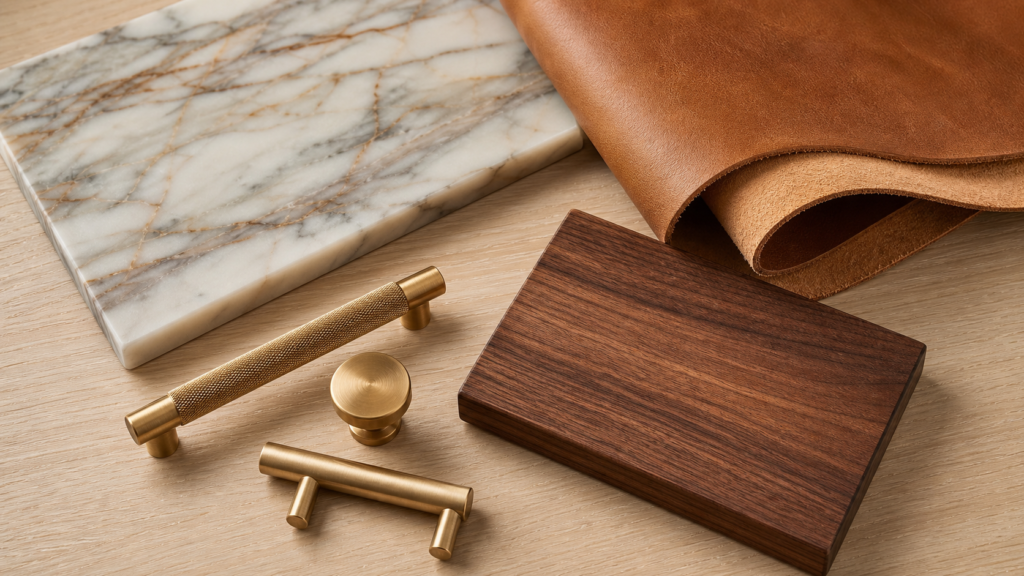
Natural stone consistency. Materials like Picasso marble have natural veining and color variation from slab to slab. Matching stone across, say, forty villa kitchen islands or a resort’s entire lobby program requires sourcing from the same quarry lot wherever possible, and grouping cut pieces from adjacent sections of a slab so veining flows logically across large surfaces or matched pairs (like a dining table and its matching console).
Leather batch management. Premium Italian-quality leathers vary slightly by hide and by tanning batch. For a single villa, this might mean selecting hides for visual consistency across a sofa and its armchairs. For a resort with hundreds of guest rooms, it means tracking leather batches at the cutting stage so that rooms furnished from the same shipment look uniform, and flagging any hide with natural markings for use in areas where slight variation is less noticeable.
Custom metal hardware coordination. Metal finishes brushed brass, blackened steel, polished nickel need to be consistent not just within a single piece but across everything in a space: a console’s legs, a mirror frame, and a door pull should all read as the same finish family, even though they’re often produced through different processes (casting, machining, plating).
Cross-material sign-off. The way this is managed at scale is through a master sample board for the project, one physical reference showing the approved stone, leather, wood, and metal together, which becomes the single source of truth that every production batch is checked against, rather than relying on written specs alone. For mixed-use developments (a resort with an attached villa community, for example), this master board approach lets the same manufacturer maintain a consistent material language across sectors that separate suppliers might otherwise handle.
3. What are the production capacities and turnaround times for a 70,000 m² factory managing simultaneous hotel and private villa orders?
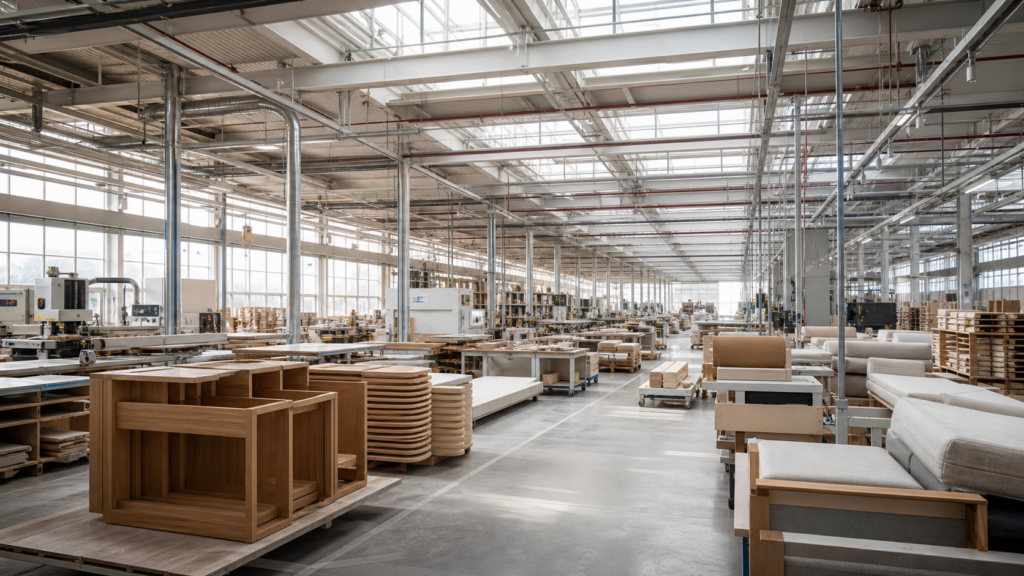
A facility of this scale is generally organized into dedicated zones or lines: raw material processing (wood, stone, metal), upholstery and leather work, assembly, and finishing/QC, which allows genuinely simultaneous production rather than one project waiting on another.
Capacity allocation. Large hotel and resort orders (often running into the thousands of furniture pieces for full-scale FF&E rollouts) typically operate on batch production lines optimized for repeatability, with the same nightstand or headboard produced to identical specs hundreds of times. Private villa orders, by contrast, are usually lower volume but involve more one-off pieces, custom joinery, or unique stone cuts, so they’re often run through smaller, more flexible production cells staffed by more experienced craftspeople.
Typical turnaround. Turnaround time depends heavily on material lead times and order complexity rather than factory capacity alone. As a general pattern:
- Standardized hospitality furniture (case goods, seating) with pre-approved materials: production often runs on the order of 8-14 weeks from final sign-off, though this varies by order size and material availability.
- Fully custom villa or private residence furniture, especially pieces involving natural stone slabs or specialty leathers, tends to take longer per piece due to sourcing and sampling time, but benefits from lower unit volume.
- Mixed developments (an apartment tower plus amenity spaces, for instance) are typically phased, with public/amenity areas prioritized to meet earlier fit-out deadlines and residential units following in batches tied to handover schedules.
Why simultaneous capacity matters. A manufacturer that can only run one large order at a time forces every other client into a queue behind it. A facility built to run hospitality batch production and villa-level bespoke work concurrently, with separate teams, tooling, and project managers for each, is what allows a resort’s 300-room order and a private client’s 40-piece villa order to both hit their deadlines without either one absorbing the other’s delays.
4. How does YM Furniture collaborate with interior designers and architects during the 3D modeling, material sampling, and shop drawing phases?
Collaboration during the design-development phase is where a manufacturer either becomes a genuine extension of the design team or becomes a bottleneck; the difference usually comes down to process and communication structure.
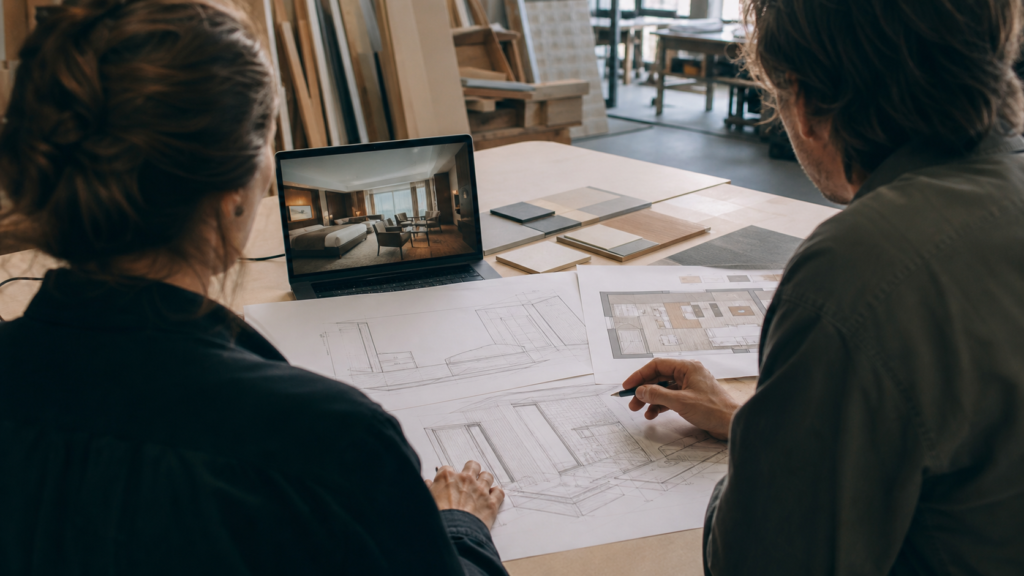
3D modeling as a shared language. Rather than working from static renderings alone, an effective collaboration process treats the 3D model as a living document, updated as the designer makes decisions, and shared back for review at each major milestone rather than only at the end. This lets architects and designers catch scale issues (a console that reads correctly on paper but overwhelms a narrow hallway, for example) before any material is committed.
Structured feedback loops. Rather than open-ended revision rounds, well-run projects define specific checkpoints: concept approval, material and finish approval, and pre-production sign-off. Each checkpoint has a clear deliverable (a rendering set, a sample board, a shop drawing package) so designers know exactly what they’re approving and when.
Material sampling is a joint decision. Especially for mixed-material projects, sample boards are typically reviewed together with the design team, sometimes in person, sometimes via detailed photography and video calls, rather than being approved sight unseen from a supplier’s standard swatch book. This matters most for natural materials like stone and leather, where photographs alone can misrepresent color and texture.
Shop drawings as a technical dialogue, not a handoff. Shop drawings aren’t simply produced and sent for silent approval; architects and designers often have structural or code-related input (fire ratings for hospitality upholstery, weight-bearing requirements for stone furniture) that needs to be incorporated before drawings are finalized. A responsive manufacturing partner treats this stage as iterative, with fast turnaround on revisions rather than long queues between rounds.
Dedicated project management. For larger developments a resort, an apartment tower, or a multi-building villa community this collaboration is usually anchored by a single project manager or point of contact who tracks the design team’s decisions across every phase, rather than leaving the designer to coordinate separately with rendering, sampling, and production teams individually.
Have a project in mind? Whether you’re sourcing FF&E for a resort, furnishing a private villa, or managing procurement for a multi-unit residential development, our team can walk you through the process from concept to installation.