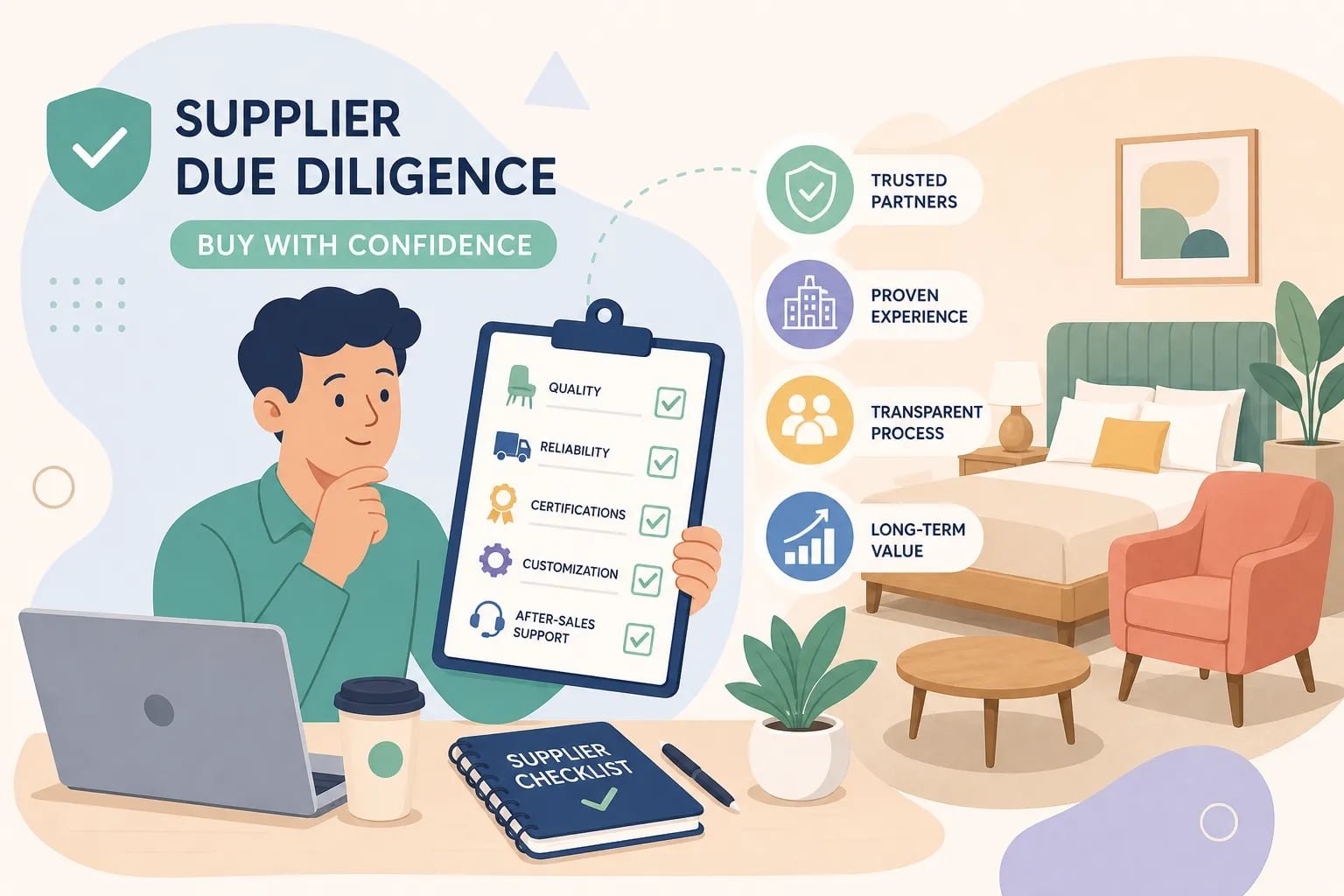
Every procurement team conducting due diligence on hotel furniture suppliers faces the same core challenge: separating genuine manufacturing capability from polished marketing. A procurement team shortlists a Chinese furniture manufacturer on price alone. The brochure looks sharp, the showroom photos are convincing, and the FOB quote comes in well under budget. So they sign, pay a deposit, and move on. Three weeks before the hotel opens, the upholstered seating fails BS 7176 fire testing. The replacement order costs twice the original. The opening is delayed. The ownership group absorbs the penalty. That scenario is entirely preventable, and, as any experienced FF&E consultant will tell you, it is far from rare.
Vetting a hospitality furniture supplier is not a procedural box-tick. It is the mechanism that separates a reliable manufacturing partner from a very expensive lesson. This guide gives procurement managers and FF&E consultants a structured framework covering certifications, factory audits, performance standards, contract terms, and true landed cost, so every shortlisting decision is grounded in evidence rather than a polished catalogue.
Manufacturers like YM Furniture carry triple ISO certification, hold independently verified test reports, and have delivered over 1,000 projects for properties operating under major international hotel brands. This hotel furniture supplier due diligence checklist shows you exactly how to identify suppliers at that level, and how to spot the ones that fall short before a contract is signed.
Why verifying a hotel furniture supplier is a risk management task, not a formality
Supplier marketing materials are optimised for persuasion, not transparency. A polished catalogue, a list of claimed brand partnerships, and a headline capacity figure tell you very little about operational reality. Factories that subcontract production to smaller workshops, hold certifications that lapsed without renewal, or lack any documented quality control process beyond a final visual check are more common than buyers expect, and they rarely advertise these gaps. A checklist-driven vetting process converts claims into evidence, and that distinction matters enormously at project scale.
The cost of skipping proper hotel furniture supplier due diligence lands directly on the project budget. Furniture delivered four weeks late pushes a hotel opening and triggers liquidated damages clauses with the ownership group. Non-compliant upholstery fails UK contract fire safety requirements and must be replaced at short notice, typically at a significant premium above the original order price. A manufacturer that looked competitive on FOB can end up costing far more once remedial work, expedited freight, and reputational exposure are factored in. Supplier verification is not overhead; it is the earliest and most cost-effective form of risk management available to a procurement team.
Hotel furniture supplier due diligence checklist: certifications
Quality, environmental, and safety management standards
Three ISO certifications form the baseline for any serious hotel furniture manufacturer: ISO 9001, ISO 14001, and ISO 45001. ISO 9001 confirms that the factory operates a documented quality management system covering supplier evaluation, production controls, inspection, corrective actions, and continuous improvement. ISO 14001 requires an environmental management system that addresses waste, emissions, resource use, and disposal. ISO 45001 covers occupational health and safety, including hazard identification, risk controls, and incident recording.
These are system certifications, not product-performance certifications. They confirm how a factory is managed, not whether a specific chair passes a structural durability test. When you receive certificates, check the issuing body, the exact scope of certification, and the expiry date. The standard certification cycle runs three years with annual surveillance audits in between; a certificate that has not been through a recent surveillance audit is not current evidence of compliance.
Sustainability and product-level compliance credentials
Beyond the ISO trio, several secondary credentials are relevant to UK and European hotel procurement. GREENGUARD Gold certification covers indoor air quality and low chemical emissions, which matters for guestroom environments. OEKO-TEX Standard 100 provides assurance on harmful substance limits in textiles. For Chinese suppliers, the China Environmental Label and CQC mark indicate domestic regulatory compliance, though UK buyers should separately confirm that products meet UK market-entry requirements by checking against the relevant UK conformity framework. None of these replace independent test reports, but they signal that a manufacturer takes compliance seriously across its product range.
The test reports that actually prove contract-grade performance
Structural durability and safety standards to request
There is a significant difference between a supplier describing their furniture as “commercial grade” and being able to produce an independently verified test report proving it. For UK hospitality procurement, the core structural standards are EN 16139 for non-domestic seating strength and durability, EN 15372 for non-domestic tables, and EN 1022 for seating stability. For projects with US market exposure, ANSI/BIFMA X5.1, X5.4, and X5.5 may also be required.
Every report you request must reference the exact product SKU, show the test method and standard, state the result numerically, and include the pass/fail threshold. Critically, the report must come from a UKAS-accredited or equivalent independent laboratory, not from the manufacturer’s internal QC team. A test report that does not identify the specific item tested is functionally worthless as evidence.
Fire safety and upholstery performance standards for UK projects
For hotel seating and upholstered furniture in the UK, the applicable standard for non-domestic settings is BS 7176, with medium hazard classification covering most hospitality environments. This is commonly referred to in the market as Crib 5 or Ignition Source 5 compliance. For mattresses, divans, and bed bases, the relevant standard is BS 7177. Request the full fire test report, not a certificate or letter of conformance.
For upholstery fabric performance, request the following documents for the exact fabric and frame combination you are ordering:
- Martindale abrasion results with the actual cycle count and fabric reference code (contract hospitality typically requires 40,000 cycles minimum)
- Pilling resistance to ISO 12945-2
- Colourfastness to ISO 105
- Seam slippage to EN ISO 13936
If the supplier cannot provide these reports for the precise specification you are ordering, treat that as a red flag and commission independent testing on samples before placing the order.
Evaluating production capacity before committing to a large order
The capacity indicators that matter for a hotel-scale furnishing programme
A supplier quoting “we produce 5,000 units per month” is providing a headline figure that could mean almost anything. The questions that reveal actual capacity are more specific: What is the total factory floor area? How many dedicated production lines operate for hotel furniture? What is manufactured in-house, and what is subcontracted? For a 300-room hotel furnishing programme, you need dedicated production capacity allocated to your schedule, not a shared queue across dozens of smaller concurrent jobs. Cross-reference claimed capacity against the scale of reference projects the supplier has actually delivered.
MOQ benchmarks and realistic lead times when sourcing from China
China-based hotel furniture manufacturers typically operate with minimum order quantities in the 100 to 500-unit range per design, with custom programmes requiring four to six months from order confirmation through to goods ready for shipment. Add 25 to 40 days for ocean freight to UK ports, plus customs clearance and inland delivery, and the end-to-end timeline for a large custom programme is comfortably six to eight months from contract signature to furniture on site. UK-based suppliers can turn around bespoke work in six to twelve weeks with lower MOQs, but at significantly higher unit costs.
Any supplier quoting unusually short lead times for a fully custom programme warrants direct, specific questioning. Either they are carrying stock that does not match your specification, they are planning to subcontract production, or the lead time excludes a significant portion of the work. Any of those scenarios creates problems downstream. Build your project schedule around realistic timelines and confirm in writing exactly what the quoted lead time includes.
What a third-party factory audit report should cover
The core sections of a credible SGS or Bureau Veritas audit
A self-declared “factory capability statement” is marketing, not verification. A credible third-party audit from SGS, Bureau Veritas, or an equivalent body produces a structured report with section-by-section ratings and a documented nonconformity log. The core sections should cover:
- Legal entity and registration details
- Production capability and capacity verification
- Quality management system (incoming material control, in-process checks, finished-goods inspection, calibration records)
- Personnel and training records
- Facility condition
- Photographic evidence across all of the above
The audit should produce both an overall score and granular section ratings so you can identify specific weaknesses. A nonconformity log with corrective action requirements and a closure timeline is equally important; it tells you what the factory needed to fix and whether it actually fixed it. An audit with no nonconformities at all should prompt scepticism rather than reassurance, no factory operating at production scale is genuinely without process gaps.
Hospitality-specific manufacturing controls to verify on-site
Beyond the general quality system, a hospitality furniture audit should confirm that woodworking, upholstery, welding and metalwork, surface finishing, and packing are all operating under documented process control. The most common failure point in hotel furniture supply is the gap between an approved prototype and what comes off the production line at volume. Ask specifically whether the auditor observed active production during the site visit and whether finished-goods samples were physically tested against the approved specification sheet. An audit conducted during a shutdown or limited-production period tells you considerably less than one completed during normal operations.
Reference verification and proven project track record
How to verify client references without relying on a curated list
Every supplier presents their strongest references by default. Your job is to look beyond the logo wall. Ask specifically for references from projects in the same scale bracket as yours: 200-plus rooms, multi-property rollouts, or comparable FF&E value. Request direct contact details rather than a testimonial letter, and ask structured questions: Was the timeline met? How were defects handled during the defects liability period? Would you use this supplier again on a similarly sized project? Cross-check any named brand partnerships against publicly available project records where possible.
What a properly vetted supplier profile looks like in practice
To illustrate the benchmark, consider what a thorough hospitality supplier background check reveals about YM Furniture. The business operates from a 70,000-square-metre facility in Foshan, holds current ISO 9001, ISO 14001, and ISO 45001 certification, and has an extensive portfolio spanning more than 1,000 projects across 30-plus countries, including supply to properties operating under major international brand standards that require detailed specification compliance and independent quality review before a purchase order is issued.
That is the evidence profile you should be working towards with any shortlisted supplier: verifiable project scale, named brand references at a relevant tier, and documented certification with current expiry dates. A supplier who cannot match that level of specificity, or who provides references without contact details and certifications without issuing-body information, warrants considerably more scrutiny before being shortlisted. The strength of a reference is in the detail, not the name.
Contractual terms you need to lock in before signing
Lead time commitments, delay penalties, and defects liability
A firm completion date with liquidated damages is the contractual mechanism that aligns the supplier’s incentives with your project timeline. Standard market terms structure delay penalties at 0.5% to 1% of total contract value per week of delay, capped at 10%. That cap is proportionate to the project value at risk and gives the supplier a meaningful financial reason to prioritise your programme. “We’ll do our best” is not a contractual commitment, and a supplier resistant to including delay penalties is signalling something about their confidence in their own delivery performance.
For defects liability, a 12-month period from delivery or practical completion is the standard baseline for UK commercial supply, with structural defects on high-value items sometimes warranting three to five years. Remedies should be clearly stated: repair or replacement within a defined timeframe (one week for urgent defects is a reasonable position), at the supplier’s cost. Liability should be capped at the invoice value, and any exclusions for wear and tear, misuse, or improper storage should be explicitly listed so there is no ambiguity when a claim is raised.
Inspection, acceptance, and installation clauses
Pre-shipment inspection at the factory of origin is a separate and equally important clause to include. This gives you a documented window to identify non-conforming items before they are loaded into a container, rather than discovering problems on site after a six-week ocean transit. Equally, the acceptance process after delivery and installation should include a snagging window during which final payment is withheld. Releasing payment before defects are documented and agreed creates a weak negotiating position if issues emerge later.
Installation contracts should also confirm that the supplier is responsible for any damage caused to the premises during assembly and placement, and that installation is explicitly included in scope rather than treated as a separately quoted variable. Ambiguity around installation costs is a common source of post-contract disputes on large hotel projects, so this clause is worth pressing on during negotiation.
Calculating the true landed cost before comparing any bid
The hidden cost categories that inflate your FOB quote
An FOB price is the starting point for a cost comparison, not the finishing point. Logistics, customs, and warehousing combined typically add 20% to 40% above the factory price, depending on route, shipment conditions, and the specific commodity codes applicable to the furniture. Installation and last-mile delivery to site commonly add a further 10% to 15%. A 2% to 5% contingency for transit damage is prudent on large-volume orders moving by ocean freight. Under the UK Global Tariff, many hotel furniture items may be classified under HS 9403, but classification depends on the specific product; duty rates vary, so verify the applicable rate for each product category using the UK Global Tariff lookup before finalising the budget. UK import VAT at 20% applies on top of the CIF value plus duty.
The landed cost formula every procurement team should use
Before any bid comparison, calculate the total landed cost using this framework:
Total Landed Cost = Product Price + Packaging + Origin Transport + Ocean Freight + Insurance + Import Duties + Customs Brokerage + Inland Delivery + Storage + Installation + Contingency
Two suppliers with different FOB prices can produce very different total project costs once logistics, duties, and site services are layered in. A supplier quoting £80 per unit FOB but offering no support on customs classification, no installation service, and no warehousing option may cost considerably more in practice than a supplier quoting £95 per unit with a comprehensive project management service covering all of the above. Suppliers who quote only FOB without supporting a landed cost estimate are making it structurally harder to compare their true competitiveness, and that reluctance is itself worth noting during the evaluation.
Bringing the hotel furniture supplier due diligence checklist together into a decision
The goal of structured supplier verification is not to generate a stack of paperwork. It is to give procurement teams the confidence to shortlist the right manufacturer and reject the wrong one before a contract is signed and a deposit is transferred. This contract furniture supplier checklist, covering certifications, test reports, factory audit evidence, reference verification, contract terms, and landed cost, is designed to be completed before shortlisting, not after a problem emerges on site.
A supplier worth building a long-term relationship with will welcome this level of scrutiny. They will provide current ISO certificates with issuing-body details, full test reports referencing specific SKUs from accredited laboratories, an independent factory audit with a credible nonconformity log, verifiable project references with contact details, contractual willingness to commit to firm lead times and a 12-month defects liability period, and a clear landed cost breakdown that goes beyond the FOB line. That combination of evidence is what separates a reliable hospitality furniture partner from a risk that looks attractive on a spreadsheet.
If you are in the process of evaluating suppliers for a hotel, villa, or apartment furnishing programme and want to understand how a factory-direct manufacturer with verified credentials approaches project delivery, the team at YM Furniture is available to walk you through their certification documentation, production capability, and reference project portfolio. Use this hotel furniture supplier due diligence checklist before you shortlist, and contact YM Furniture to see exactly how a well-documented supplier responds to each point.