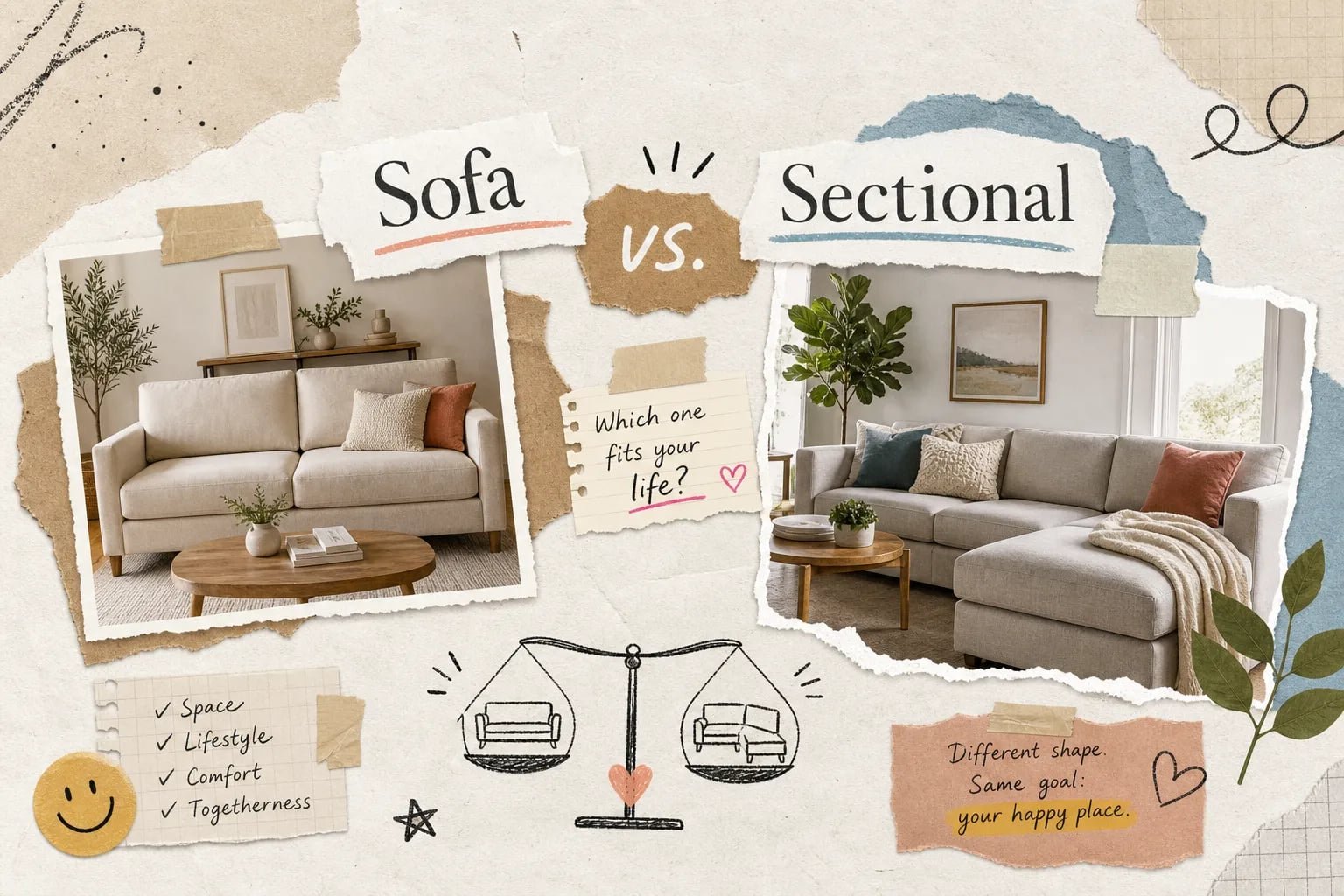
You’ve measured the room. You’ve set the budget. Now you’re standing in a showroom, or scrolling through tab after tab online, staring at two fundamentally different answers to the same question. When choosing between a sofa and sectionals, the difference goes well beyond size. A sofa says clean lines and clear sightlines. A sectional says sink in and stay a while. Neither is wrong by default, but one of them is wrong for your space, and buying the wrong one is an expensive mistake to undo.
This isn’t a purely aesthetic decision. The sofa-versus-sectional choice determines how traffic moves through a room and how many people can actually use the space comfortably, and how well the furniture holds up over years of real use. That last point matters more than most buyers realize at the time of purchase, which is why this guide doesn’t stop at living rooms. Hotel designers, villa developers, and FF&E specifiers face this same decision on a much larger scale, and the logic they use translates directly to smarter residential choices.
Here’s what this guide covers: room type and function, physical sizing and configuration, fabric and fill performance, what hospitality projects do differently, current Canadian pricing, and the delivery and warranty details that many buyers miss until after the sale. Work through each section, and you’ll have a clear answer before you commit to anything.
Sofa and Sectionals: What Actually Separates Them
The structural difference most buyers overlook
A sofa is a single, self-contained unit. It has two defined arms, a fixed frame, and a predictable footprint. A sectional sofa is a collection of connected pieces, typically arranged into an L-shape or U-shape, that function together as one seating system. This isn’t simply a size distinction. It’s a design philosophy. A sofa defines a conversation zone with clear edges. A sectional creates an environment that wraps around the people in it.
That distinction has real consequences for how a room feels and functions. A sofa can be repositioned, paired with other pieces, or moved to a new home without much drama. A sectional, once placed, is essentially an architectural decision. The room gets organized around it, not the other way around.
Why configuration determines function, not just form
The configuration of a sectional, whether it features a chaise, a corner piece, a reclining section, or a full U-shape, directly controls how traffic flows through the space. A sofa leaves open sightlines and clear circulation paths on more sides. A large L-shaped sofa claims real estate across a significant portion of the room and should be treated as semi-permanent from the day it’s delivered; plan on at least 30 to 36 inches of walkway clearance around it. In commercial spaces like hotel lobbies, this distinction becomes critical: foot traffic management and guest comfort have to coexist, and a configuration decision made without accounting for both typically sacrifices one for the other.
When a sofa is simply the smarter choice
Bigger isn’t always better. For narrow rooms, open-plan apartments, or multipurpose spaces, a well-proportioned sofa consistently outperforms a sectional that overwhelms the layout. As a general guideline, rooms under about 12 feet wide often suit a standard sofa better; a sectional will eat the floor space and leave circulation paths too tight to feel comfortable, regardless of how good it looks in the product photo.
How Room Type Should Drive Your Seating Decision
Hotel lobbies: seating that works for strangers
Hotel lobbies require seating that handles high turnover, varied body types, and near-constant use, often 16 or more hours a day. In this setting, individual sofas arranged in clusters consistently outperform large sectionals because they allow flexible group configurations without forcing strangers into proximity. A sectional presumes a degree of familiarity between users. A lobby full of independent business travelers doesn’t have that dynamic, and hospitality designers generally account for this when specifying seating clusters for transient guest areas.
Durability and cleanability rank higher than plush comfort in commercial lobby seating. Seat height is a practical consideration too: 17 to 19 inches makes entry and exit straightforward for guests across all age ranges, with enough leverage for older guests to rise without difficulty, a spec that retail-oriented sectionals rarely prioritize. These two requirements together mean commercial-grade sofas in a lobby context are specced quite differently from anything you’d find in a standard showroom.
Villa and luxury residential living rooms: the case for bold sectionals
Villa-scale living rooms, typically 400 to 700-plus square feet of open-plan space, are one of the few settings where a large modular sectional or U-shaped configuration genuinely earns its footprint. These spaces are built for long, relaxed occupancy rather than throughput. Depth, cushion quality, and visual presence become the dominant selection criteria, not traffic flow. A well-specified sectional in a villa living room doesn’t compete with the architecture; it anchors it.
Developers and interior designers specifying seating for luxury villas routinely go beyond retail options because the scale, customization requirements, and durability standards for a villa project, sometimes spanning dozens of suites or common areas, rarely match what standard showrooms carry. That gap is precisely where factory-direct sourcing becomes the rational path.
Standard residential spaces: matching scale to the room
For typical Canadian residential living rooms in the 12×15 to 15×18 foot range, the decision usually comes down to one question: where is the room’s focal point? If there’s a TV wall, a fireplace, or a view that anchors one end of the room, a chaise sectional placed to face that focal point often works well. If the room needs seating that addresses multiple directions, or if there’s a dining area nearby that requires clear separation, a three-seat sofa paired with an accent chair typically serves the layout better and leaves more flexibility to evolve the space over time.
Getting the Size Right Before You Buy Anything
The four measurements that actually matter
Before ordering any seating, measure four things: the room’s overall length and width; the sectional’s total footprint including both the long side and the depth of the chaise or return; doorway and hallway clearance for delivery (each module separately, not just the assembled unit); and recliner extension space if the configuration includes power recliners. These aren’t optional steps. They’re the difference between a piece that transforms a room and one that has to go back.
The core spacing rules are non-negotiable minimums, not suggestions. Leave 30 to 36 inches for main walkways and 18 to 24 inches between the sofa face and the coffee table. Going tighter makes the room feel cramped regardless of how well the furniture looks on its own.
A quick sizing reference by room footprint
Use this as your starting framework:
- Rooms under 10×12 ft: loveseat or compact two-seat sofa
- Rooms 12×14 to 13×16 ft: standard three-seat sofa or small L-shaped sectional (95 to 120 inches wide)
- Rooms 14×18 ft or larger: standard sectional sofa, U-shaped sectional, or modular sectional
- Open-plan villa or lobby zones over 400 sq ft: large modular sectional or multiple sofa groupings
The painter’s tape trick that saves expensive returns
Before you finalize any sectional order, tape the exact footprint of the piece onto your floor using painter’s tape and live with it for 24 hours. Walk the traffic paths. Sit in the center of the taped area and look at the room from that vantage point. This single step eliminates the most common sizing mistake: overestimating how much open floor space a large sectional leaves once it’s in the room. It costs nothing and takes 10 minutes. Do it every time.
Sofa and Sectionals Configuration: What Each One Is Built For
L-shaped sofas and chaise sectionals
The L-shaped sofa with a chaise extension is one of the most common sectional configurations in Canadian homes, and for good reason. It works well in rooms with one open wall and a clear focal point opposite the main seating position. Whether the chaise faces left or right should be determined by the room layout and the TV position, not personal preference alone. A chaise on the wrong side blocks traffic and forces an awkward viewing angle that you’ll notice every single day.
The limitation of a chaise sectional is that it delivers seating in one direction only. In rooms that need to address guests coming from multiple entry points, or in open-plan spaces with activity on more than one side, a standard sofa arrangement often serves the room better.
Modular sectionals: flexibility at a cost
A modular sectional is built from interchangeable components- ottomans, armless chairs, corner pieces, and chaises- that can be rearranged into different configurations over time. This makes them well-suited to spaces that evolve, such as vacation rentals, villa common areas, or open-plan residential spaces where the owner’s needs are likely to change. The trade-off is real: some modular systems carry a higher price than comparable fixed sectionals, and connection hardware between modules can loosen with use, requiring periodic attention to keep the configuration stable.
Reclining and sleeper sectionals: added function, added weight
Reclining sectionals work well in dedicated media rooms where the sole purpose of the space is watching content in extended comfort. They need significant clearance behind them, often 6 to 12 inches from the wall, a detail many buyers miss until the piece is already in the room. Sleeper sectionals can substantially increase the total weight of the unit, which affects delivery logistics, floor load on upper levels, and the practical ease of opening and closing the bed mechanism over years of use. Confirm weight specifications with the manufacturer before ordering if floor load or stairwell access is a concern. Both configurations serve specific needs well; neither is a general-purpose solution.
Fabric and Fill: What Actually Holds Up Over Time
Performance fabrics for high-traffic and pet households
For any home with pets, children, or frequent entertaining, performance fabrics are the most practical starting point. Brands like Crypton, Sunbrella, and Revolution, along with treated polyester blends, resist moisture at the fiber level rather than just on the surface. That distinction matters: a surface treatment wears off over time and washing, while fiber-level resistance doesn’t. Microfiber and tightly woven polyester blends are the accessible, budget-friendly alternative with similar core benefits for households that don’t need the full performance-fabric specification.
Leather and faux leather: the honest trade-offs
Protected leather is the easiest surface to wipe clean after spills, but it can be more susceptible to drying in Canadian heated interiors if not properly conditioned. Regular use of a leather conditioner and maintaining indoor humidity helps prevent stiffening and surface cracking over time. Faux leather, including PU and bonded leather, is cheaper upfront, though many lower-grade versions commonly show visible wear, peeling, and flaking within a few years of regular use, in ways that are difficult or impossible to repair. For hospitality applications, genuine protected leather or high-grade performance fabric consistently delivers better value over the full life of the piece.
Cushion fill and what it means for long-term shape
High-resilience foam holds its shape best and is the easiest to maintain in households with heavy use. Foam wrapped with a polyester fiber layer sits slightly softer and feels more inviting, with a modest trade-off in long-term resilience. Down and feather blends deliver a luxurious sit but demand regular redistribution to prevent lumping, and they’re less forgiving when spills happen. For households with pets and children, or for any furniture intended for commercial use, high-resilience foam or HR foam with a tight fiber wrap is the practical, defensible choice.
How Hospitality and Villa Projects Approach This Decision Differently
Why 5-star hotels don’t shop at furniture stores
Hotels and villa developers work with fundamentally different criteria than residential buyers. They need contract-grade durability built for 16-hour daily use, fire-safety compliance to meet building-code requirements, consistent replication across dozens or hundreds of identical units, and custom dimensions that fit designed floor plans precisely. Standard retail sectionals, even premium ones, rarely meet all four requirements simultaneously. This is why hospitality procurement operates through a completely different channel than residential retail.
The factory-direct model and what it means for cost and customization
Factory-direct procurement is how most serious hospitality and luxury residential projects get seating that performs commercially while looking residential-luxurious. Manufacturers like YM Furniture (Foshan Yauming Furniture & Construction Co., Ltd.), based in Foshan, China, produce fully custom sofas and sectionals built to exact client specifications: any configuration, any dimension, any fabric, with the contract-grade construction that hotel projects demand. For developers and FF&E specifiers, working with a dedicated hospitality manufacturer gives you a reliable, experienced partner when specifying custom seating at scale.
The cost difference can be significant. Factory-direct pricing through a manufacturer like YM Furniture can represent meaningful savings compared to equivalent pieces sourced through Western retail channels, depending on specifications and order volume. For a villa developer furnishing 20 suites or a hotel ownership group specifying seating for an entire lobby and lounge complex, those savings aren’t marginal. They’re often the difference between a project that stays on budget and one that doesn’t.
What residential buyers can learn from this approach
The same logic that drives hotels toward custom, durable seating applies directly in high-end Canadian homes. Choosing the right fill, frame construction, and fabric from the outset, even if it means spending more upfront, consistently costs less over a 10-year horizon than replacing retail-grade furniture every four to six years. Residential buyers who adopt the same thinking tend to spend less money in the long run and live with better furniture while they’re doing it.
What Sofas and Sectionals Cost in Canada (and What You Get at Each Level)
Entry-level to mid-range: $700 to $3,500
At the entry level, loveseats and small sofas typically run $300 to $1,400 in Canada. Standard three-seat sofas land between $700 and $2,500, and small chaise sectionals start around $2,500 and climb toward $4,000. At this price range, frame construction is usually engineered wood or a combination of materials rather than solid hardwood, foam density is lower, and fabric quality reflects the price. Most entry-level sectionals use foam that begins to compress noticeably within two to three years of regular use. That’s not a criticism; it’s a reality to factor into the true cost of ownership.
Mid-range to premium: $3,500 to $9,500 and beyond
Large L-shaped or modular sectionals in the mid-premium tier typically run $3,500 to $6,500 at Canadian retail. Premium custom or Canadian-made sectionals push from $6,000 to $15,000 and beyond. Canadian-made custom sectionals from brands like CouchHaus, which carries an 8- to 12-week lead time, and Rove Concepts, which runs 14 to 20 weeks for custom orders, occupy the upper mid-range and offer meaningful customization in both configuration and fabric choice. These represent a genuine step up in durability and tailoring compared to mass-market imports at similar price points.
Where to find the best value in each budget range
Leon’s covers the entry-level volume end of the market with broad selection and relatively fast delivery on in-stock pieces. Ashley operates in a similar space, though delivery timelines and policies vary by location, so confirm current terms with the store before ordering. EQ3 and Urban Barn sit in the mid-range and offer more considered design and Canadian options without jumping to full custom territory. Rove Concepts and CouchHaus serve buyers who want custom-configurable sectionals with meaningful material choices and are willing to wait for production. For developers or buyers furnishing large properties who need commercial-grade product at scale, direct factory sourcing is the channel that makes economic and operational sense, and that’s a conversation worth having before committing to retail volume orders.
Delivery, Warranty, and What to Confirm Before You Commit
Delivery terms many buyers overlook
Standard delivery at major Canadian retailers typically runs three to seven business days for in-stock pieces, while custom or made-to-order sectionals run eight to twenty weeks depending on the manufacturer. The word “delivery” in most retailer terms means curbside or threshold drop-off. White-glove in-room placement and assembly costs extra and must be confirmed before checkout, not after the truck arrives. For any large sectional, in-room placement is almost always worth the additional fee. Sectionals arriving as multiple heavy modules are not practical for most buyers to handle alone, and many retailers do not cover customer-caused damage after DIY assembly; confirm the policy with your retailer before proceeding.
Warranty terms and what to look for
Most major Canadian retailers cover sofas and sectionals under the manufacturer’s warranty, which typically addresses structural defects but excludes fabric wear, cushion compression, and anything categorized as normal use. Leon’s, as one concrete example, treats sales as final after delivery but handles concealed damage reported within 72 hours as a service issue rather than a standard return. Extended protection plans are available at most retailers and are worth evaluating seriously for households with heavy use, pets, or young children, where the “normal use” exclusion in a standard warranty can swallow the most common problems.
The five questions to ask before you finalize any order
Before you confirm any sofa or sectional purchase, get clear answers to these five questions. They’re not bureaucratic formalities; they’re the difference between a smooth purchase and a frustrating one.
- What are the exact assembled dimensions, not just the listing dimensions?
- Is delivery white-glove or curbside, and what does it cost to upgrade?
- What is the return policy if the piece doesn’t fit or arrives damaged?
- Does the warranty cover cushion compression and fabric pilling, or only structural defects?
- If custom or made-to-order, what is the confirmed lead time and the cancellation policy?
Any retailer or manufacturer that can’t answer these questions clearly before the sale is a flag worth taking seriously.
Making the Right Call for Your Space
The sofa-versus-sectional decision comes down to three things working in alignment: the room’s function, its physical dimensions, and the durability requirements of the people using it. Get all three right, and the furniture serves the space for years. Miss any one of them and the problems show up fast.
Residential buyers need to match sofa and sectional configuration to room footprint, measure before anything else, and invest in fabric and fill quality upfront rather than paying twice over a five-year cycle. Hospitality and villa developers need to operate at a fundamentally different scale: custom dimensions, contract-grade durability, fire-safety documentation, and sourcing models that reflect the volume and precision those projects demand. That’s where factory-direct procurement from a manufacturer like YM Furniture becomes the rational choice rather than an exotic one. If you’re specifying seating for a hotel lobby, a villa development, or a luxury residential project at scale, get in touch with the YM Furniture team directly to discuss your project requirements and what factory-direct procurement looks like in practice.
Whether you’re furnishing a condo living room or a hotel lobby in Vancouver, the decision process is the same: measure the space first, define who uses it and how, then choose the sofa and sectionals configuration that fits the life being lived in that room. The actual room. The actual people in it. That’s what the right choice is built around.