How do hotel developers source furniture for large projects? It starts with a scope that most people outside the industry underestimate. A 200-key hotel project can involve upward of 15,000 individual furniture pieces spanning dozens of SKUs and multiple supplier relationships, with a procurement window that typically runs 20 to 30-plus weeks for a fully custom package. That’s before you factor in custom finishes, mock-up room approvals, international freight, and brand-standard compliance reviews. The math is unforgiving: if your FF&E program slips by eight weeks, your opening date slips with it, and the carrying costs on a stalled project compound fast.
Here’s what experienced developers know: furniture procurement failures are a leading cause of hotel projects running over budget and behind schedule. The concrete goes up on time. The casegoods don’t arrive. When the sourcing process is managed reactively instead of strategically, that’s where hotel builds lose control of their timeline and their budget.
This guide covers the full operational arc of hotel FF&E procurement, from scoping your needs before you talk to a single supplier, through on-site installation and punch list closeout. Factory-direct manufacturers like YM Furniture (Foshan Yauming Furniture & Construction Co., Ltd.) have changed how forward-thinking developers approach large-scale sourcing, compressing the gap between custom hospitality-grade quality and aggressive cost targets. The framework below is designed to help you run that process with discipline.
Map Your FF&E Scope Before You Talk to a Single Supplier

Most sourcing mistakes happen before an RFP is ever written. Developers who skip a rigorous needs assessment end up issuing vague briefs that generate inconsistent bids, slow down sample approvals, and create costly change orders mid-production. The discipline you put into the scoping phase directly determines how much control you have over the rest of the program.
Define Your Room Categories, Item Counts, and Brand Standards
Start with a room-by-room breakdown: guestrooms by type, suites, public areas, F&B spaces, meeting rooms, fitness areas, and back-of-house. Each category carries its own FF&E schedule with distinct specifications, durability requirements, and finish expectations. For flagged properties, the brand’s FF&E design guide sets the baseline for every line item; for independent properties, the interior designer’s specification package serves the same function.
Your interior designer and the brand’s FF&E guide should shape the specification list before any supplier conversation starts. Locking down material specs, finish schedules, construction standards, and dimensional requirements at this stage gives your suppliers the information they need to price accurately and produce correctly. Vague specs at this stage translate directly into change order exposure later.
Set a Realistic FF&E Budget Per Key
The per-key budget is the most useful early benchmark in hotel FF&E planning. Based on current industry benchmarks, a 4-star property typically runs $12,000 to $25,000 per key on FF&E, while a full-service 5-star property often falls in the $35,000 to $65,000 range depending on luxury positioning and scope. Those figures are useful anchors, but only if you’re measuring the right thing.
Landed cost budgeting is the only number that matters for procurement decision-making. Your budget has to account for factory cost, international freight, customs duties, port handling, domestic drayage, warehousing, and installation, not just the supplier quote. Developers who budget on factory price alone routinely discover a significant gap between their quote and their actual landed cost; industry experience suggests that difference commonly ranges from 20 to 50 percent depending on destination, product category, and duty rates. Build the full cost stack into your model before you go to market.
How Do Hotel Developers Source Furniture for Large Projects: Sourcing Channels Explained
There’s no single right way to source hotel furniture for a large project, but there are four well-established channels, each with meaningful trade-offs in cost, control, and complexity. Understanding those trade-offs before you commit to a sourcing strategy will save you from a mismatch between your procurement model and your project’s actual requirements.
Direct Factory Sourcing vs. Agent-Led Procurement
Direct factory sourcing, especially from contract manufacturers in China or Southeast Asia, gives developers maximum pricing control and customization latitude. When you’re buying directly from a manufacturer like YM Furniture rather than through a distributor or trading company, you’re eliminating one or more layers of margin. On a 200-key project, that adds up to real money. The trade-off is internal bandwidth: direct sourcing requires more hands-on vendor management, QA oversight, and logistics coordination on your end.
Agent-led or consultant-led procurement reduces that internal burden by adding an experienced layer of oversight. A qualified FF&E procurement firm manages supplier selection, bid comparison, sample approvals, quality inspections, and logistics across all categories. You pay for that service through fees or margin, but for ownership groups without a dedicated FF&E team, the cost is often justified by the risk reduction and project discipline it provides.
Domestic Distributors and Digital Procurement Platforms
Domestic distributors offer faster lead times, simpler communication, and local warranty support. Those advantages are real, but they come at a meaningful price premium over factory-direct sourcing, often significantly more per unit on comparable specifications, a gap that varies considerably by product and category. For select-service projects on tight budgets, that premium can represent hundreds of thousands of dollars on a single guestroom casegoods package alone.
Digital procurement platforms are increasingly part of the toolkit, particularly for large hotel brands and ownership groups that manage multiple properties simultaneously. These platforms allow teams to run parallel RFPs, compare landed costs, and track purchase orders in one system. Group purchasing organizations also come into play for larger operators, leveraging consolidated volume across a portfolio to negotiate improved pricing and lead time commitments from qualified vendors.
How to Build Your Vendor Shortlist and Write an Effective RFP
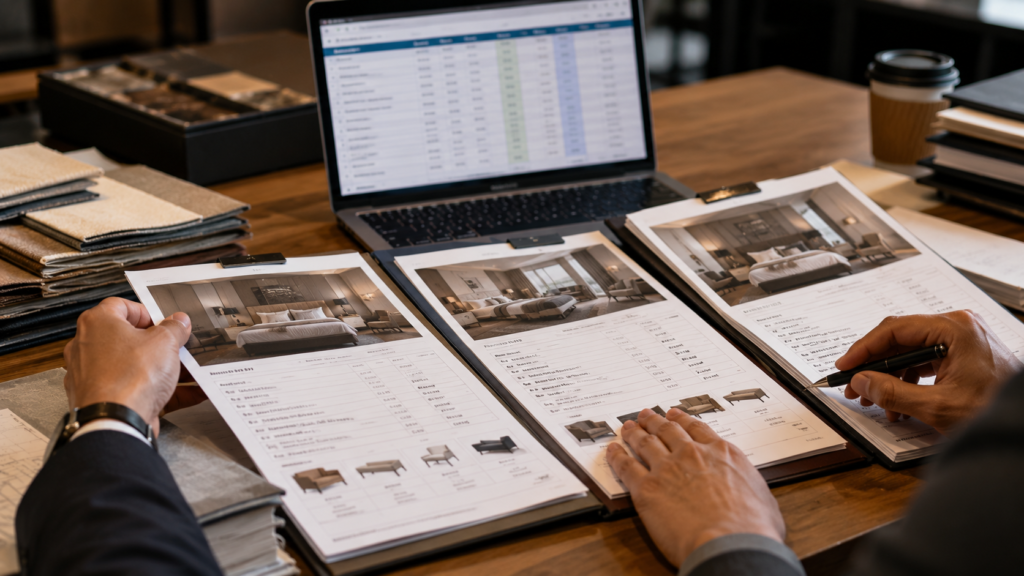
An FF&E RFP that generates useful, comparable bids requires more than a product list and a price request. The quality of your RFP determines the quality of the supplier responses you receive, and by extension, the reliability of the partners you end up with.
What Belongs in a Hotel FF&E Request for Proposal
A professional FF&E RFP should include the full FF&E schedule with item descriptions and quantities, specification sheets or design drawings, finish schedules and material requirements, your proposed delivery timeline, and required certifications. For international shipments, that certification list needs to cover fire compliance standards (such as BS 5852 Crib 5, CAL TB 117, or EN 1021 depending on your destination market), formaldehyde emission limits, and any regional standards specific to the project location.
The RFP should also specify terms for sample production and mock-up room setup, because those aren’t optional extras on a large hospitality project. For brand-flagged properties, include the brand-compliance documentation requirements so vendors understand exactly what approval checkpoints their product will need to pass. A thorough RFP signals to qualified manufacturers that you’re a professional buyer, which tends to attract more serious, accurate bids from capable suppliers.
Evaluating Supplier Bids Beyond Unit Price
Your evaluation matrix should cover per-unit price, total landed cost, lead time, MOQ, factory credentials, sample approval process, QA/QC methodology, and logistics capability. The cheapest bid is rarely the right bid on a large hospitality project. Selecting a supplier based on unit price alone is how developers end up with production delays, non-compliant materials, and installation problems three weeks before their opening date.
ISO certifications matter in this evaluation. ISO 9001 for quality management, ISO 14001 for environmental compliance, and ISO 45001 for occupational health and safety are the core certifications that global hotel brands like Marriott and Hilton expect from qualified FF&E suppliers. A factory without these certifications isn’t automatically disqualified, but you’ll face more scrutiny from brand QA teams during the approval process, and you’re taking on additional compliance risk.
Key Qualification Questions to Ask Every Vendor
Ask every shortlisted supplier these questions directly: How many hotel projects of similar scale have you completed? What is your standard lead time for custom casegoods, and what factors affect it? Can you produce a fully furnished model room before bulk production begins? What QA checkpoints do you run during manufacturing, and how are results documented? What customs and compliance documentation do you provide with each shipment?
These questions separate actual manufacturers from trading companies that present themselves as manufacturers but subcontract production. A factory with CNC production lines, in-house finishing capability, and dedicated QA staff will answer those questions with specifics. A trading company will deflect, generalize, or simply fail to answer. That distinction determines whether your bulk run will match your approved sample.
What Factory-Direct Overseas Sourcing Looks Like in Practice
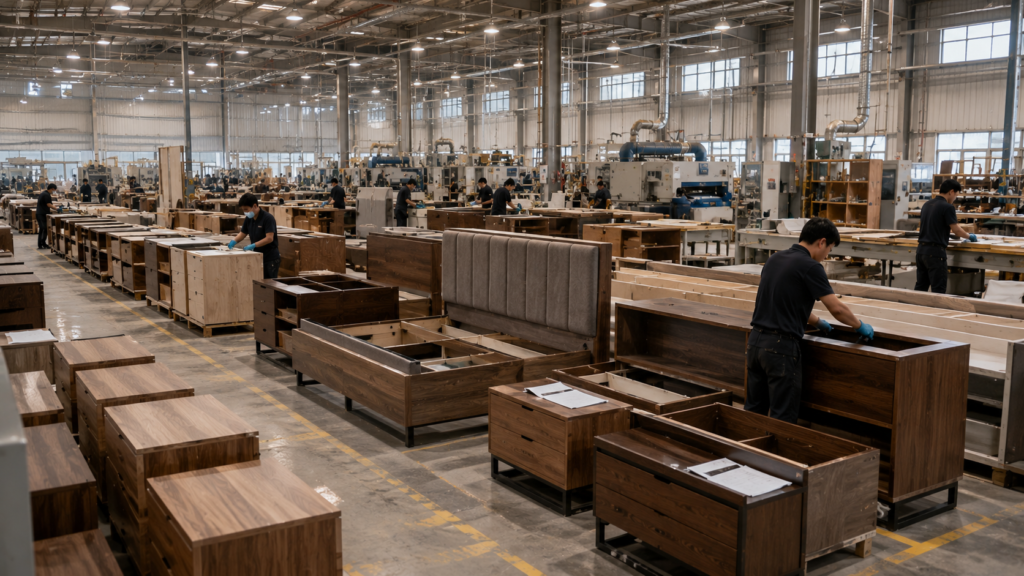
For developers willing to engage directly with overseas manufacturers, the economics can be compelling. Sourcing custom hotel furniture directly from a certified factory in China often delivers significant cost advantages over domestic retail or distributor pricing, with landed-cost gaps that vary considerably by product category, duty rate, and level of customization. The key is identifying a manufacturer capable of delivering hospitality-grade product at scale, with the documentation, certifications, and project experience to back it up.
How Hotel Developers Source Furniture for Large Projects Through Factory-Direct Partners
The typical engagement model starts when the developer or their design team submits FF&E specifications and a project brief to the factory. The manufacturer provides a quote based on custom drawings and material selections, a sample or model room is produced for multi-stakeholder approval, and bulk production begins only after formal sign-off. From first inquiry to production release, this process typically takes 8 to 14 weeks depending on specification complexity, covering quote, shop drawings, and sample approval cycles before bulk manufacturing begins.
YM Furniture operates exactly this model, with 17 years of hospitality manufacturing experience and a portfolio spanning more than 1,000 completed hotel and villa projects across more than 30 countries. Their factory-direct approach means developers work with the production team directly, not a middleman, which gives procurement leads faster response times, more accurate pricing, and direct accountability when it matters. Their model room capability and turnkey project scope, covering design consultation, production, logistics, and installation support, make them a strong option for large-scale hotel builds where speed and quality consistency are priorities.
What to Look for When Vetting a Chinese Furniture Manufacturer
The due-diligence checklist for a Chinese manufacturer should cover: ISO 9001, ISO 14001, and ISO 45001 certifications; factory visit capability or willingness to conduct a virtual audit; previous hospitality project references with photos and client contacts; destination-market compliance certifications for fire resistance and formaldehyde emissions; and clear evidence of in-house production capability versus subcontracted work.
The manufacturer vs. trading company distinction is critical. An actual manufacturer operates CNC machining, veneer pressing, lacquer finishing, and upholstery in-house or in tightly controlled partner workshops. A trading company sources from whoever offers the best price that week, with no consistent quality control over production. When you’re placing an order for 2,000 beds, that difference defines whether your bulk run matches your approved sample.
Sample Approvals, Mock-Up Rooms, and Production Sign-Off
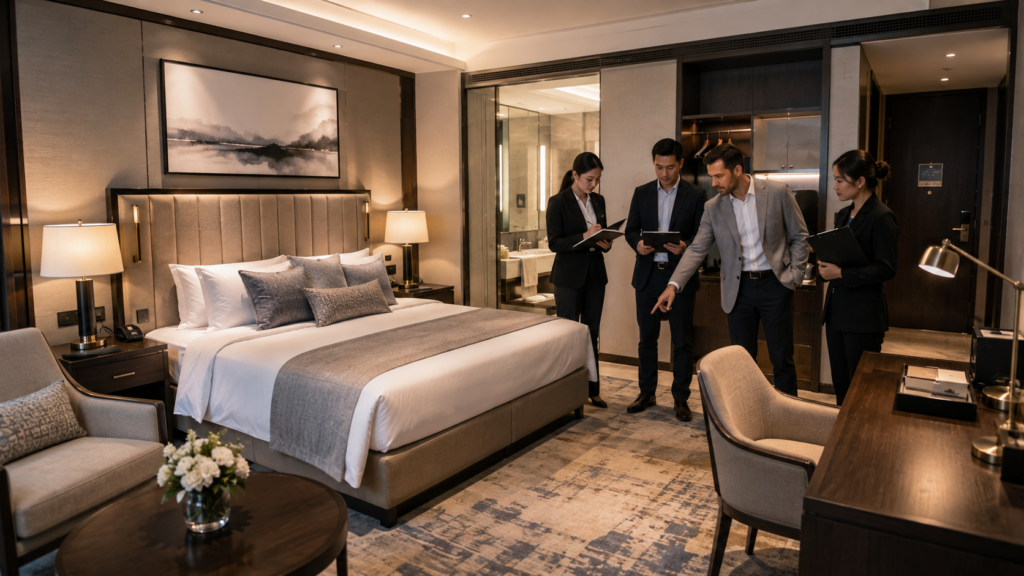
No bulk production order should start without a physically approved sample, this is the single most important quality gate in the entire FF&E procurement process. Skipping it to save time almost always costs more time later, when production defects, non-compliant finishes, or dimensional errors are discovered at installation instead of during review.
The Approval Workflow from Shop Drawings to Sealed Samples
The sequential approval process runs: shop drawing review and sign-off, first sample production, multi-stakeholder review, revisions if needed, and final sample sealing with signatures and photographic documentation. Every stakeholder who has authority over the final product should be part of the review, the owner’s representative, interior designer, brand QA representative, engineering, and housekeeping all bring different perspectives to the same piece of furniture.
The approved and sealed sample becomes the production benchmark. Every piece in the bulk run is judged against it, which means the sealing documentation needs to capture dimensions, finish references, material specifications, hardware details, and construction method with enough specificity to make comparison unambiguous. Vague approval documentation creates the conditions for disputes at punch list time.
Using a Model Room to Protect Brand Standards at Scale
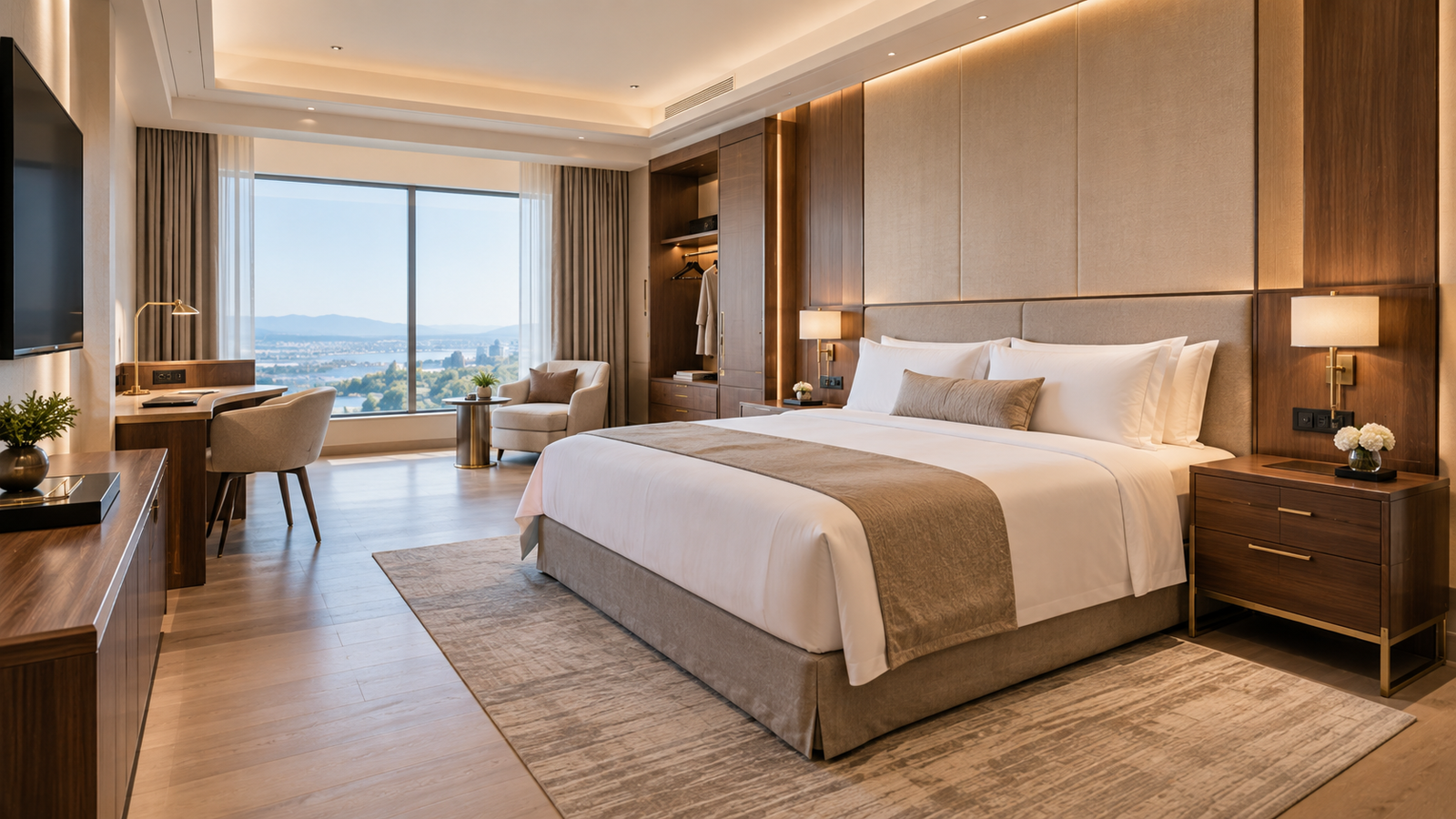
A model room, or mock-up room, is a fully assembled, fully finished representative guestroom with all specified FF&E items in place, lit and dressed to reflect the design intent. It’s where the theoretical specification meets physical reality before you’ve committed to 200 rooms of production. Coordination issues invisible on paper, like a nightstand that blocks the wall outlet or a headboard that visually competes with the window treatment, show up clearly in a model room walk-through.
Model room sign-off typically involves the owner, interior designer, brand QA representative, and sometimes the asset manager. Once approved, the model room becomes the visual and material reference standard for the entire production run. YM Furniture offers dedicated mock-up room capabilities for hotel clients as part of the pre-production process, which allows the full approval team to conduct a structured review in a controlled environment before bulk manufacturing begins.
Lead Times, MOQs, and How Customization Affects Your Timeline
One of the most consistent mistakes in hotel FF&E procurement is underestimating how long the sourcing process takes end to end. Developers who treat furniture as a late-stage procurement item consistently create schedule pressure that forces either rushed approvals or compromised specifications. Build your timeline from the production reality, not from wishful thinking.
Typical Production Lead Times by Furniture Category
Stock casegoods run 4 to 8 weeks from order to ex-factory. Custom wood casegoods run 10 to 18 weeks. Custom upholstered seating runs 12 to 22 weeks. Metal furniture runs 8 to 16 weeks, and decorative lighting typically falls in the 8 to 14-week range. Then add the international logistics layer: ocean freight and customs clearance add 4 to 8 weeks to the production timeline for most destinations.
At a Glance: Lead Times by Furniture Category
| Furniture Category | Typical Lead Time (Ex-Factory) |
|---|---|
| Stock casegoods | 4 to 8 weeks |
| Custom wood casegoods | 10 to 18 weeks |
| Custom upholstered seating | 12 to 22 weeks |
| Metal furniture | 8 to 16 weeks |
| Decorative lighting | 8 to 14 weeks |
| Ocean freight + customs clearance (add-on) | 4 to 8 weeks |
For a fully custom FF&E package, plan on 20 to 30-plus weeks from RFP issuance to on-site delivery. That figure assumes a clean approval process without major revision cycles. Add two to four weeks for each significant sample revision, and you can see quickly how a late procurement start creates a hotel opening problem. Developers who initiate their FF&E program at the start of design documentation, not at the end of construction, give themselves room to manage approvals without compressing the schedule.
How Customization Decisions Affect MOQ and Cost
Stock or ODM-style catalog products typically start at 50 to 100 units per SKU. Fully custom OEM production, with proprietary dimensions, bespoke finishes, and non-standard hardware, often requires 200-plus units per SKU due to tooling, setup, and material commitment. Customization of finishes, branding elements, and non-standard components can add tooling fees in the range of $2,000 to $5,000 per SKU on custom upholstered items.
The trade-off is straightforward: more customization means longer lead time, higher MOQ, and greater upfront investment. What it delivers in return is a product fully aligned with the property’s brand identity and design intent, not a catalog compromise. For luxury and full-service properties where differentiation is a competitive asset, that investment is almost always the right call. For select-service projects with tighter budgets and more standardized specifications, ODM-style selections with targeted customization on high-visibility items often represent the better balance.
Coordinating International Logistics, Freight, and Customs
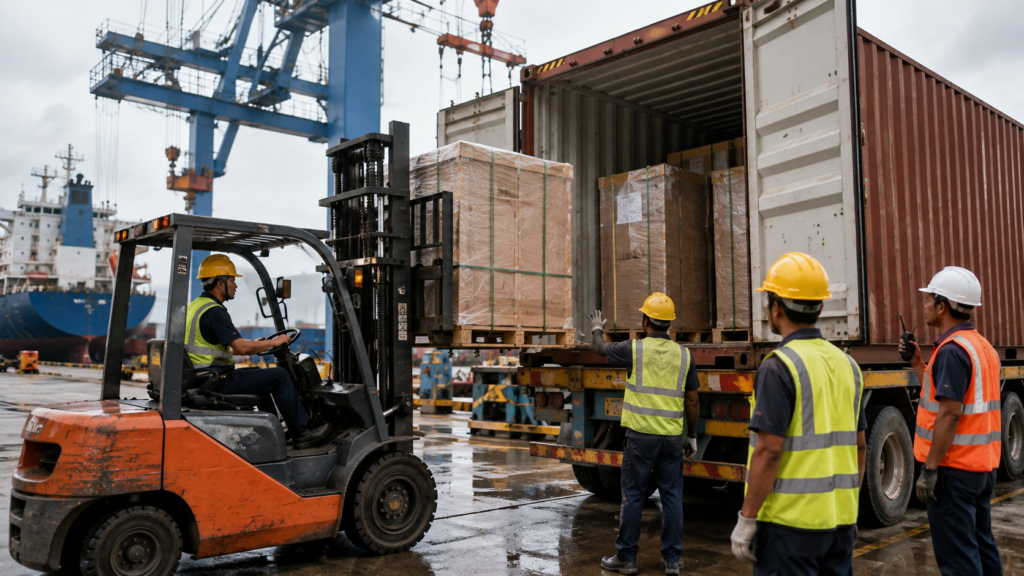
Getting custom hotel furniture manufactured is only half the challenge. Getting it delivered on-site, in sequence, undamaged, and cleared through customs, is where many projects lose time and money. International logistics for hotel FF&E is a discipline in its own right, and treating it as an afterthought creates problems that are expensive and slow to fix.
Packing, Consolidation, and Freight Planning
Items are inspected, packed, and often consolidated at a staging warehouse or port facility before ocean or air freight booking. The choice between LCL (less than container load) and FCL (full container load) shipping depends on project scale and delivery timing. Large hotel projects almost always move FCL for cost efficiency, with the consolidation strategy designed to align shipment timing with the on-site installation sequence.
Documentation requirements for international furniture shipments include commercial invoices, packing lists, certificates of origin, and fumigation or heat-treatment certificates for solid wood packaging under ISPM-15 standards. For shipments entering the United States, additional filings apply: the Lacey Act declaration (PPQ Form 505) covers wood products, and TSCA Title VI certification is required for composite wood components such as MDF and plywood.
On the duty side, engaging an experienced customs broker familiar with furniture tariff classifications in Chapter 94 of the HTS is essential. Import duties on Chinese-origin furniture in 2026 include base MFN rates plus potential Section 301 surcharges depending on the specific 10-digit HTS code. Those combined rates need to be factored into your landed cost model from day one, not discovered at customs clearance.
Customs Clearance, Import Duties, and Delivery Sequencing
Developers should factor total landed cost, covering product plus freight plus duties plus brokerage fees, into their budget from the outset. The difference between factory price and landed price on Chinese-origin furniture can range from 20 to 50 percent depending on destination, product category, and applicable duty rates. That range has a material impact on the apparent cost advantage of overseas sourcing, which is why landed cost modeling should be the basis for any sourcing channel comparison.
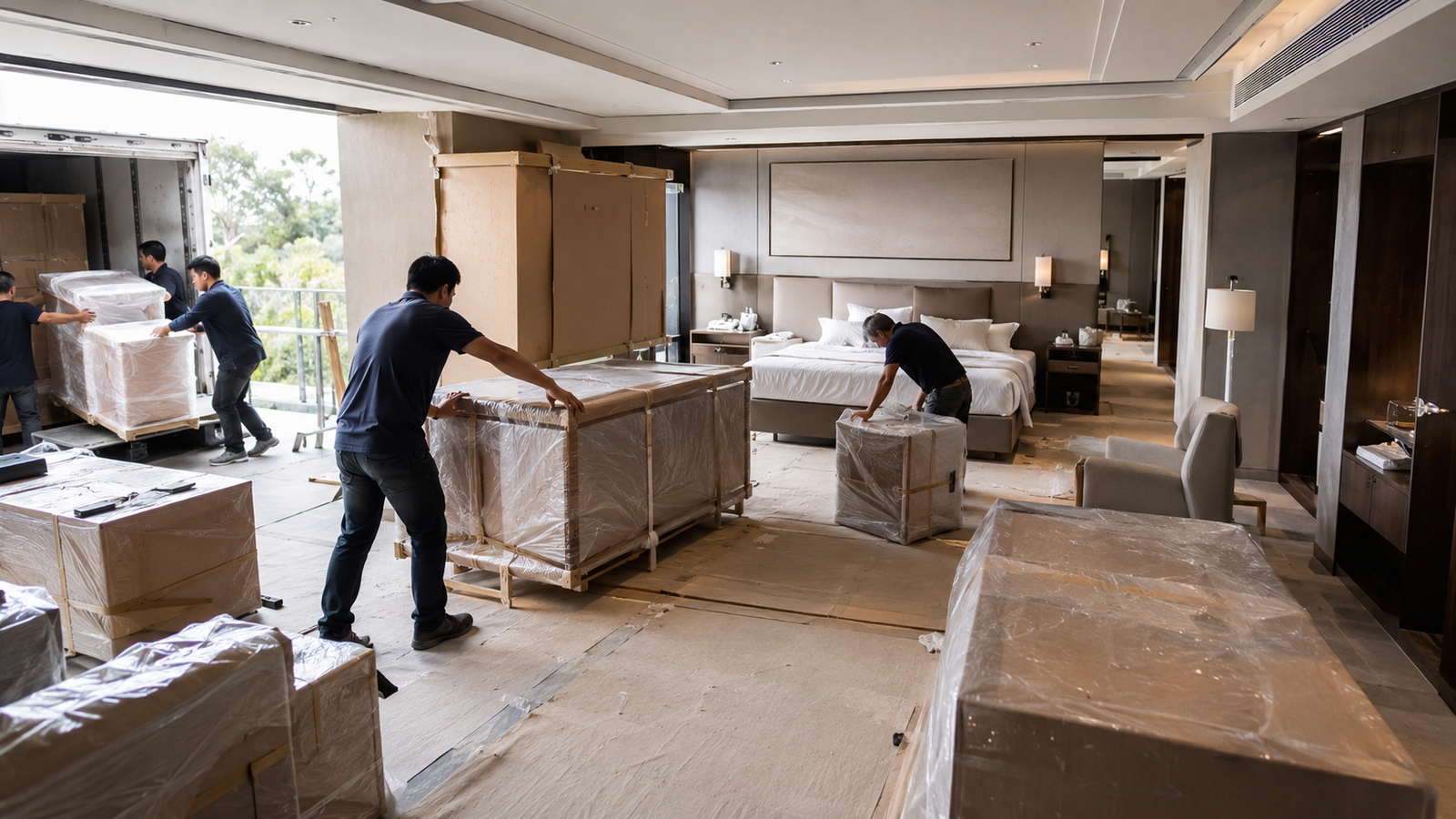
Staged or sequenced delivery is one of the highest-value logistics practices on large hotel projects. Shipments timed to arrive in the order they’re needed on-site prevent casegoods from sitting in containers while finishes are still being applied, or furniture from being placed in rooms before flooring is complete. Coordinate delivery sequencing with the general contractor’s milestone schedule and build the logistics timeline backward from your target installation start date, not forward from when you’d like to place the order.
On-Site Installation and Project Closeout
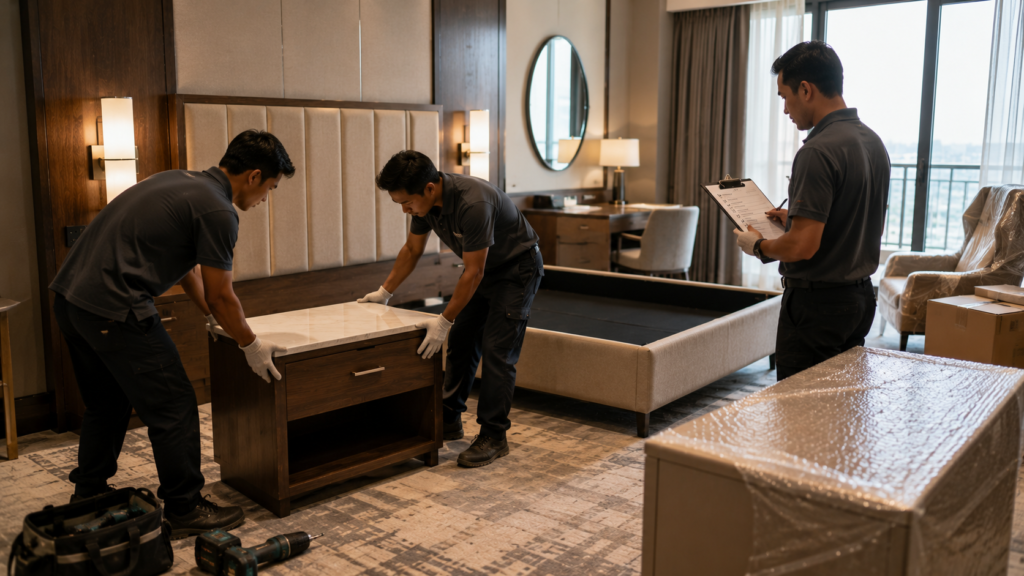
A perfectly sourced and shipped FF&E package can still create serious problems if installation coordination breaks down on-site. The last mile of hotel FF&E procurement is where all the upstream planning either pays off or falls apart, and it requires the same disciplined coordination as every earlier phase.
Coordinating Installation with GC, Designer, and Brand QA
FF&E installation is sequenced after final hard-finish trades and MEP completion but before soft goods and accessories. Installation crews need access coordination, elevator scheduling, and room-by-room sequencing plans that align with the GC’s milestone schedule. A room handed over to the FF&E installation team before it’s truly ready creates damage risk and rework. A room held back while crews are on-site creates idle time that extends the installation schedule and increases cost.
For brand-flagged properties, brand QA inspectors typically conduct walk-throughs at key installation milestones to confirm compliance with brand standards before the property is signed off. Those inspections are easier to prepare for and pass when the procurement process included proper sample approvals and the manufacturer’s documentation matches what was specified. Properties that cut corners on the approval process often discover during the brand QA walk-through that they’re dealing with substitutions or deviations that require replacement at the worst possible time.
Managing the Punch List and Final Acceptance
The punch list is a room-by-room audit of every installed FF&E item against the approved sample and specification. Damage, missing items, incorrect finishes, assembly issues, and hardware defects are logged and resolved before the property opens. The punch list is the moment when the quality of your approved sample documentation is tested: clear dimensional, material, and finish references make comparison straightforward. Vague approval documentation turns every disputed item into a negotiation.
A strong manufacturer relationship makes punch list resolution faster and less contentious. When you’ve worked with a factory that has clear accountability for the approved benchmark, there’s no ambiguity about what was specified versus what was delivered. YM Furniture manages production in-house and maintains documented quality checkpoints throughout manufacturing, a structure that allows them to diagnose and address punch list findings at their source. That responsiveness at closeout is part of what a quality manufacturing partnership delivers, and it matters most in the final weeks before opening when every day counts.
Frequently Asked Questions
How do hotel developers source furniture for large projects on a tight timeline?
By starting the FF&E program at the design documentation stage rather than waiting until construction is underway, and by favoring stock or ODM-style products on high-volume items while reserving custom orders for a smaller set of signature pieces.
What is a realistic FF&E budget per key for a hotel project?
A 4-star property typically runs $12,000 to $25,000 per key, while a full-service 5-star property often falls between $35,000 and $65,000 per key, depending on luxury positioning and scope. These figures should be treated as a starting anchor, not a final number, since landed cost can shift the real total significantly.
Should hotel developers source furniture directly from a factory or through a trading company?
Direct factory sourcing gives more pricing control and eliminates a margin layer, but requires more internal vendor management. Trading companies add convenience and a layer of oversight, but less accountability over actual production quality. Verifying whether a supplier is a genuine manufacturer or a trading company is one of the most important qualification steps in the entire process.
Why is a model room important in hotel FF&E procurement?
A model room surfaces coordination problems, like a nightstand blocking an outlet or a headboard clashing with a window treatment, that are invisible on paper. Once approved, it becomes the reference standard the entire production run is measured against, which protects brand consistency across every guestroom.
How much does customization affect MOQ and lead time?
Stock or ODM-style products typically start at 50 to 100 units per SKU, while fully custom OEM production often requires 200-plus units per SKU due to tooling and setup costs. Custom orders also carry longer lead times and added tooling fees, so the right balance usually mixes ODM selections for standard items with custom orders reserved for signature, high-visibility pieces.
Building a Sourcing Program That Holds Up Under Pressure
Understanding how hotel developers source furniture for large projects comes down to recognizing that the process is a structured sequence of decisions, and each one compounds on the next. The framework is consistent across project types: scope your needs before you write an RFP; build your vendor shortlist on credentials and capability, not just price; get your samples and model room approved before you release bulk production; plan your logistics timeline backward from your installation date; coordinate delivery sequencing with your GC; close the punch list against a documented benchmark.
The difference between a smooth FF&E program and a costly one almost always comes down to two factors: the quality of the manufacturer partnership and the rigor of the approval process. A factory-direct manufacturer with genuine hospitality project experience and ISO-certified production is a fundamentally different partner than a trading company or domestic distributor with limited accountability for production quality. The former gives you direct access to the people making your furniture; the latter gives you a layer of separation at exactly the moment when accountability matters most.
If you’re in early development on a hotel or resort project, the next right step is to define your FF&E scope, build a per-key budget with full landed cost assumptions, and start shortlisting manufacturers with the credentials and scale to handle your program. YM Furniture (Foshan Yauming Furniture & Construction Co., Ltd.) works directly with hotel developers, FF&E procurement teams, and interior designers on projects of all sizes, from single-property boutique builds to multi-property rollouts. Reach out to start a project conversation, request factory credentials, or discuss your timeline and scope. The earlier you engage a qualified manufacturing partner, the more control you have over the outcome.
Quick-Start Checklist: How Developers Source Furniture for Large Hotel Projects
- Define scope first. Complete a room-by-room FF&E schedule before issuing any RFP.
- Build a landed-cost budget per key. Include freight, duties, drayage, warehousing, and installation, not just factory price.
- Shortlist manufacturers on credentials. Verify ISO certifications, in-house production capability, and hospitality project references.
- Issue a detailed RFP. Include specs, finish schedules, compliance requirements, and sample/mock-up terms.
- Approve samples before bulk release. Seal samples with photographic and dimensional documentation.
- Plan logistics backward from installation. Allow 20 to 30-plus weeks for custom packages; coordinate sequencing with your GC.
- Engage a customs broker early. Factor Section 301 surcharges and HTS duties into your cost model from day one.