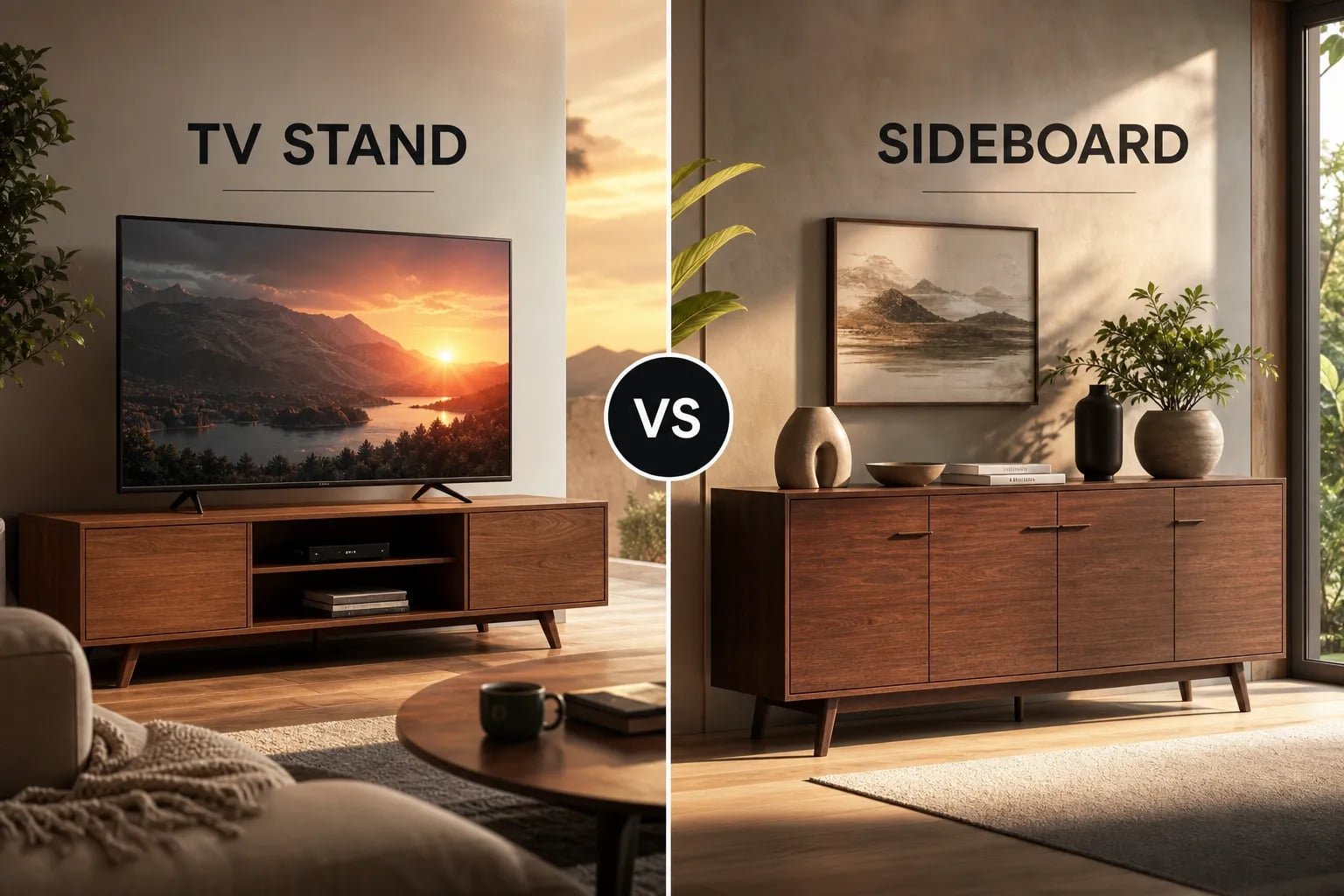
What is the difference between a TV stand and a sideboard? It is a question that comes up constantly among interior designers, property developers, and homeowners, and retail labelling makes it worse before it makes it better. The same piece of furniture gets called a credenza, a media console, an entertainment unit, or a TV cabinet depending on who is selling it and what keyword they are targeting. Walk into any furniture showroom and you will find a sideboard wearing a “TV unit” price tag sitting three feet from a piece with identical proportions sold as a “media console”.
The naming confusion is not just cosmetic. Choose the wrong piece and you end up with a TV positioned too high for comfortable viewing, electronics running hot inside a sealed cupboard, or a cable installation that looks like it was done in the dark. This guide cuts through all of that. The focus here is on what actually matters: construction, proportions, storage design, weight capacity, and styling versatility. By the end, you will know exactly which piece belongs in your project and why, whether that is a single living room or a 200-room hotel rollout.
Clearing up the terminology: TV stand vs sideboard
Most of the confusion around TV stands and sideboards starts with language, not furniture design. Retail brands apply labels so loosely that the same physical piece gets listed as a sideboard, buffet, credenza, or TV unit depending on that week’s SEO priorities. A sideboard marketed as a “media console” is rarely built the same way as a piece designed specifically for AV equipment. Understanding the original intent behind each term gives you a reliable framework for evaluating any piece you come across, regardless of what it is called on the listing.
What a TV stand actually means
A TV stand is a broad catch-all term for any piece designed primarily to support a television. That definition covers everything from a basic open shelf on legs to a full-width enclosed cabinet with integrated cable management. Because the definition is so wide, “media console” and “TV cabinet” are more useful when you need precision. A media console, sometimes called a TV console, typically refers to a long, low cabinet built specifically for a television and AV equipment, with shelves, cable openings, and ventilation built into the design. A TV cabinet leans toward enclosed storage and concealment, hiding cables and devices behind doors while still providing a dedicated TV position.
Sideboard, buffet, credenza: dining-room origins matter
Sideboards, buffets, and credenzas all originated as dining and general storage furniture. Their traditional purpose was storing dinnerware, linens, and serving equipment, and providing a surface for food during meals. The proportions these pieces were built to reflect that history directly. A sideboard sits at a comfortable serving height and offers enclosed storage configured around tableware and flatware. A buffet is similar but often slightly taller and oriented more specifically toward food service, and it is worth noting that the sideboard vs buffet distinction is frequently blurred in retail listings just as much as the TV stand vs sideboard question. A credenza is a long, low case piece with doors and drawers that straddles dining rooms, living rooms, and offices. None of them were engineered around a cable box, a gaming console, or an AV receiver generating significant heat.
When a label tells you nothing useful
Retailers now apply labels so loosely that the same physical piece gets listed as a sideboard, buffet, credenza, or TV unit depending on that week’s SEO priorities. The label is irrelevant. What matters is height, depth, load capacity, ventilation, and cable-management openings. Those five factors are the evaluative framework this article uses throughout, and they are the only ones worth your time when you are making a buying or specification decision.
What is the difference between a TV stand and a sideboard in terms of dimensions?
This is where the functional split between these two furniture categories becomes very clear. TV stands and sideboards land in overlapping but distinct dimensional ranges, and those differences have direct consequences for viewing comfort and usable storage. Getting these numbers right before you buy saves a significant amount of frustration on site.
Standard TV stand and media console dimensions
Purpose-built TV stands and media consoles typically fall between 18 and 30 inches (45, 76 cm) tall, 14 to 24 inches (35, 61 cm) deep, and 48 to 90 inches (122, 229 cm) wide. A common sizing rule is that the console should be 4 to 12 inches wider than the television overall, leaving roughly 2 to 6 inches of visual margin on each side. Depth is where the real work happens: 14 to 18 inches suits a TV and basic electronics, but 20 to 24 inches gives you room for a full AV setup with a receiver and gaming console without crushing cables at the rear.
Typical sideboard proportions and what that means for viewing height
Sideboards typically sit at 30 to 36 inches (76, 91 cm) tall, 16 to 20 inches (41, 51 cm) deep, and 48 to 72-plus inches wide. That height range was designed for comfortable serving and dining use, not for seated television viewing. At 30 to 36 inches, the top surface is significantly higher than a low media console, which means the base of your television starts higher before you account for the TV’s own height. For seated viewing, this pushes the centre of the screen above the comfortable eye-level range for most adults on a standard sofa.
Why depth is the dimension most people overlook
Both pieces can look similarly wide in a showroom, but a 16-inch-deep sideboard leaves very little room for devices, cable bends, power adaptors, and the rear ventilation clearance that electronics need. The practical minimum depth for a storage cabinet for TV and AV equipment is around 18 to 20 inches. Many compact sideboards at 16 inches depth may be too shallow for media use; target 18 to 20 inches if media use is a requirement. Measure depth first, before width, before height. It is the dimension that eliminates the most options most quickly.
Storage design: built for completely different jobs
The internal configuration of each piece tells you everything about its design intent. Pull apart the storage layout of a purpose-built media console versus a traditional sideboard and you see two pieces of furniture solving completely different problems, even when they look similar from the front.
What a TV stand is configured to handle
Purpose-built TV stands and media consoles feature open or ventilated shelving, adjustable shelf heights for different devices, rear cutouts for cables, and sometimes integrated power-strip trays or recessed cable channels. These decisions are deliberate responses to the practical demands of electronics: heat dissipation, cable clutter, and device size variation. A streaming box is a very different height from an AV receiver, and a well-designed TV console reflects that understanding in its internal layout, not just how equipment is stored, but how it is actually used day to day.
How sideboard interiors are typically arranged
Sideboards commonly pair shallow drawers for flatware, napkins, and small items with enclosed cupboards for larger objects. Adjustable shelves may be present but are typically set at heights suited to tableware and serving dishes, not electronics. Glass-front doors and fixed compartments are common finishes. Ventilation is rarely a design priority because the original use case never involved storing heat-generating equipment inside a small enclosed space. That is not a criticism of sideboards; it is simply an accurate description of what they were built to do.
The cable management and ventilation gap
This is the practical detail that matters most for day-to-day use. A purpose-built TV unit typically provides rear pass-throughs, grommets, and recessed channels for cable routing. It also offers open-back panels, perforated or slatted doors, or dedicated ventilated compartments for AV equipment. A standard sideboard offers none of these features as standard. Sealing a cable box, router, or AV receiver inside a small, fully enclosed sideboard cupboard is a real operational risk: equipment overheats, performance degrades, and in extreme cases you create a fire hazard, a concern supported by device manufacturer thermal-clearance guidance and fire-safety best practice. If you are converting a sideboard to media use, ventilation is the first feature to verify or add, not the last.
Can a sideboard safely support your TV?
Many people want to use a sideboard as a TV unit because they already own one, or because the aesthetic fits the room far better than a standard media console. The answer is not a flat no. But it comes with specific conditions, and skipping any one of them creates a real safety risk.
Weight capacity: what the ratings actually tell you
Flat-pack and lightweight consoles typically carry 50 to 100 lb on the top surface. Solid-wood or metal-frame units handle 150 to 250 lb or more. For sideboards specifically, budget particleboard models typically manage around 15 to 30 kg on the top surface, mid-range engineered-wood units around 30 to 50 kg, and premium solid-oak models 75 to 100 kg or more. The critical detail is that the rated capacity often applies to the top surface only, not individual shelves or the total unit. When the TV and all devices combined exceed the rated top capacity, the risk of structural failure is real and not theoretical.
Anti-tip, anchoring, and structural requirements
Safe installation requires two layers of security. First, secure the TV to the furniture using manufacturer-approved anti-tip straps from the VESA mounting points on the rear of the television. Second, anchor the furniture itself to a wall stud using an anti-tip bracket or furniture strap. In the UK, this means fixing into the actual structure: a timber stud, masonry, or a load-rated cavity fixing where studs are unavailable. Standard plasterboard plugs are not adequate for this purpose. Sideboards with drawers carry a specific additional risk: a child or young person climbing on an open drawer dramatically shifts the centre of gravity, and an unanchored unit will tip. If in doubt, wall-mount the TV instead.
When a sideboard works well for TV use
A sideboard can work well as a TV unit when it is at least 18 inches deep, rated to carry the combined weight of the TV and any equipment on the top surface, has rear access for cables, and is anchored securely to the wall. Living-room and media-focused sideboard models increasingly include ventilated compartments and cable routing as standard features. When those features are present and the dimensions are right, the distinction between a sideboard and a TV unit narrows considerably. The piece is, in practice, a media console under a different name.
How each piece reads in a room
Beyond function, a TV stand and a sideboard carry very different aesthetic signals. For interior designers and property developers, this is often what drives the specification decision as much as the storage layout or dimensions. Silhouette height and surface proportions send different signals to the eye, and those signals affect how the whole room is read.
The visual weight and silhouette of a TV stand
A purpose-built media console or TV unit reads immediately as AV furniture. It is typically low at 18 to 24 inches, horizontal, and visually associated with the screen above it. Floating or wall-mounted versions reduce visual weight further and free up floor space. The styling potential exists, but it operates within a narrower range: the piece exists primarily in service of the screen, and it tends to be read that way regardless of the designer’s intent, a natural consequence of its low profile and the dominant presence of the television above it.
A sideboard as a multi-function styling anchor
A sideboard at 30 to 36 inches tall sits closer to credenza or console-table height, which means it reads as general living furniture rather than AV furniture. A lamp, a piece of artwork leaning against the wall, a curated arrangement of objects: these all land on a sideboard surface in a way that looks deliberate rather than incidental. This versatility is why interior designers reach for the sideboard form in living rooms, dining rooms, and hotel bedrooms alike. The same piece works differently in different contexts, and that flexibility has real value in both residential and hospitality projects.
Styling implications for open-plan and dual-function spaces
In open-plan layouts or studio apartments where the same piece must serve multiple visual roles, a sideboard’s aesthetic neutrality works strongly in its favour. It can anchor a dining zone, define a living area, and support a television without looking like it was purchased from an electronics retailer. The trade-off is the functional compromises already covered: height, depth, ventilation, and cable management all need to be verified before the aesthetic decision is finalised. Style and function need to be resolved together, not sequentially.
Placement rules that affect both function and sightlines
Where you position either piece shapes how well it performs, regardless of which type you choose. These are practical spatial rules based on ergonomics and traffic flow, not stylistic preferences.
Optimal TV viewing height and what it means for furniture selection
The ideal seated viewing position places the centre of the screen at or slightly below eye level. For most adults on a standard sofa, that is roughly 40 to 42 inches (102, 107 cm) from the floor to the screen centre, with 42 to 48 inches (107, 122 cm) covering the common range. A media console at 20 inches tall paired with a 48-inch TV places the screen centre at around 44 inches: comfortable. A sideboard at 34 inches paired with the same TV moves the screen centre significantly higher, often above comfortable eye level for seated viewers. Run the maths for your specific TV height before committing to any furniture piece, because the numbers change the answer more than the general principle does.
Clearance, traffic flow, and wall placement
Both pieces work better positioned against a wall rather than floating in a room, but the depth difference has real consequences for floor clearance and traffic flow. A 24-inch-deep media console requires more floor clearance in front of it than a 16-inch sideboard. In hospitality settings where room layouts are tightly controlled and every square metre is accounted for, this is not a trivial calculation. In hotel bedrooms especially, the difference between a 16-inch and a 22-inch-deep unit affects the clearance between the console and the bed end, which affects how freely guests can move around the room.
Managing cables and keeping the installation tidy
Regardless of which piece you choose, cable routing from the furniture to wall outlets affects how clean the installation looks and whether it holds up to a client or guest’s visual inspection. Plan the cable path before the furniture is placed, not after. In hotel bedrooms and serviced apartments, maintenance access is an ongoing requirement, not a one-time consideration. Furniture that conceals cables beautifully but makes them inaccessible creates an operational problem every time a device needs to be replaced or serviced.
Why luxury hotel rooms and villa projects tend to favour sideboards
The design logic of hospitality interiors and high-end residential projects diverges from a typical home decision in one important way: the choice is almost never just about where to put the television.
The dual-function logic behind hospitality furniture specification
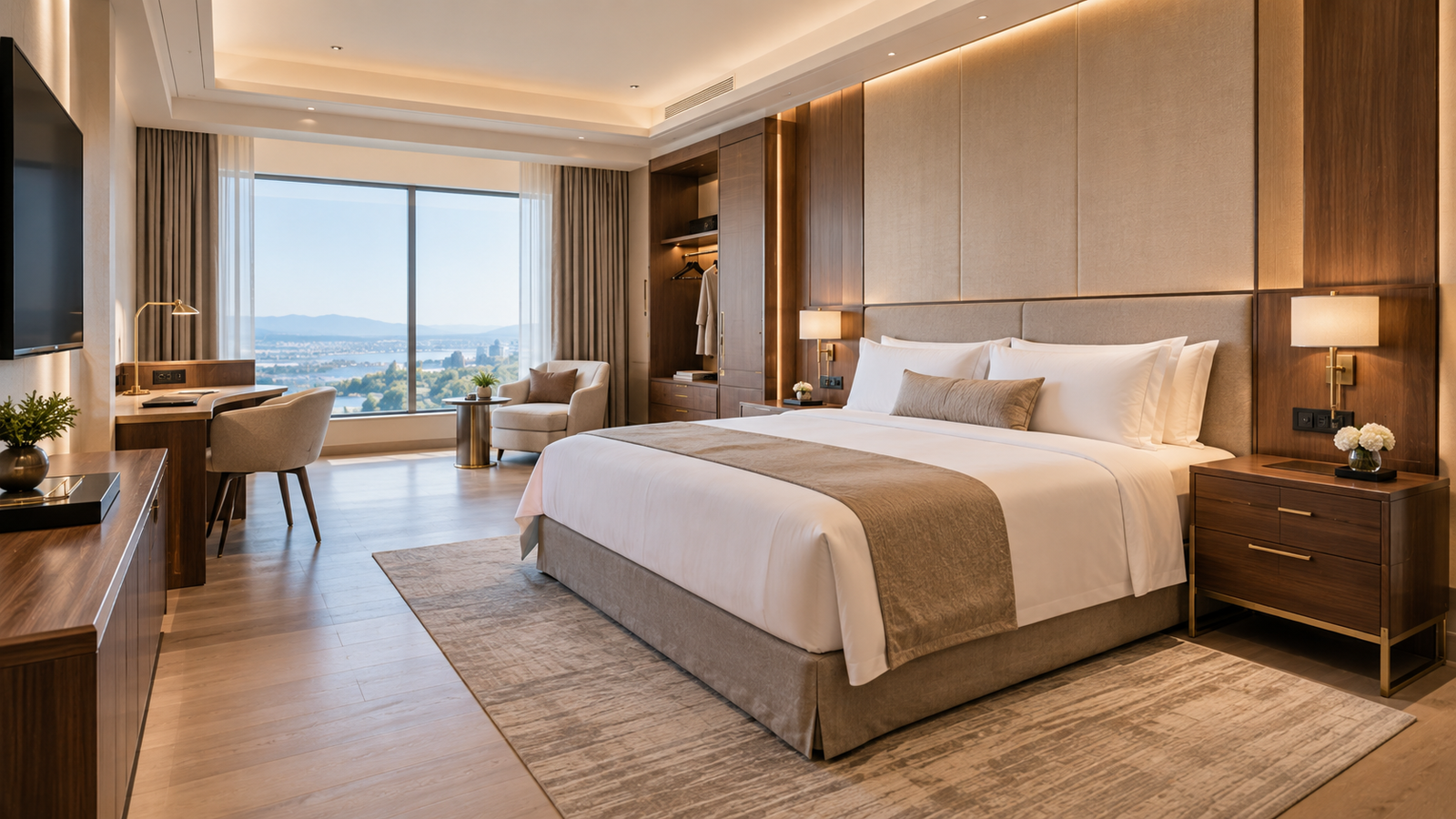
In a luxury hotel room, every piece of furniture has to work harder than its residential equivalent. A sideboard-style TV unit in a 4- or 5-star guest room typically stores the minibar, holds the in-room safe, conceals the kettle and mugs, provides a luggage surface, and supports the television, all within a single footprint. A narrowly defined TV stand cannot do that. Interior designers working on luxury hotel bedrooms routinely specify a sideboard or credenza form for exactly this reason: it maximises function per square metre of floor space while presenting a single coherent visual element rather than a collection of separate units.
What specifiers look for when commissioning these pieces
When interior designers and developers commission furniture for a 100-room hotel or a villa development with 30 units, they need pieces produced to exact specification consistently. Height, depth, finish, internal configuration, weight capacity, cable access: all of these need to be locked to a detailed brief and replicated without variation across every unit. The TV compartment must ventilate correctly in every room. The cable pass-throughs must align with the wall outlet positions on every floor. Off-the-shelf retail furniture almost never meets this requirement, because it was not designed with consistent replication across a large site in mind.
Custom manufacturing as the practical answer for large-scale rollouts
For large-scale FF&E rollouts, this is where factory-direct custom manufacturing becomes a practically important part of the conversation. Manufacturers such as YM Furniture (Foshan Yauming Furniture & Construction Co., Ltd.) produce both purpose-built TV units and sideboard-style bedroom consoles for hotel and villa projects, with factory-direct supply enabling designers and developers to specify exact internal configurations: ventilation openings, cable pass-throughs, drawer layouts, minibar housing dimensions, and finish matching across full-room collections. That level of control over specification and replication is what separates a clean, on-brief delivery from a costly problem resolved at site level after installation. For project-scale procurement, engaging a manufacturer who can produce consistently to a custom brief will always be more reliable than assembling a specification from retail stock.
A practical checklist for making the final decision
At this point, you understand the differences across every relevant dimension. This section distils everything into a decision framework you can use immediately, whether you are furnishing a single living room or specifying across a development.
Questions to ask about your space and use case
Start with the basics before you look at a single product listing:
- What is the television’s weight and base footprint?
- What viewing height does the room layout require, based on seating height and the seated eye level of the typical user?
- What else needs to be stored in or on the piece, and does that list include heat-generating electronics?
- Does the room require the furniture to serve more than one visual or functional role?
- Has cable routing from the furniture to the wall outlets been planned, or does the furniture need to provide it?
Features to verify before committing to a purchase or specification
Work through these non-negotiable checks before you commit:
- The rated top-surface weight capacity should be at least 25 to 50% above the TV’s weight.
- The depth must accommodate your devices and provide adequate cable clearance at the rear.
- If electronics will be stored inside the unit, ventilation or open-back access is required, not optional.
- Cable pass-throughs or grommets must be present or added.
- The unit must be compatible with anti-tip restraints, either through VESA anchor points or a solid rear rail that accepts a strap.
- For project-scale procurement: confirm finish consistency across units, lead times, and the supplier’s ability to produce to a custom brief with replication across multiple units.
The difference comes down to what each piece was built to do
So, what is the difference between a TV stand and a sideboard? It is not just the label on the product page. It is the proportions, the internal configuration, and the original design intent. A TV stand or media console, sometimes called a TV console or storage cabinet for TV, is optimised for AV equipment: low height, sufficient depth, ventilation, and cable management built in. A sideboard is optimised for general storage: serving height, enclosed drawers, and cupboards configured for tableware and household items. Either can work as a TV unit when the dimensions, weight capacity, and safety requirements are all met. But a sideboard’s dual-function versatility makes it the preferred choice in high-end living rooms and hospitality environments where one piece needs to do many things elegantly and consistently.
Measure before you decide. Check the weight rating against your TV’s actual specification. Plan the cable routing before the furniture is in position, not after. The transition from those short imperatives to a broader principle is worth stating plainly: if you are working on a project where both consistency and customisation matter across many units, sourcing from a manufacturer who can produce to a precise brief will always be more reliable than assembling a specification from retail stock. The label on the piece matters far less than the dimensions, the construction, and the features built into it.