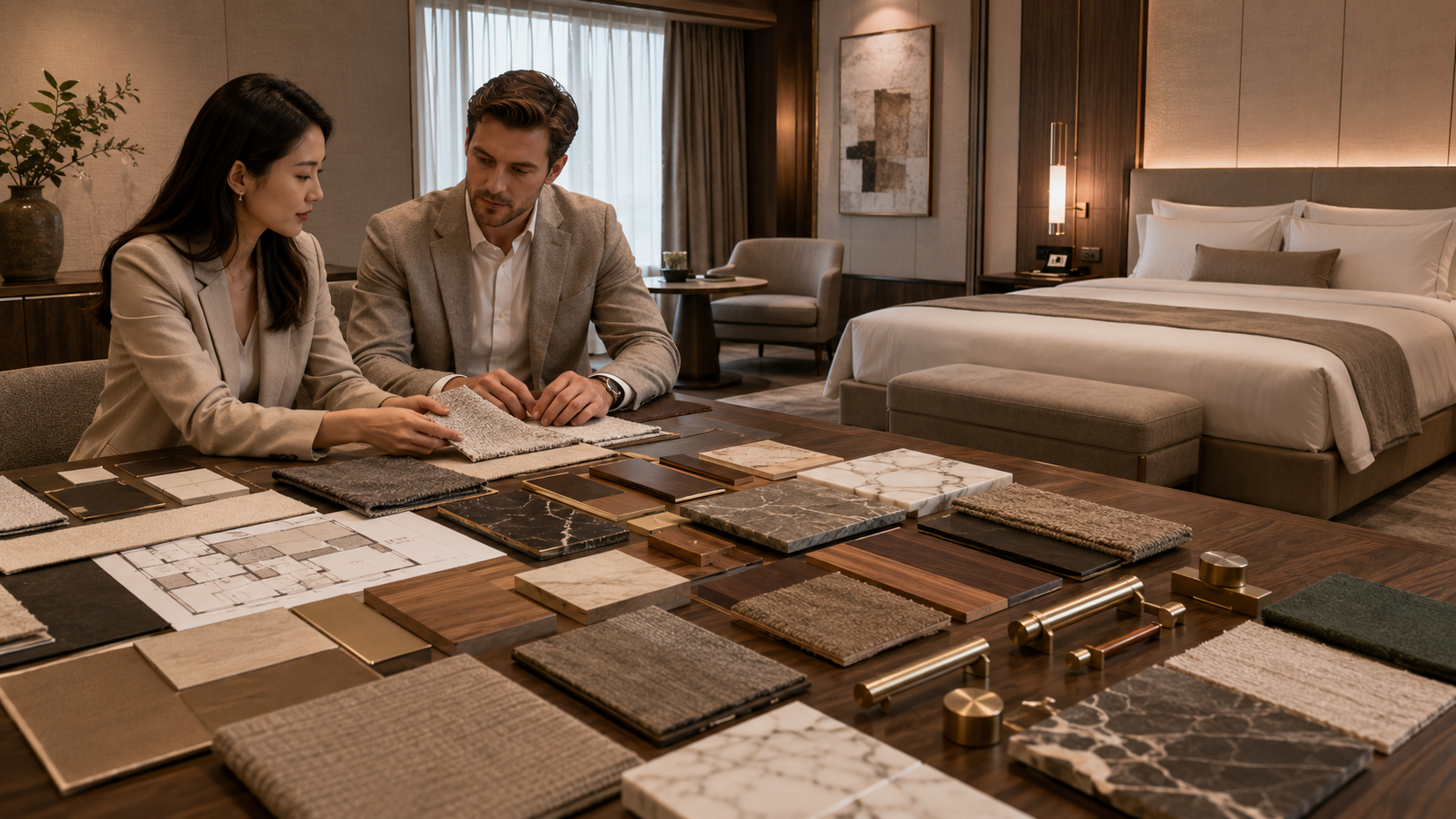
Choosing the right china hotel furniture manufacturer is one of the highest-leverage decisions in any FF&E project. Done well, sourcing direct from a qualified Chinese factory can deliver substantial savings compared to US market pricing. Industry buyers commonly report reductions of 40% to 60% on case goods when factoring in direct manufacturing costs, though final landed cost depends on tariffs, freight, and scope. That’s why hotel developers, procurement firms, and general contractors consistently return to Chinese manufacturers for large-scale hospitality projects. But those savings disappear fast if you pick the wrong factory. Missed production timelines, failed brand standards, and costly re-orders are not hypothetical risks. They happen on real projects every year.
The right manufacturers are identifiable before you commit to a single purchase order. Factories like YM Furniture (Foshan Yauming Furniture & Construction Co., Ltd.), an ISO-certified hospitality furniture manufacturer with an extensive portfolio of completed projects across more than 30 countries, set a clear benchmark for what a qualified supplier looks like. Use that profile as a reference point as you work through the five criteria categories below.
This guide covers what to audit, what to ask, and what the numbers actually look like so you can build a short list of three to five vetted candidates and start outreach prepared.
Factory credentials that actually tell you something about a Chinese hotel furniture manufacturer
Not every operation that markets itself as a hospitality furniture supplier has the infrastructure to execute a 4- or 5-star FF&E project at scale. Factory floor area is a useful proxy. Major examples among hotel furniture manufacturers in China range from roughly 50,000 to 320,000 square meters of production space, which gives you a practical sense of where serious operators sit. The highest concentration of qualified hotel furniture exporters in China clusters in Guangdong Province, specifically Foshan, Dongguan, and Zhongshan. For additional context and industry listings, see resources such as Top 10 hotel furniture manufacturers in China, OPPEIN’s list of top hotel furniture manufacturers, and compendia like top hospitality furniture manufacturers in China.
How to read production scale and operational history
Years in business matter more than most buyers realize. A factory with 10 or more years of documented hospitality project history has survived multiple economic cycles, managed international clients, and refined its QC systems under real production pressure. New entrants to the hotel furniture market may quote low and promise fast turnaround, but they lack the institutional knowledge that comes from outfitting hundreds of hotel rooms across different brand standards. When evaluating a supplier’s operational profile, look at machinery count alongside floor area. A large facility running 100 or more precision CNC machines signals a meaningfully different production tier than a smaller shop with general-purpose equipment. Use this as a directional indicator when comparing candidates rather than a hard rule. Regional sourcing guides, Such As Guangzhou sourcing for hotel furniture and industry overviews, like Chinese Furniture Manufacturers
can help you triangulate facility sizes and specializations.
How to verify factory claims before you visit
Factory brochures are marketing materials, not audit reports.
Before scheduling a visit or placing a deposit, run these verification steps: request time-stamped factory floor photos or a live video walkthrough, pull satellite imagery of the facility address through Google Maps, and cross-check the company’s registration details through China’s National Enterprise Credit Information Publicity System. If a supplier resists providing any of these, treat that as a disqualifying signal, not a minor inconvenience. Use a practical factory audit checklist and a concise hotel furniture quality checklist when preparing your on-site questions, and consult buyer-focused guidance like how to purchase quality hotel furniture from China to set realistic verification expectations.
Certifications required from any Chinese hotel furniture manufacturer
Certifications are the fastest filter for separating serious suppliers from those who self-declare quality standards they’ve never had audited. A factory that holds a full certification stack has submitted to third-party review of its quality systems, environmental controls, and worker safety practices. That is a fundamentally different level of accountability than a supplier who lists “quality-focused” in their company profile.
ISO and environmental certifications that signal operational maturity
The core certification stack for a credible China contract furniture factory includes ISO 9001 for quality management, ISO 14001 for environmental management, and ISO 45001 for occupational health and safety. CQC certification and the China Environmental Label are additional markers worth noting when they appear, they indicate a supplier has pursued further third-party review beyond the ISO baseline. A factory holding all three ISO standards has passed Stage 1 and Stage 2 audits by an accredited certification body, meaning its processes are documented, implemented, and actively reviewed. For an overview of these standards as they apply to wooden furniture operations, see ISO certifications for wooden furniture manufacturers.
US-specific compliance requirements buyers often overlook
For US buyers, ISO certification is necessary but not sufficient. CARB Phase 2 compliance (now aligned with TSCA Title VI) is mandatory for any composite wood component in furniture sold or imported into the United States. The standard limits formaldehyde emissions from particleboard (0.09 ppm), MDF (0.11 ppm), and hardwood plywood (0.05 ppm). California TB 117-2013 applies to upholstered goods and establishes smolder-resistance requirements for fabric; verify exact applicability for your upholstery categories with a regulatory reference before finalizing specs. Request SGS or equivalent third-party test reports for both standards before approving any production run. For technical background, see industry discussions of CARB Phase 2 and a practical explanation of what CARB2 compliance means. Factories with documented North American export history are significantly better positioned to provide this paperwork without delays because they’ve already navigated the compliance process for prior clients.
Production capacity, MOQ, and lead times for a china hotel furniture manufacturer
In FF&E sourcing engagements, misaligned expectations on minimums and timelines are consistently where friction starts. Getting specific numbers before you’re deep in negotiations protects your project schedule and your budget.
How MOQs actually work for hotel FF&E projects
Serious hotel furniture manufacturers structure their minimums around room sets and full project packages, not rigid per-SKU counts. A factory capable of outfitting a full hotel property will typically require a deposit before custom production begins, and room-set quantities of 20 to 50 or more are where the economics work for both sides. If a supplier insists on very high individual SKU minimums for a custom project, that signals they are set up for catalog production rather than bespoke FF&E execution. Always ask “What is your MOQ per item and per project?” as separate questions; the answers will differ, and both matter.
Realistic timelines from design approval to your loading dock
Map the full timeline in your project schedule. Design review and 3D rendering typically take one to two weeks, based on standard custom manufacturing workflows. Sample or model room production runs 20 to 30 days for qualified factories. After buyer sign-off, bulk production spans six to ten weeks, depending on complexity and volume. Add quality inspection time, then ocean freight to a US port at four to eight weeks. Total elapsed time for a full project runs 16 to 24 weeks minimum, with 20 weeks as a reasonable working assumption and 24-plus weeks as contingency for approvals or port delays. Any supplier quoting shorter timelines dramatically
without explaining how deserves a follow-up question, not a purchase order. For practical shipping and arrival expectations, compare your schedule against industry references like how long hotel FF&E shipments typically take to arrive.
How to read a supplier’s project track record
Past project references are the most honest signal of a factory’s real capabilities. A polished brochure and a well-maintained website say nothing about execution. A verifiable history of completed hospitality projects at the 4- and 5-star tier says everything.
What a credible hotel project portfolio actually includes
Expect named hotel properties with confirmed star ratings, project photos broken down by room type, and documentation of the FF&E scope. References from recognized hospitality brands, Marriott, Sheraton, Hilton, Wyndham, carry significantly more weight than unnamed “luxury resort” references. A manufacturer that lists completed projects across 30-plus countries, including North American hotel brands, provides a credibility signal that matters specifically to US buyers: those clients faced the same compliance documentation requirements and import logistics challenges you face, and the factory delivered. If you want to see the kinds of developments driving sourcing demand, read coverage of new 4- and 5-star hotel projects in China.
Questions that reveal real experience versus marketing copy
Four questions cut through the noise quickly when evaluating a hospitality furniture supplier:
- What is the largest single hotel project you have delivered by room count?
- Can you provide a contact reference from a client in North America?
- What was the on-time delivery rate for your last five hotel projects?
- Have you built a model room for client approval on a US-bound project?
Slow or vague answers to these questions during shortlisting predict slow and vague answers during production. Response speed and specificity are data points, not just formalities.
Pricing benchmarks and the factory-direct cost structure
Understanding price ranges before collecting quotes protects you from both inflated proposals and suspiciously cheap ones that signal material or labor shortcuts.
FOB and CIF benchmarks for hotel bedroom/” title=”Luxury Bedroom Furniture”>bedroom FF&E sets
Mid-range hotel bedroom sets (bed, headboard, two nightstands, dresser) run roughly $700 to $1,100 FOB from Chinese factories. Upper mid-range to high-end custom sets, with premium veneers, higher-grade hardware, and custom finish schedules, run $1,100 to $1,900-plus FOB. Add 10 to 25% to estimate CIF pricing to a US port. These figures cover case goods only; upholstery, loose seating, and other room elements are quoted separately. For additional input on furnishing costs relative to room size, see a practical furnishing cost by hotel room size and budgeting guidance, such as hotel furniture costs and budgeting.
How to compare quotes without being misled
Any quote worth evaluating should be fully line-itemed by material specification and grade, surface finish type, hardware brand and grade, packaging standard, and whether tooling or sample fees are credited against the bulk order. Beyond the quoted price, US buyers must factor Section 301 tariffs into their landed-cost model. As of 2026, furniture imported from China under List 3 carries a 25% Section 301 additional tariff on top of standard MFN duty rates. Build that into your cost comparison from the start, not as an afterthought when the shipment clears customs, consult a complete guide to Section 301 China tariffs in 2026,
and an importers’ guide to China tariffs for current import planning.
What a qualified Chinese hotel furniture manufacturer looks like in practice
It’s one thing to work through a checklist of criteria in the abstract. Seeing those criteria applied to a real supplier profile makes the framework concrete.
How YM Furniture checks every credential box
YM Furniture (Foshan Yauming Furniture & Construction Co., Ltd.) maps directly to every criterion covered in this guide. The company reports 17-plus years in business, a 70,000 sqm factory in Foshan running 100-plus precision machines, ISO 9001 / ISO 14001 / ISO 45001 / CQC certifications, and a project portfolio spanning 30-plus countries that includes references from North American hotel brands. As with any supplier, buyers should request primary documentation, certificate numbers, certifying bodies, and verifiable project references to confirm these claims firsthand. Factory size, certification stack, project depth, and export history all represent the right profile for a serious FF&E partner. That kind of operational depth doesn’t appear overnight; it’s built through years of delivering hospitality furniture at scale.
Why end-to-end service reduces project risk for US buyers
One-stop supplier capabilities matter more than most buyers account for during vendor selection. When design consultation, custom manufacturing, model room build-out, quality control, logistics, and on-site installation are managed under one contract, the number of vendor handoffs drops sharply. For US buyers managing a hotel development from abroad, fewer handoffs means fewer communication gaps and less room for scope to slip. That operational structure is worth including in your evaluation criteria alongside certifications and pricing. For additional supplier examples and sourcing firm profiles, industry homepages like MingSun Group can provide contact and service-model context.
Start your outreach prepared
The five-criteria framework, credentials, certifications, capacity and lead times, project track record, and pricing transparency, gives you a structured basis for evaluating any Chinese hotel furniture manufacturer. The goal is not to find the cheapest factory; it’s to find one that can execute your brand standard, meet your timeline, and back every claim with documentation you can verify.
Build your outreach checklist from the questions in this guide and send it to three to five candidates simultaneously. Compare responses for completeness and response speed: a supplier who takes a week to answer basic qualification questions during shortlisting will not move faster when you’re waiting on a production update. YM Furniture is one candidate worth including in that initial outreach, given its certifications, operational scale, and documented project history across North American properties.
You now have the framework, the benchmarks, and the right questions. That puts you in a position to negotiate on evidence rather than assumptions, which is exactly where a hotel developer or FF&E procurement manager should be before committing to an overseas factory relationship with any china hotel furniture manufacturer.