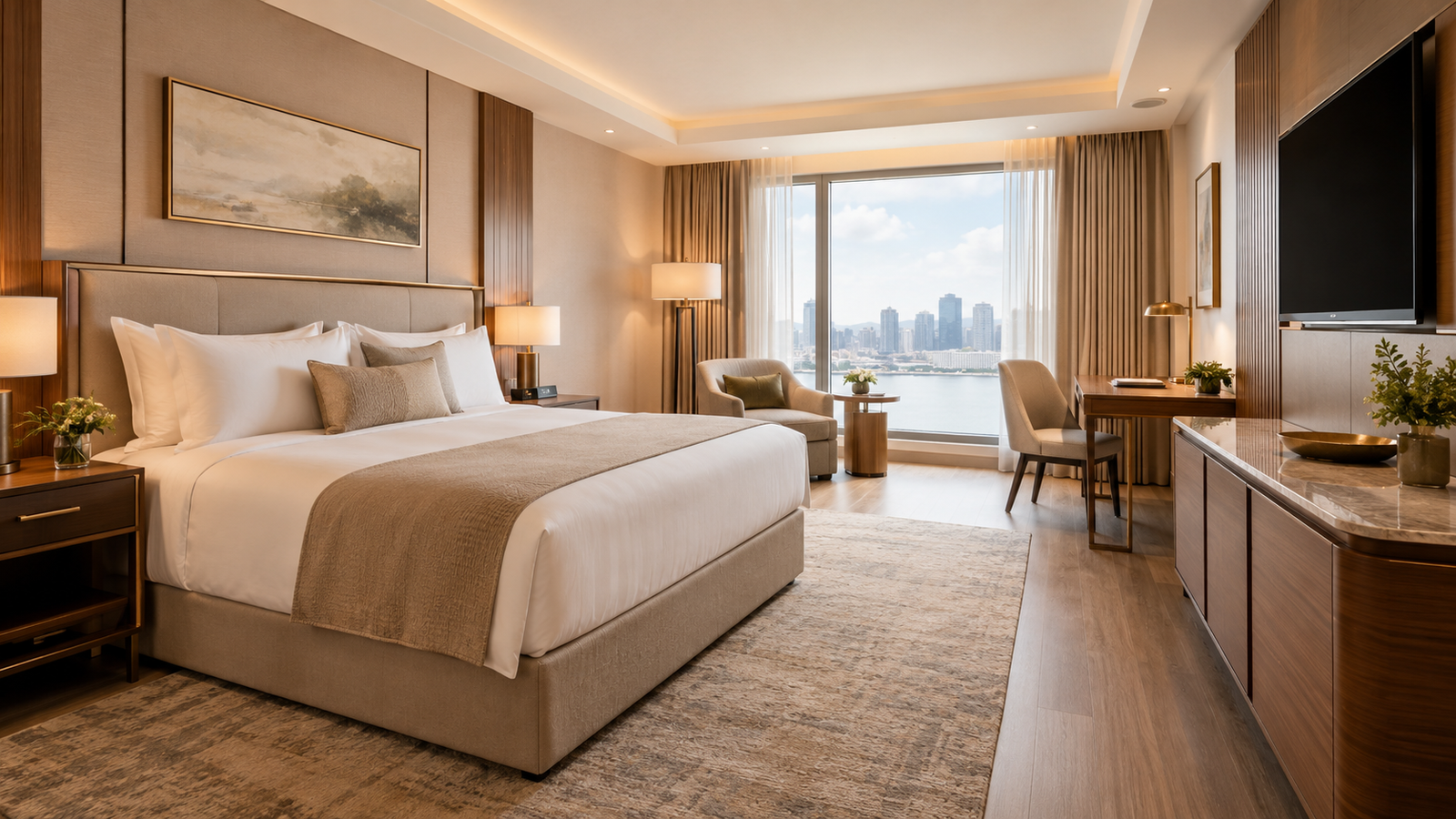
Factory-direct pricing from China is no secret in the hospitality industry. Most UK hotel developers and FF&E procurement managers know it can deliver significant cost savings against domestic suppliers, industry estimates commonly cite figures in the range of 40, 70%, though results vary by product category and project scope. What feels opaque is the process itself: how do you move from a design brief to a finished container of hotel furniture without losing control of quality, missing your construction programme, or walking into a customs bill you didn’t budget for?
The concerns are legitimate. Communication gaps, material substitutions, extended lead times, and post-Brexit import complexity are all real risks, but they are manageable risks when you know the process. This guide maps every stage, from writing your specification to coordinating on-site installation, so you can approach a direct factory order with a clear plan rather than an uneasy guess.
Throughout this guide, we draw on the working practices of YM Furniture (Foshan Yauming Furniture & Construction Co., Ltd.), a fully integrated hotel furniture manufacturer with 17+ years of experience and 1,000+ completed projects for brands including Marriott, Sheraton, and Pullman across 30+ countries. Their model illustrates what a capable Chinese factory actually looks like in practice.
What is the process for sourcing hotel furniture directly from a Chinese factory?
The hotel FF&E sourcing process from a Chinese factory follows eight sequential stages: specification, supplier verification, RFQ, negotiation, quality control, logistics, customs clearance, and on-site delivery. Each stage builds on the last, and skipping any one of them is where costs and delays originate. The sections below walk through each step in the order you will encounter it on a live project.

1. Build your FF&E specification before contacting a single factory
This is the non-negotiable starting point. Without a precise specification, every quote you receive will be built on assumptions, and those assumptions will cost you money during production, delivery, or both. Factories cannot calculate material costs or labour accurately without exact grades, codes, and dimensions in front of them.
What every hotel furniture spec sheet must include
A complete FF&E specification covers five core elements. Start with exact dimensions: height, width, and depth for every component, not just overall product size. Follow that with material and substrate details written out explicitly, for example, “solid oak frame, marine-grade plywood substrate, high-density foam core.” Finish specifications should reference colour codes such as RAL or Pantone rather than descriptive words like “warm grey.” For upholstered items, include fabric composition and rub counts: “100% polyester, 35,000 rubs minimum.” Finally, list required performance standards upfront, including fire ratings, weight capacities, and any sustainability certifications such as FSC. For a practical template and examples you can adapt, refer to a dedicated FF&E specification guide with examples and templates.
Always attach shop drawings or high-resolution renders showing all angles. A factory quoting from a single front-facing image will make assumptions about depth, joinery method, and hardware that may not match your design intent.
How to communicate quantities and room-type breakdowns
Use a matrix layout: list each furniture item down one axis and each room category across the other, with quantities per area filled in for every cell. This might look like “Lounge chair: 2 per Deluxe Room (150 rooms), 4 per Suite (20 rooms), 12 in Lobby.” This approach prevents quoting errors and gives the factory a clear production scope from day one, which is also what protects you when it comes to agreeing a final price.
Why performance standards must appear in the spec upfront
For UK hotel projects, upholstered furniture must comply with BS 7176:2007+A1:2011 at medium hazard classification. This requires Crib 5 testing under BS 5852:2006 Section 11, plus match flame and smouldering cigarette tests. This is separate from the Furniture and Furnishings (Fire Safety) Regulations 1988, which apply only to domestic supply. Factories that see these requirements early can confirm compliance capability and source appropriate materials before you invest time in samples. Raising them at the final inspection stage is too late and too expensive.

2. How to find verified direct manufacturers, not trading companies
China’s export ecosystem is full of trading companies presenting themselves as factories. Buying through a middleman adds a margin layer, removes accountability, and creates quality control blind spots because the middleman is not on the production floor. The first job in any sourcing project is confirming you are talking to the actual manufacturer; for practical guidance on identifying genuine manufacturers see our piece on how to find the right hotel furniture manufacturer from China.
The documents that confirm manufacturer status
Request the Business Licence with Unified Social Credit Code and cross-reference it on the GSXT (National Enterprise Credit Information Publicity System) at gsxt.gov.cn. The scope of operations field is the key data point: a genuine manufacturer will list “production” or “manufacturing” as core activities. Trading companies typically show “sales,” “import/export,” or “wholesale” with no production activities listed. Also request the Production Licence, which only state-registered manufacturers can hold, along with any independent onsite audit reports from third-party agencies. For a checklist and practical steps on verifying suppliers remotely, this how to verify a Chinese supplier guide is a useful companion to your due diligence process.
Practical signals that separate factories from resellers
Red flags include an unusually broad product range covering unrelated categories, suspiciously low MOQs with “factory price” claims on orders of two or three pieces, no verifiable physical facility address, and an inability to provide ISO certifications with the registered company name on the certificate. Green flags are the opposite: a focused product specialisation, a specific industrial facility address, and independently verifiable certifications. YM Furniture, as a reference point, holds ISO 9001, ISO 14001, and ISO 45001 certifications, operates from a 70,000 sqm production facility in Foshan, and can evidence a delivery record across 30+ countries, the kind of verifiable profile that distinguishes a genuine manufacturer from an intermediary.
How to conduct a remote or in-person factory audit
For significant project orders, a factory audit is worth the investment. You can hire a third-party audit firm such as QCI or Amrep Inspect to conduct a physical site visit, or request a structured video walkthrough as an initial shortlisting step. The audit should confirm that the factory operates relevant production machinery for your specific items, has no undisclosed subcontracting arrangements, and follows documented QC processes. An audit report from a recognised third party also gives your procurement team defensible documentation for internal sign-off.

3. Key steps in the hotel furniture sourcing process: structuring your RFQ and evaluating responses
Once you have a shortlist of verified factories, a structured RFQ will return comparable, accurate quotes. A vague enquiry email returns wildly different estimates because each factory fills the gaps differently. Your goal is to remove those gaps entirely.
What to include in your RFQ document
Your RFQ should attach your complete FF&E spec sheets with the matrix quantity breakdown, confirm the delivery destination as a UK port (Felixstowe or Southampton), state your preferred Incoterm, list required certifications including fire testing, and specify your target programme timeline. As a practical tip, including a target budget range per item can accelerate the process with larger factories, as it allows them to align their material proposals with your commercial expectations from the start rather than after a full quoting cycle.
How to read and compare factory quotes
When quotes arrive, scrutinise the line items rather than comparing headline unit prices directly. Check whether tooling or mould costs are included or billed separately. Review the packaging specification: export-grade packaging for a 40ft container voyage is not the same as domestic packaging, and factories cutting costs here risk damage in transit. Compare sample lead times separately from mass production lead times, and examine payment terms carefully. The lowest quoted unit price is rarely the best option. Factories pricing materially below market are almost always making substitutions in material grade, foam density, or finishing quality, and you will only discover this during inspection or after delivery.
4. Negotiating MOQs, pricing, and securing a production slot
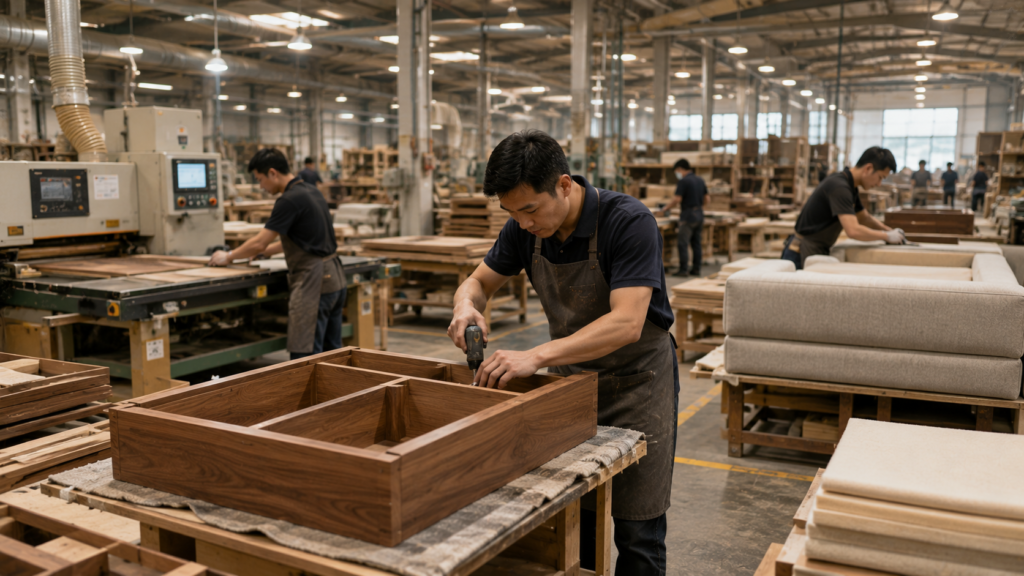
The MOQ conversation with a hotel furniture factory is very different from buying wholesale catalogue products. Factories specialising in contract hospitality orders want large project commitments, and they will negotiate accordingly. Understanding the dynamics puts you in a stronger position at the table.
What MOQs actually look like for project-scale hotel orders
Many established hotel furniture factories operate with no fixed MOQ for contract orders, or set a floor of around 10 pieces per SKU. The reason is straightforward: a 100-room hotel order represents enough production volume to justify setup costs many times over, and a factory would rather waive a minimum than lose the whole contract. When total project volume is significant, MOQ flexibility is the norm, not the exception. What factories do care about is total order value and production scope clarity, both of which your spec sheets and matrix quantities address directly.
Realistic production lead times and what affects them
Plan your programme around the following realistic timeline: sample and mock-up stage runs two to four weeks, mass production runs 45 to 75 days from design approval, and ocean freight from Foshan to a UK port adds approximately 35 to 45 days. Door-to-door, including UK port handling and inland delivery, typically extends the total to 40, 55 days from shipment. For more on typical project timelines, costs, and quality control considerations see our article on hotel furniture from China: costs, lead times & QC. YM Furniture’s 20-day model room customisation capability illustrates what an experienced factory can achieve from design approval to sample sign-off, which compresses the overall programme timeline meaningfully on time-critical hotel openings.
How to lock in your production slot without overpaying
Deposit terms vary by factory and order type, but commonly run at 30, 50% on order confirmation, with the balance paid against shipping documents, always confirm exact terms with the factory and capture them in the signed contract. More important than the deposit percentage is securing a written production schedule with milestone dates tied to your site programme. Factory capacity fills up during peak production periods, typically running from March to May and August to October, so confirming your slot early protects you from delays caused by the factory prioritising other clients. A written schedule also gives you grounds for escalation if milestones slip.
5. Quality control checkpoints you must build into the production schedule
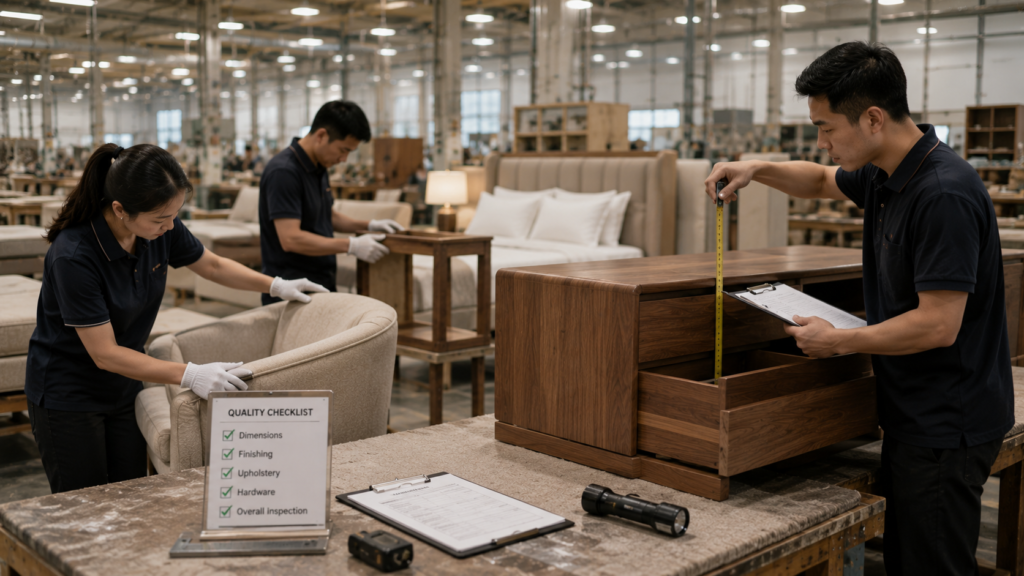
Quality cannot be inspected at the end of production. It must be controlled during it. The majority of costly sourcing problems, including rework, non-conforming deliveries, and delayed shipments, most trace back to absent in-process checks, not to any inherent limitation of Chinese manufacturing.
Incoming quality control: verifying materials before production starts
IQC (Incoming Quality Control) involves inspecting raw materials against your specification before any cutting or assembly begins. This means checking timber grades, foam density, fabric batch, and hardware against the agreed spec, with pass/fail criteria tied to objective measurements rather than visual judgement. Require the factory to provide IQC reports at this stage. Catching a substandard material batch before production starts costs almost nothing. Catching it after 500 chairs have been assembled costs considerably more.
In-process inspections and first-piece sign-off
IPQC (In-Process Quality Control) covers two types of check. First-piece inspection involves examining three to five initial units to catch dimensional errors, finish deviations, or joinery issues before a full batch runs. Patrol inspections are periodic checks at key production stages: frame assembly, foam fitting, upholstery, and lacquering. For buyers who cannot visit the factory in person, remote inspection via live video or third-party inspector visits from services such as QCI or Amrep Inspect provides an independent checkpoint without requiring you to be on site.
Pre-shipment final inspection and model room sign-off
FQC (Final Quality Control) is the full-batch random sampling inspection conducted before the container is loaded. This covers dimensional checks, finish consistency, packaging verification, and documentation against your spec sheet. For larger hotel projects, model room sign-off is the most effective pre-shipment risk reduction tool available. YM Furniture’s 5,000 sqm showroom with fully furnished mock-up rooms allows buyers to physically review and approve finished pieces before mass production begins, which substantially reduces the risk of delivering furniture that fails to match the design intent at handover.
6. Choosing the right Incoterms and organising freight to the UK
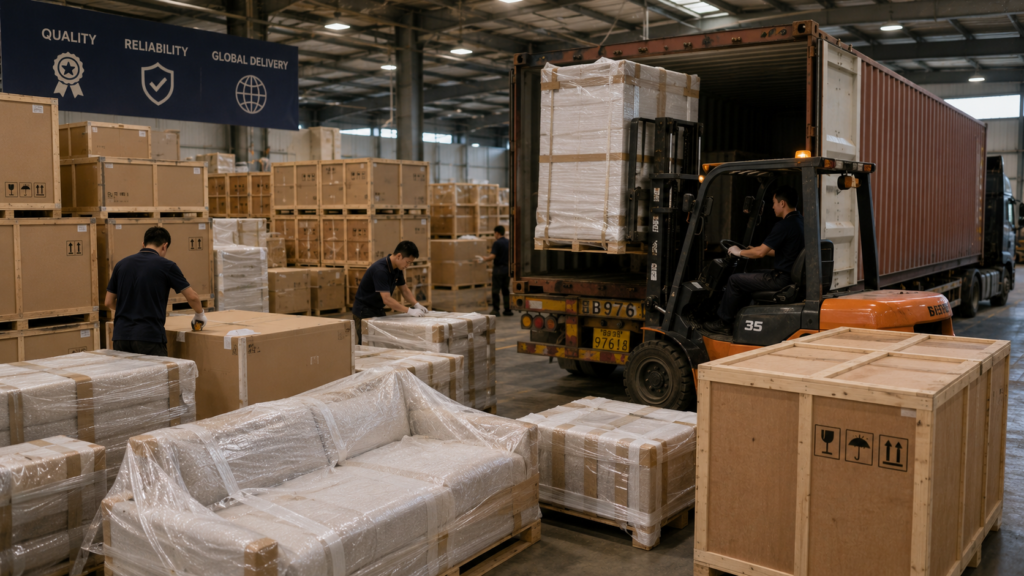
Most buyers default to whatever the factory suggests for shipping. A clear understanding of Incoterms lets you make an informed choice that fits your budget, your risk tolerance, and your logistics setup, rather than defaulting to whatever margin the factory builds into a bundled price.
FOB, CIF, and DDP: which works best for hotel furniture shipments
FOB (Free On Board) is the recommended choice for main project shipments. Under FOB, the factory covers inland transport to the port and export customs, and you take responsibility from the moment the cargo is loaded onto the vessel. This gives you full visibility over freight costs and the freedom to select your own freight forwarder, which typically delivers better rates and more reliable service than the factory’s preferred carrier. CIF (Cost, Insurance, and Freight) suits smaller supplementary orders where you want the factory to manage freight logistics and a single invoice is simpler to process. DDP (Delivered Duty Paid) offers maximum convenience by covering all costs through to your warehouse, but at a premium that rarely makes sense for main project shipments. DDP is occasionally used for urgent replacement pieces where speed justifies the additional cost.
FCL vs LCL: container options and realistic cost estimates
For hotel furniture orders, FCL (Full Container Load) is the standard choice. A 40ft container holds approximately 25, 30 cubic metres of furniture and gives you full control over the container without consolidation delays. As of 2026, ocean freight estimates for a 40ft FCL from China to a UK port run approximately $3,500, $5,500, excluding UK port charges, customs clearance, and inland delivery; confirm current rates with a freight forwarder as market conditions fluctuate. For background on sea freight options and transit considerations see this sea freight guide from China. LCL (Less than Container Load) is available for smaller consignments at approximately $150, $250 per cubic metre, but introduces consolidation delays that can add several days to your transit timeline and increase the risk of handling damage. For anything approaching a full project delivery, FCL is the right choice operationally and commercially.

7. UK customs clearance, import duties, and compliance requirements
This is where first-time importers encounter unexpected costs and delays. Post-Brexit, UK customs operates independently from EU routes, so any guidance written for EU imports will not apply to your shipment. Understanding the requirements in advance prevents the kind of clearance hold that can leave a container sitting at Felixstowe during a live construction programme.
UK import duty, VAT, and the documents your customs broker needs
The principal commodity code for wooden hotel bedroom furniture from China is 9403 50 00, attracting a UK Global Tariff rate of 2.0%. Metal-framed furniture under 9403 20 00 attracts 0%. On top of the duty, import VAT at 20% applies to the combined CIF value plus duty. If you are VAT-registered, you reclaim this through your periodic return using the HMRC C79 certificate, so the net cost is the duty only. Your customs broker will need a commercial invoice, packing list, bill of lading, certificate of origin, fumigation certificate (mandatory for wooden furniture and wooden packaging), any relevant product certification documents, and your EORI number. No import licence is required for furniture. Ensure all documents are consistent with one another, as any discrepancy will trigger a hold and, potentially, an inspection. For a detailed walkthrough of tariff classification, duties, VAT and customs procedures when importing furniture into the UK, consult this formal UK importing guide.
UK fire safety and hospitality compliance standards
The Furniture and Furnishings (Fire Safety) Regulations 1988 apply specifically to domestic supply and do not cover hotel furniture directly. As noted in the specification stage, the applicable standard for upholstered hotel furniture in the UK is BS 7176:2007+A1:2011 at medium hazard classification, with Crib 5 testing under BS 5852:2006 Section 11 as the relevant ignition source test. For mattresses and bed bases in hotel bedrooms, the equivalent standard is BS 7177:2007+A1:2011. These requirements must be agreed with the factory and confirmed in writing before production begins. Do not assume compliance and do not raise the question during customs clearance. Test reports from accredited laboratories must accompany your shipment documentation.
8. Coordinating on-site delivery, installation, and project handover
The final stage is where logistics meet the live construction site, and where poorly managed sourcing projects tend to unravel. Phased delivery scheduling, installation coordination, and snagging all need planning before the container leaves China, not after it arrives at the docks.
Phased delivery scheduling and warehouse logistics
Furniture for a 150-room hotel does not arrive in one container and it does not get installed in one day. Phased delivery by floor or room block is the standard approach, and it requires matching furniture arrival to the construction programme precisely. Pieces arriving before their floor is ready will sit in temporary storage, which means handling risk, potential damage, and storage costs. Discuss phased delivery timing with your factory during contract negotiations, and build a delivery schedule that maps each container to a specific installation phase on your programme. Your project manager and site logistics coordinator need to be aligned on this before the first container is dispatched.
What end-to-end project management from a factory actually looks like
The burden of coordinating design, production, freight, customs, and installation typically falls on the procurement team or project manager unless the factory offers genuine end-to-end project management. YM Furniture’s service model covers design consultation, production management, logistics coordination, and on-site installation as an integrated offering. For buyers managing their first direct China sourcing project, this kind of support removes the coordination complexity that creates delays and cost overruns, reducing the project management overhead that would otherwise sit entirely with your team. Their track record of 1,000+ completed projects for global hospitality brands demonstrates that the process is repeatable at scale, not just achievable in isolation.
Snagging, replacements, and aftercare expectations
Agree your warranty and replacement terms in the contract before you sign anything. The industry-standard warranty for hotel casegoods is typically five years. Your contract should specify the process for reporting non-conforming or damaged pieces post-delivery, the response time for replacement production, and the shipping arrangement for replacement items. Factories with dedicated project management teams handle snagging systematically through documented resolution processes. Factories without that structure will leave you chasing resolutions individually, which consumes project management time and creates programme risk during the critical pre-opening phase.
From spec sheet to installation: the process in sequence
Sourcing hotel furniture directly from a Chinese factory is a learnable, repeatable process. Every stage follows logically from the last. Here is the sequence in full:
- Build your FF&E specification before contacting any factory
- Verify manufacturer status using GSXT records and third-party audits
- Issue a structured RFQ to your shortlist with full spec and quantity matrix
- Evaluate quotes on quality criteria, not headline unit price alone
- Negotiate MOQs and lock in a production slot with a written milestone schedule
- Build IQC, IPQC, and FQC checkpoints into the production timeline from the start
- Select FOB Incoterms and organise FCL freight with an independent forwarder
- Manage UK customs clearance with the correct documentation package in place
- Coordinate phased delivery against your construction programme before shipment
What makes the difference between a smooth project and a costly one is preparation at each stage rather than improvisation when problems arise. Factories that offer genuine end-to-end support, covering design through to installation, remove a substantial portion of that coordination burden from the buyer’s side, and the difference shows in project timelines and handover outcomes.
Frequently asked questions
What is the process for sourcing hotel furniture directly from a Chinese factory?
The process covers eight stages: writing a complete FF&E specification, verifying that your supplier is a genuine manufacturer, issuing a structured request for quotation, evaluating quotes and negotiating terms, managing quality control at IQC, IPQC, and FQC stages, selecting appropriate Incoterms and organising FCL freight, handling UK customs clearance, and coordinating phased on-site delivery and installation. Each stage is covered in detail in the sections above.
How long does the hotel furniture sourcing process from a Chinese factory take?
A realistic total timeline runs from 90 to 140 days from design approval to UK port arrival: two to four weeks for sampling, 45 to 75 days for mass production, and 35 to 45 days for ocean freight. Add UK port handling and inland delivery and the door-to-door total typically reaches 40, 55 days from the shipment date.
Do I need to visit the factory in China?
Not necessarily. Remote factory audits via structured video walkthroughs, third-party inspection services, and model room sign-off processes mean you can manage the sourcing process without travelling to China. For larger projects, a site visit during the production phase or for model room sign-off is strongly recommended if your programme allows it.
If you are planning a hotel build, villa development, or apartment complex and want to understand what a direct factory order would look like for your specific project, YM Furniture offers design consultations and project-specific quotes. With 17+ years of experience across 1,000+ completed projects globally, they are well-positioned to take your specification from brief to finished room. Get in touch through their website to start the conversation: How To Source Hotel Furniture From China: Complete 2026 Guide.