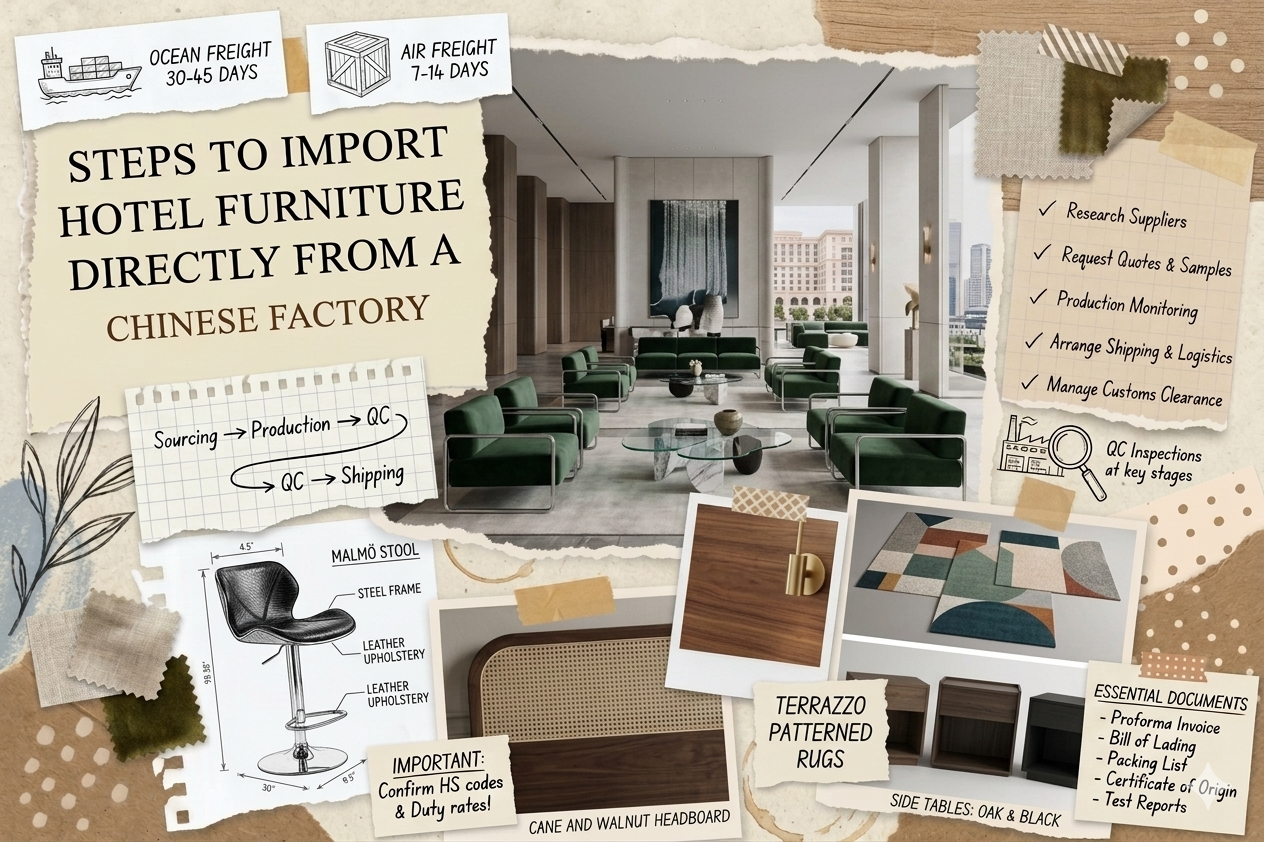
Importing hotel furniture directly from Chinese factories is one of the most effective ways a developer or procurement manager can reduce FF&E costs without compromising on specification quality. The savings are real, the customization options are extensive, and the process is well-established. But importing furniture directly is not the same as buying from a local showroom. It requires a different kind of preparation, a different set of decisions, and a clear understanding of where mistakes are made and what they cost.
This guide covers the five steps that determine whether a direct-import hotel furniture project succeeds: building the right specification, identifying and qualifying a genuine manufacturer, managing samples and approvals, handling quality control and shipment, and understanding compliance and documentation requirements. It also covers sourcing strategy, because the choice between a trading company and a direct manufacturer like YM Furniture (Foshan Yauming Furniture & Construction Co., Ltd.) is the single decision that affects everything else downstream.
Why Direct Factory Sourcing Changes the Economics of Hotel FF&E
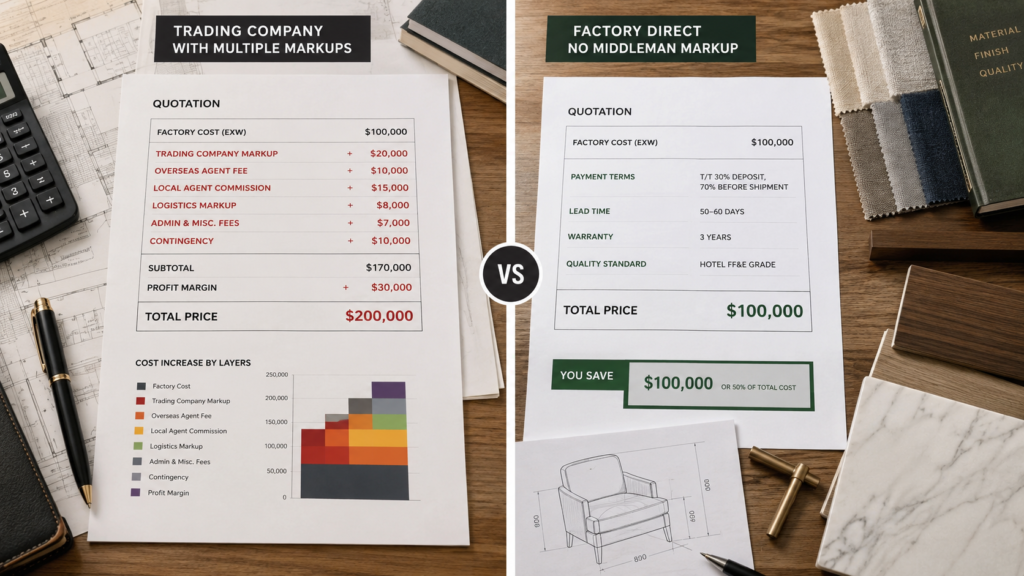
The furniture supply chain between China and a hotel in Europe, the Middle East, or North America typically includes a trading company or agent, a regional importer, and a local distributor, each adding margin before the product reaches a procurement desk. Buying directly from the factory removes all three layers. On a 200-room hotel project, that margin stack is not a rounding error. It is a meaningful portion of the FF&E budget that can be redirected into better materials, tighter specifications, or a larger scope.
Foshan, Guangdong Province, is the sourcing destination that matters most for hotel-grade furniture. It accounts for a significant share of global furniture exports and is home to manufacturers who supply five-star hotel groups, branded residence developments, and luxury villa projects across every major market. The infrastructure, the material supply chain, and the manufacturing expertise are concentrated in one region in a way that does not exist anywhere else at this price point.
Direct sourcing also unlocks full specification control. Dimensions, materials, finishes, upholstery, joinery details, and hardware can all be specified to your exact project requirements. That level of customization is either unavailable or prohibitively expensive through Western retail and import channels.
Step 1: Build a Complete FF&E Specification Before You Contact Any Supplier
The single most common reason direct-import hotel furniture projects run over budget or over schedule is an incomplete specification at the start. A manufacturer can only quote accurately against what you give them. Vague briefs produce vague quotes, and vague quotes produce expensive surprises when production begins.
What a Proper Hotel Furniture Specification Covers
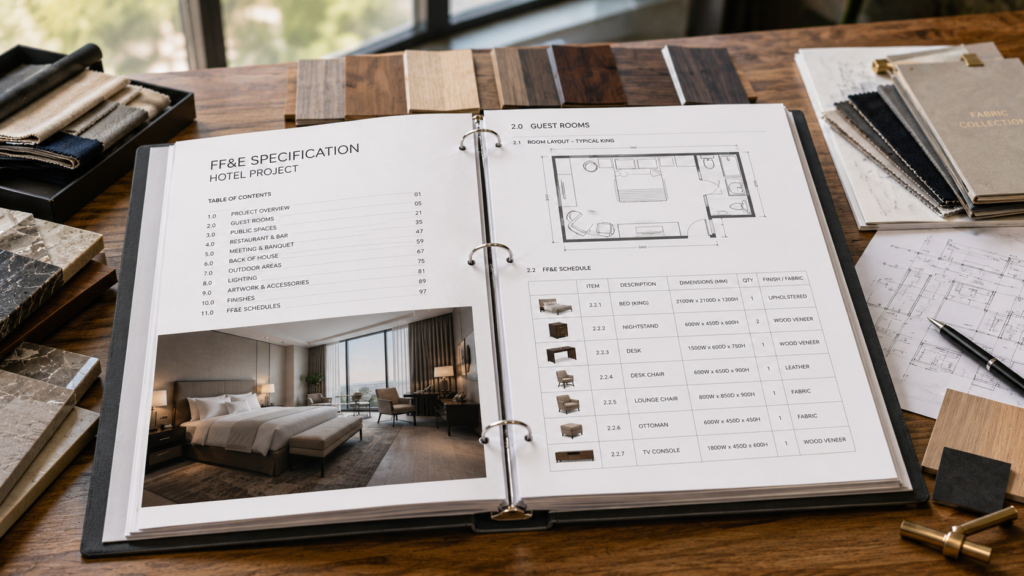
A complete FF&E specification document should cover every room type in the project, the furniture categories required per room, exact or target dimensions for each piece, preferred materials and finish references, upholstery fabric specifications including performance ratings, hardware finishes, and any brand standard compliance requirements. For hotel projects with multiple room categories, specify each category separately. A standard room brief and a suite brief are not interchangeable documents, and treating them as the same will generate incorrect quotes and production errors.
Material specifications deserve particular attention. Specify frame construction clearly: solid hardwood, engineered wood, or metal, and identify which components require which construction type. For upholstered pieces, specify foam density in the range of 30 to 40 kg/m³ for seating that holds its shape under hospitality-level use. Fabric rub counts matter for hotel environments; a minimum of 30,000 Martindale cycles is a reasonable hospitality-grade threshold for most seating applications, with high-traffic pieces requiring 50,000 cycles or more.
A finish schedule compiled before any supplier contact is one of the highest-value steps in the entire process. It costs nothing and prevents the most expensive corrections later, because finish changes after production begins are not adjustments. They are restarts.

Step 2: Identify a Direct Manufacturer, Not a Trading Company
The distinction between a direct manufacturer and a trading company is the most important qualification decision in Chinese furniture sourcing. Trading companies source finished goods from multiple factories, add a margin, and resell. They have no production capability, no quality control authority, and no ability to customize beyond what their supplier factories already offer. A genuine manufacturer owns its factory, employs its production workforce, and controls every stage of the process from raw materials to finished goods.
How to Verify You Are Speaking With a Manufacturer
Request a business registration certificate that shows a manufacturing classification, not a trading classification. Ask for the factory address and verify it matches the company registration. Request a live video call that walks through the production floor, not a showroom. A genuine manufacturer will agree immediately; a trading company will offer product photos or a showroom visit instead. Ask which specific factory produced any reference projects they show you. If the answer is indirect or evasive, treat it as a clear signal.
ISO certification is a meaningful indicator of production consistency, not just a marketing credential. An ISO-certified facility runs documented quality processes across every production batch. Ask for the certification number and verify it. For hotel and hospitality projects specifically, ask whether the manufacturer has existing hotel project references, and request photos of furnished rooms, not product shots on a white background.
YM Furniture operates as a direct manufacturer in Foshan with an integrated factory, ISO-certified production, and a project portfolio that includes hotel and villa developments internationally. The factory floor is available for live video inspection at any stage of the qualification process.
Step 3: Manage Samples and Design Approvals Before Production Is Committed
No direct-import hotel furniture project should commit to full production without a physical sample approval stage. This is not a precaution for cautious buyers. It is standard practice in every professional hotel FF&E procurement process, and skipping it is the decision that generates the most expensive corrections at the worst possible moment in a project timeline.
What the Sample Stage Should Cover
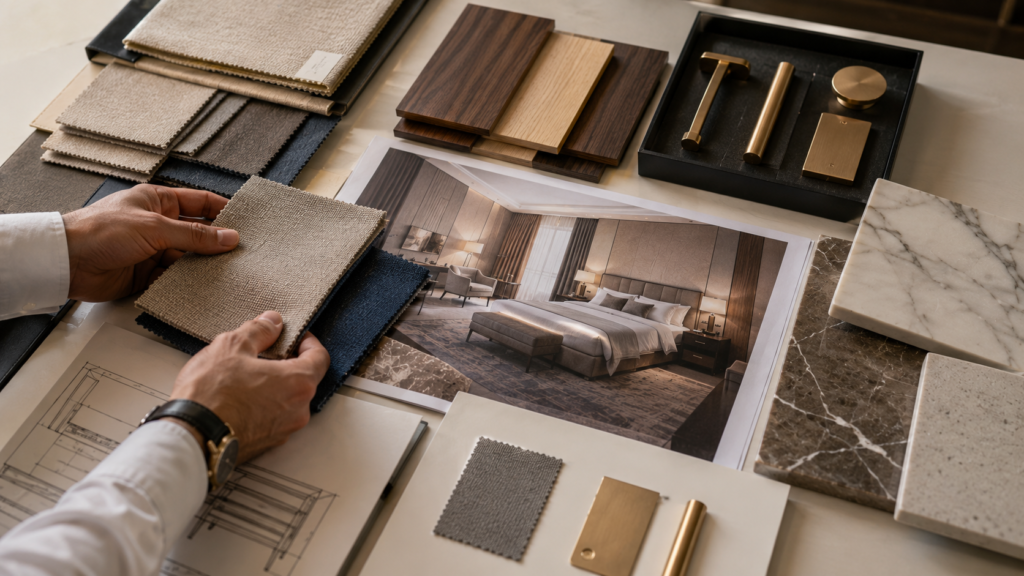
Request physical samples of key pieces: the primary bed, the main seating item, and one casegoods piece at minimum. For material-heavy specifications, request material swatches and finish samples separately before the furniture sample is produced. Evaluate frame construction by checking joint quality and stability, not just surface finish. Check upholstery tension and seam quality. Verify that foam density and cushion performance match the specification. Review hardware alignment and finish consistency. A sample that passes a visual check but fails a construction check is not an approval.
Sample costs from a reputable manufacturer are typically credited against the full production order. The timeline for sample production from a Foshan manufacturer is generally two to four weeks for standard pieces and four to six weeks for complex upholstered or joinery-intensive items. Build this into the project schedule from the first design meeting, not after the contract is signed.
Model room capability, where a manufacturer can furnish and photograph a complete room setup for approval before full production, is available from manufacturers like YM Furniture and gives project teams a far more reliable approval reference than individual piece samples alone. For hotel projects with multiple room types, a model room sign-off is the most efficient single step in the approval process.
Step 4: Quality Control and Pre-Shipment Inspection
Quality control is not a single event at the end of production. It is a process that runs through every production stage, and the manufacturer’s documented QC process is what you are evaluating when you ask about it during supplier qualification. Pre-shipment inspection is the final checkpoint, not the only one.
In-Process Quality Checkpoints
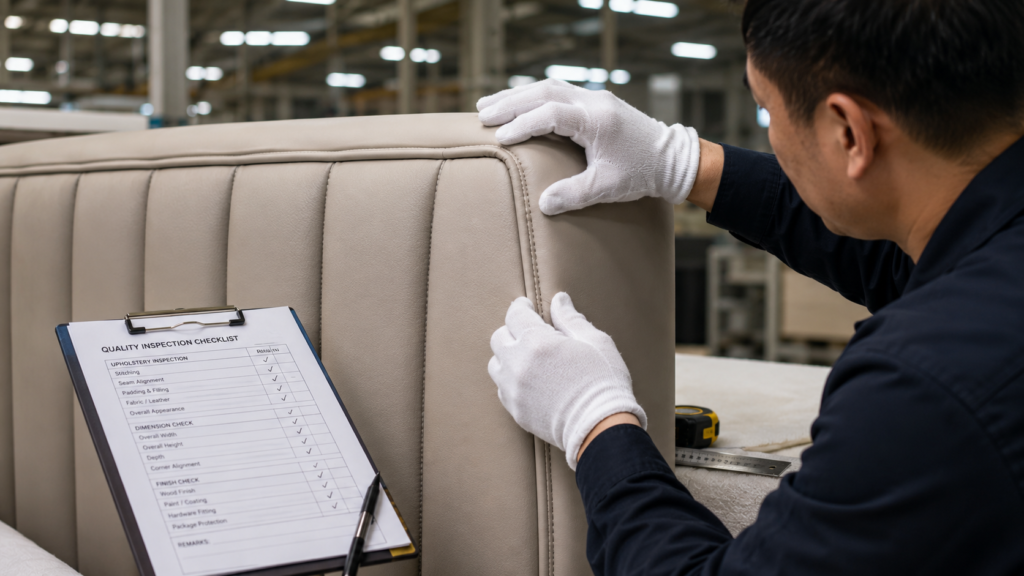
A well-run hotel furniture factory runs quality checks at frame completion, after upholstery, and at final assembly. Ask for photographic documentation at each stage, and expect a reputable manufacturer to provide it as a standard part of the production update process. If a manufacturer is reluctant to share production photos, that reluctance is the answer to your quality control question.
For large hotel projects, consider arranging a third-party pre-shipment inspection through a recognized inspection company. The cost is a small fraction of total order value, and the documentation it produces is useful for both shipment and insurance purposes. A manufacturer confident in its production quality will actively support third-party audits rather than resist them.
Pre-Shipment Inspection Checklist
At pre-shipment stage, verify quantity against purchase order, check finish consistency across all units of the same SKU, confirm upholstery and fabric match approved samples, test structural integrity on a representative sample of pieces, verify packaging adequacy for ocean freight, and confirm all labeling and documentation requirements are in place. Furniture shipped in inadequate packaging for container transit does not arrive in the condition it left the factory, and that damage is a negotiation problem, not a warranty problem.

Step 5: Shipping, Incoterms, and Import Compliance
Shipping and compliance are where direct-import projects most often encounter costs and delays that were not in the original budget. Understanding the standard terms and requirements before the order is placed, rather than after, is the difference between a well-run project and an expensive recovery.
Choosing the Right Incoterms for Your Project
Most hotel furniture exports from Foshan use FOB terms from Guangzhou or Nansha port. Under FOB, the manufacturer handles export clearance and loading onto the vessel; the buyer manages ocean freight, insurance, and import clearance from that point. For buyers who prefer a simpler arrangement, CIF terms include cost, insurance, and freight to the destination port, with the buyer handling import clearance on arrival. Door-to-door DDP arrangements, where the manufacturer or their freight partner manages the full logistics chain to the delivery address, are available from some suppliers and are worth requesting if your team does not have established freight and customs relationships.
Ocean freight on hotel furniture from Foshan to a European, Middle Eastern, or North American port typically adds 15 to 25 percent to the FOB value, depending on destination, container type, and current freight market conditions. Build this into your budget from the specification stage, not after the FOB quote is received.
Compliance and Documentation Requirements for Imported Hotel Furniture
For furniture entering the US market, CARB Phase 2 compliance under TSCA Title VI is required for any composite wood components. Documentation must include product labeling showing compliance and import records kept for a minimum of three years. Request this documentation in writing before production begins, not at the point of shipment. A supplier who cannot produce compliance documentation during qualification is unlikely to produce it under shipment pressure.
For hotel projects in markets with fire safety and durability requirements for contract furniture, specify relevant certifications in the FF&E document from the outset. Fabric fire-resistance ratings, leather grade documentation, and structural load certifications for seating are examples of documentation that affects installation sign-off in regulated hotel environments. Getting this paperwork after production is complete is both possible and significantly more expensive than specifying it upfront.
Lead Times, Budget Benchmarks, and Building Your Import Plan
Realistic planning starts with realistic numbers. The benchmarks below reflect 2026 factory-direct pricing from Foshan and standard lead times across each stage of the import process.
2026 Factory-Direct Price Ranges by Category
- Upholstered king beds (with headboard): USD $400 to $1,800 depending on frame construction and fabric specification
- Hotel lounge seating (per piece): USD $150 to $800 depending on material grade and joinery complexity
- Dining and meeting tables: USD $300 to $2,500 depending on material, size, and base specification
- Casegoods (wardrobe, dresser, nightstand per set): USD $500 to $2,500 depending on wood species, hardware, and finish
- Outdoor hospitality furniture (dining set): USD $800 to $4,000 depending on material and configuration
These are FOB Guangzhou benchmarks. Add 15 to 25 percent for ocean freight, insurance, and import duties depending on destination. Factory-direct pricing on larger orders decreases per unit as volume increases, which makes the comparison against retail channels more favorable the larger the project scope.
Lead Time Expectations at Each Stage
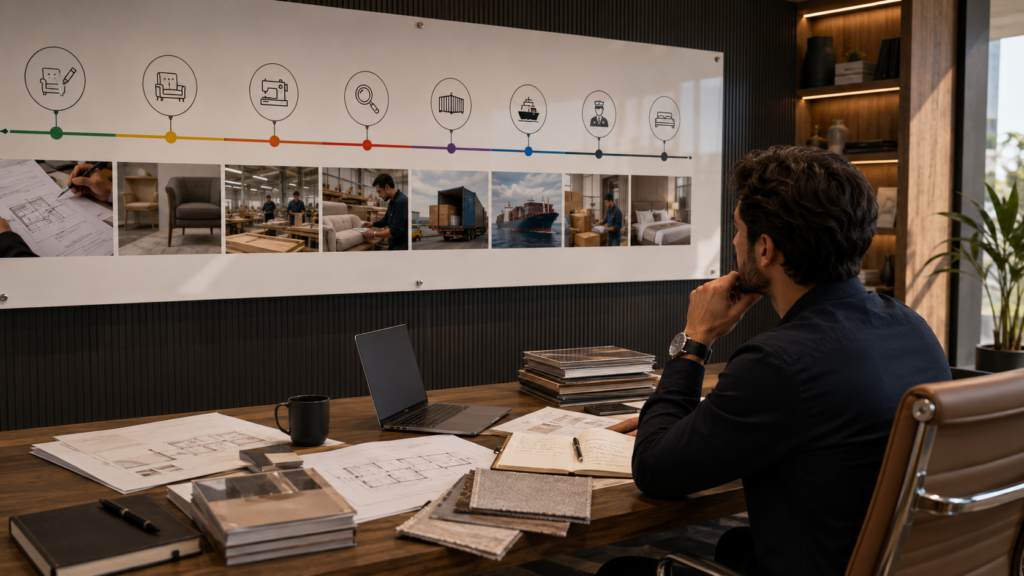
Sample production runs two to four weeks for standard pieces. Full production for a standard hotel room package runs 30 to 45 days after sample approval and deposit confirmation. Large-scale projects of 100 rooms or more typically require 45 to 60 days. Add two to four weeks for ocean freight to European or Middle Eastern ports, and four to six weeks for North American destinations. Pre-shipment inspection, if arranged through a third party, adds three to five working days at the end of production. Build every one of these stages into your project schedule before contracts are signed, not after.
A Prioritized Checklist for Your First Direct Import Project
Lock your FF&E specification document before approaching any supplier. Qualify at least two manufacturers against the criteria in Step 2 before requesting quotes. Get quotes from both a direct manufacturer and a trading company on the same specification so you have a genuine comparison. Request samples before committing to production. Confirm compliance documentation requirements for your destination market in writing before production begins. Arrange pre-shipment inspection before the balance payment is made. Confirm packaging standards for container transit before the order is finalized. The projects that encounter the most expensive corrections are almost always the ones that skipped one of these steps in the interest of moving faster.

The Sequence That Makes Direct Import Work
The five steps in this guide are not independent. They build on each other, and the most expensive problems in direct-import hotel furniture projects are almost always the result of a step being skipped or compressed rather than a manufacturer failing to deliver. A complete specification makes qualification faster. A qualified manufacturer makes the sample stage reliable. A rigorous sample approval makes production predictable. Documented QC makes pre-shipment inspection a confirmation rather than a discovery. And compliance documentation handled upfront makes arrival and installation straightforward rather than contingent.
For hotel developers and procurement managers considering factory-direct sourcing for the first time, the most useful step is running a parallel quote on an active project: get your current supplier’s price and a factory-direct quote from a manufacturer like YM Furniture on the same specification. The comparison will give you more useful information about the real economics of direct import than any estimate.
Request a factory-direct quote from YM Furniture for your hotel project →