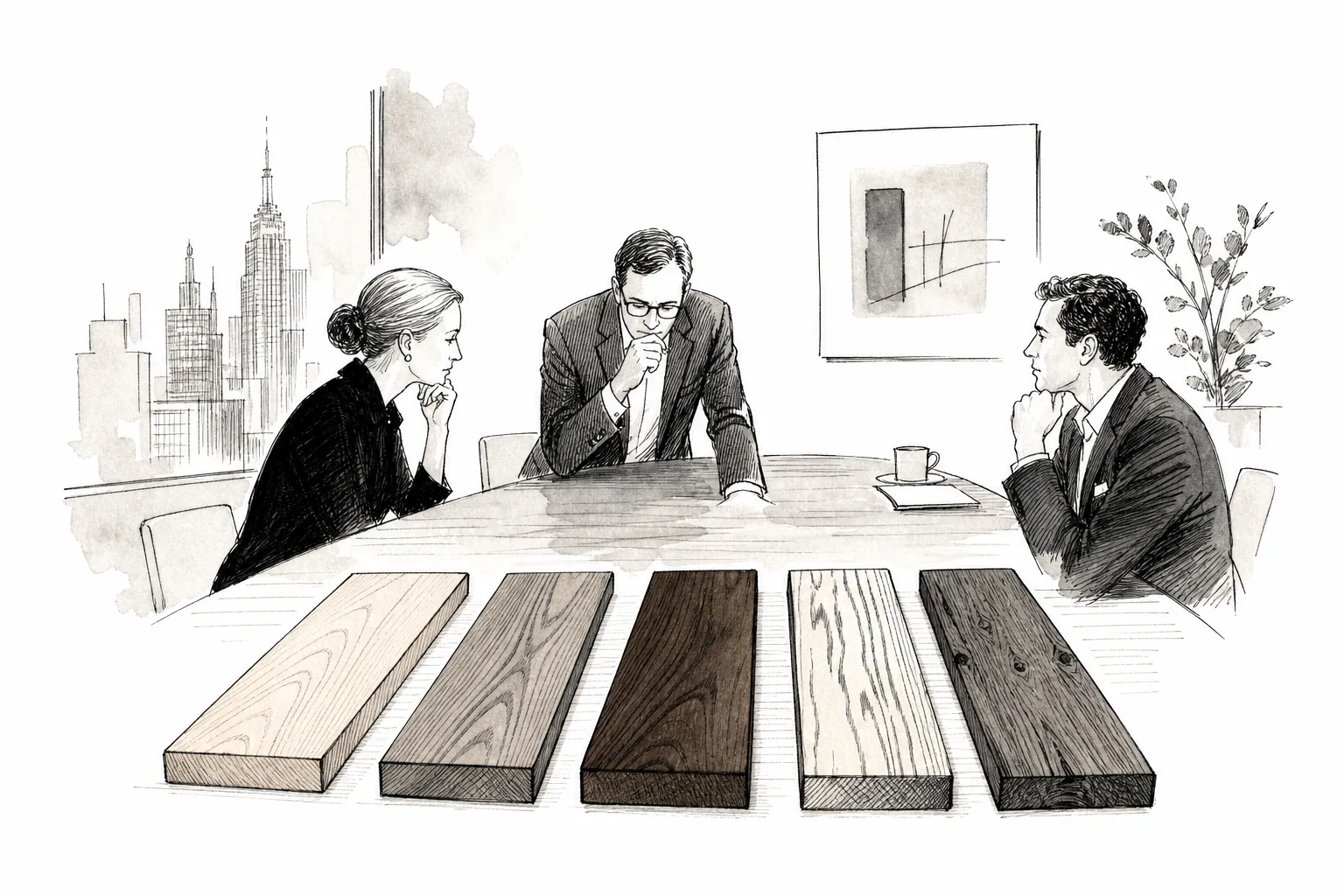
Picture this: you’re pricing out a new conference table and facing two quotes side by side. The first is a white oak solid top at $4,200. The second is a walnut veneer option at $1,900. The veneer version looks stunning in the catalogue photo, and the price difference is hard to ignore. Six months after installation, the oak still looks like day one. The walnut veneer has a chip on one corner, a heat ring near the head of the table, and a scratch pattern where someone drags their laptop in every morning for the 9 a.m. standup.
So what are the most durable wood options for a meeting table surface, and how do you match the right species to the actual demands of the room? The wrong wood choice announces itself quickly. A conference table takes more daily punishment than almost any other piece of office furniture: laptops, coffee cups, keys, pens, the occasional elbow slam during a heated discussion. The material you choose directly determines how that table looks two, five, and ten years from now. This guide compares the five most durable wood options for commercial meeting table surfaces, ash, oak, maple, walnut, and teak, ranked by hardness, scratch and moisture resistance, maintainability, and current Canadian pricing. Every recommendation here is grounded in Janka hardness data, real material behavior, and current Canadian supplier pricing. For B2B buyers sourcing at volume, it’s also worth noting that factory-direct manufacturers like YM Furniture (Foshan Yauming Furniture & Construction Co., Ltd.) let commercial buyers specify exact hardwood species, including solid ash and white oak, built to order, which can significantly reduce costs compared to local fabrication.
What are the most durable wood options for a meeting table surface?
Before comparing species, it helps to understand what drives durability on a commercial-grade table top. The answer starts with a single standardized measurement: the Janka hardness rating.
What the Janka scale actually measures
The Janka hardness test measures the force in pounds-force (lbf) required to embed a steel ball to half its diameter into the wood surface. The higher the number, the more resistant the wood is to denting and surface scoring. Red oak, at 1,290 lbf, is the industry benchmark that flooring manufacturers and furniture specifiers use as a reference point. Anything above it handles heavier use with less surface damage over time; anything below it needs a stronger finish system to compensate for the softer wood beneath.
The commercial use threshold: what Janka score should you target?
For a high-traffic boardroom or a shared meeting table used multiple times daily, most commercial furniture specifiers recommend a minimum of 1,200 lbf as a practical working threshold. That keeps surface denting manageable under regular commercial use without requiring constant maintenance. For a private executive meeting room with lighter, more controlled use, anything above 1,000 lbf can perform adequately when paired with the right finish system. These ranges reflect common practice among commercial furniture specifiers and set realistic expectations before you get to the species breakdown below.
What hardness doesn’t tell you
Janka ratings measure resistance to embedding force, not scratch resistance, moisture behavior, or how well the wood accepts a protective finish. Grain structure (open vs. closed), natural oil and silica content, and finish compatibility all play a role in how a scratch-resistant table surface actually performs over years of use. A species with a modest Janka score but exceptional natural oils, like teak, can outperform a harder species with poor grain structure in a humid meeting room environment. Keep that nuance in mind as you read through each species.
Ash, oak, maple, walnut, and teak: how each species performs as a durable tabletop material
Here’s the head-to-head data for the five species most commonly specified in commercial meeting table surfaces:
| Species | Janka Rating (lbf) | Quick Verdict |
|---|---|---|
| Hard Maple | 1,450 | Hardest of the five; best for heavy daily use |
| White Oak | 1,360 | Best all-round performer; moisture-resistant |
| Ash (White) | 1,320 | Underrated; shock-resistant, takes finish well |
| Walnut (Black) | 1,010 | Softer; chosen for aesthetics, needs strong finish |
| Teak | 1,000 | Lowest Janka here; compensates with natural oils |
Hard maple and white oak: the workhorses of the commercial table world
Maple and oak dominate commercial furniture specifications for good reason. Hard maple at 1,450 lbf is the same wood used for gymnasium floors. It takes sustained punishment from heavy foot traffic, dropped equipment, and constant abrasion without flinching. A meeting table surface in hard maple is one of the most resilient durable tabletop materials available, and it’s widely stocked by Canadian hardwood suppliers, which keeps material costs predictable.
White oak at 1,360 lbf adds a bonus that maple doesn’t offer: a closed-grain structure that resists liquid absorption at the surface level. Spilled coffee doesn’t wick into white oak the way it does into open-grain species. Its quarter-sawn variant is worth specifying for high-end meeting rooms, adding both visual stability and the distinctive ray-fleck pattern that many interior designers and FF&E specifiers request by name. For a corporate boardroom where both durability and aesthetics need to perform, white oak is the safest all-around specification.
Ash: the hardwood that commercial buyers often overlook
White ash sits at 1,320 lbf, placing it squarely between red oak and white oak in hardness, but it brings something distinct to the table: exceptional shock resistance. Ash is the traditional wood for tool handles and baseball bats precisely because it absorbs impact without fracturing. On a meeting table surface, that translates to better resistance to the blunt-force events, a chair back, a dropped laptop corner, that create impact dents on softer species.
Ash also has a pronounced open grain that accepts stain very evenly, making it an ideal choice when wood tone matters as much as structural performance. It’s one of the more accessible premium hardwoods on the Canadian market, often priced notably below white oak, making it a strong value candidate among the most durable wood options for a meeting table surface. For commercial buyers who want a custom conference table in a specific hardwood species, solid ash is available through factory-direct manufacturers like YM Furniture, allowing buyers to specify the material at the production stage rather than paying local retail fabrication premiums. That distinction is meaningful when furnishing multiple rooms or an entire office floor. (See YM’s Ash Wood Dining Table for a representative solid-ash offering.)
Walnut and teak: when aesthetics are driving the brief
Both walnut and teak fall below 1,100 lbf, which puts them under the commonly cited commercial threshold for heavy daily use, a trade-off worth stating plainly. Walnut’s rich dark grain and teak’s warm honey tone are genuinely beautiful, and both species can perform well in low-to-moderate traffic environments when specified with a proper finish system. The problem arises in high-traffic boardrooms where both will show wear faster than maple or oak without a conversion varnish or epoxy coating protecting the surface. If you love the look, plan for the right finish and factor in a regular maintenance schedule.
Scratch and moisture resistance: beyond the hardness number
Hardness predicts dent resistance. Scratch resistance and moisture behavior are governed by different properties: grain structure and natural chemistry. This distinction explains why two species with nearly identical Janka scores can perform very differently in a real meeting room environment.
Teak’s natural oil and silica content: a genuine commercial advantage
Teak is unique among common furniture hardwoods because it contains significant natural silica deposits (up to 1.4% by weight) alongside high natural oil content (approximately 5, 7% by weight). That combination creates a scratch-resistant table surface that resists moisture absorption without relying entirely on the applied finish coating. For meeting rooms near a kitchen or break room, near exterior windows with condensation, or in buildings with significant seasonal humidity swings, teak’s inherent water resistance is a meaningful differentiator. For more on species and moisture behavior, see resources comparing commonly used moisture-resistant woods. The trade-off: those same natural oils can interfere with adhesives and some finish systems, so surface prep before finishing is more technically demanding than with oak or maple.
White oak’s closed-grain structure vs. ash’s open grain
White oak has a tyloses-rich closed-grain structure, the same quality that makes it the traditional material for whiskey barrels. Liquids bead on the surface rather than wicking into the wood grain. Ash, by contrast, has a more open grain that absorbs liquid faster, which means a penetrating sealer coat is essential before the protective topcoat is applied. This doesn’t disqualify ash for commercial use, but it makes the finishing specification more critical. A properly sealed and finished ash top performs comparably to white oak; an improperly finished one shows water staining within months.
Why walnut needs a strong finish to compete in commercial settings
Walnut at 1,010 lbf is genuinely soft by commercial standards. Without a hard-film finish, fine scratches from daily laptop use appear within weeks on a busy conference table surface. Walnut is a premium aesthetic choice, not a low-maintenance workhorse. Buyers who specify walnut should budget for a two-component polyurethane or conversion varnish finish at the factory level, and should plan for annual finish inspection, with refinishing when the surface shows dullness or micro-scratches under raking light, typically every two to three years in moderate commercial use, though actual frequency depends on traffic volume and finish condition. Walnut can look spectacular in an executive meeting suite for a decade with that kind of care; in a shared boardroom used five days a week, it requires honest conversations about long-term maintenance expectations.
Solid wood tabletops vs. veneer: what holds up in a commercial meeting room
The choice between solid hardwood and a veneered tabletop is often framed as a budget decision. It’s really a decision about long-term repairability and risk tolerance. Getting this specification wrong is one of the most common sources of premature commercial furniture failure.
Long-term repairability: the real advantage of solid wood
A solid hardwood tabletop can typically be sanded and refinished four to five times over its lifespan, assuming it starts at a minimum of one inch in thickness. Each full refinishing cycle removes roughly 1.5mm of material, restoring the surface to original condition. A deep scratch, a heat ring from a coffee cup, or a stubborn stain that won’t respond to cleaning can be fully removed by a professional refinisher. For a high-investment meeting room where the table is expected to last 15, 20 years, that repairability is a genuine long-term value argument that the initial price gap with veneer doesn’t capture.
When a veneered top is a reasonable trade-off
A quality engineered core with a face veneer of 3mm or more offers better dimensional stability than solid wood in environments with significant HVAC fluctuation or large glass walls that create temperature swings across the tabletop. For a meeting room that gets moderate use and is expected to be refreshed or replaced within a decade, a well-specified veneer top can make financial sense. The critical specification to request from any manufacturer: minimum 3mm face veneer and a hardwood plywood substrate (not MDF). A 3mm face can support one to two refinishing cycles, which extends usable life significantly compared to paper-thin commercial veneers.
What to avoid in commercial meeting table construction
The combination that generates the most complaints in commercial furniture procurement is an MDF substrate with a face veneer under 1mm thick. Edge chipping often appears within the first few years of heavy use. A single spilled glass of water near a corner can cause permanent swelling and veneer bubbling that cannot be repaired. If a quote comes in significantly below the market rate for the species being specified, this construction method is usually the explanation. Always ask for the substrate material and face veneer thickness in writing before approving an order.
Finish systems that actually protect a hardwood conference table
The wood species sets the ceiling for durability. The finish system determines whether the table reaches that ceiling or falls well short of it under real commercial conditions.
Polyurethane, conversion varnish, and epoxy: a practical comparison
- Oil-based polyurethane: Produces a strong, durable protective layer with excellent scratch and stain resistance. Develops a slight amber tint over time, which works well with the warm tones of oak and walnut. Takes roughly a month to reach full hardness cure.
- Water-based polyurethane (two-component formulations): Dries clearer than oil-based, preferred for maple and ash where a neutral, light tone is the design intent. High-performance two-component versions rival oil-based in scratch and chemical resistance.
- Conversion varnish: A catalyzed finish applied by professional furniture manufacturers using spray equipment in a controlled environment. It produces a harder, more chemically resistant film than either polyurethane type, making it the standard for factory-finished commercial-grade table tops from quality manufacturers. Not a DIY option.
- Epoxy resin: Creates a near-impenetrable surface shell resistant to heat, chemicals, moisture, and impact. Ideal for extremely high-traffic boardroom surfaces or meeting tables in hospitality environments. The limitation: if the epoxy film chips or cracks, a full section replacement is required rather than a spot repair.
Maintenance frequency by wood and finish type
Solid oak or maple with a conversion varnish finish generally needs cleaning with a pH-neutral cleaner and a light topcoat refresh every two to three years, a low-maintenance schedule for a commercial surface. Walnut and teak with an oil-based polyurethane finish should be inspected annually and refinished when the surface starts to look dull or shows micro-scratches under raking light; actual frequency will vary depending on traffic levels, environment, and finish condition. Pure oil finishes (linseed, tung oil) require monthly reapplication and offer minimal stain or scratch protection. They are not appropriate for any commercial meeting table surface, regardless of species.
What these hardwoods cost in Canada: a realistic price breakdown
Canadian buyers sourcing solid hardwood for custom meeting tables face a wide price range depending on species, cut, and how far up the supply chain they’re purchasing. The figures below are sample ranges from Canadian hardwood suppliers as of mid-2026; actual pricing will vary by grade, thickness, supplier, and region.
Price per board foot for the five species
- White Oak: $10.00, $19.50/bf (quarter-sawn: $12.50, $19.00/bf)
- Hard Maple: $8.35, $13.00/bf (curly maple reaches $12, $25+/bf)
- White Ash: $6.10, $8.00/bf, making it one of the most accessible premium hardwoods in Canada
- Black Walnut: $10.75, $22.00/bf depending on grade and figure
- Teak: $25, $40+/bf for true imported teak; African Iroko (a common alternative) at $19.95, $38.00/bf
Wide-board slabs over 15 inches wide typically add $1, $2/bf to those base prices. A custom conference table top at 96 x 48 inches in 4/4 stock requires 32+ board feet before accounting for milling loss and defect cuts. At white oak pricing, that’s $320, $625 in raw lumber alone, before any fabrication, finishing, or base costs. Ash delivers a comparable hardness profile at a noticeably lower material cost, part of why it deserves more attention from commercial buyers balancing durability with budget.
How factory-direct sourcing changes the cost equation for B2B buyers
At Canadian retail lumber prices plus local fabrication labor and finishing, a fully custom solid hardwood boardroom table easily runs into five figures. A single conference table for a corporate headquarters or hotel meeting suite can reach $8,000, $15,000 from a domestic commercial furniture supplier, depending on species and size. That cost multiplies fast when furnishing a full office floor, a hotel conference center, or a multi-room corporate campus renovation.
Factory-direct commercial furniture manufacturing can fundamentally change that math. Foshan furniture manufacturers like YM Furniture (Foshan Yauming Furniture & Construction Co., Ltd.) produce fully custom solid-wood meeting tables in premium hardwoods, including solid ash, white oak, and walnut, built to the buyer’s exact dimensions, finish specification, and design brief. Production is factory-direct from their 70,000 m² facility in Foshan, China. For B2B buyers furnishing multiple rooms at once, factory-direct pricing can offer substantial cost advantages compared to Canadian commercial furniture suppliers, though actual savings depend on order volume, species, and specification. The key for buyers using this route: specify the wood species, grade, face veneer thickness or solid construction, finish system, and substrate material in writing before production begins. Knowing what to ask for is what separates buyers who get exactly what they ordered from those who get a difficult phone call when the shipment arrives.
Choosing the right hardwood for your specific meeting room
All five species in this guide can serve well in the right application. The mistake is treating them as interchangeable. Match the species to the actual use conditions and traffic level of the space, not just to what looks good on a mood board.
Matching species to traffic level and room function
- Daily heavy use (large boardroom, hotel conference center, shared co-working table): Hard maple or white oak with conversion varnish. The hardness-and-finish combination handles the most demanding commercial environments without requiring frequent refinishing cycles.
- Moderate use (private executive meeting room, small team room): White ash or white oak. Ash gives a distinctive visual texture and excellent shock resistance at a lower price point. White oak is the reliable all-around specification when in doubt.
- Low-to-moderate use with a premium aesthetic brief (hotel VIP meeting suite, executive boardroom where design impact is the priority): Walnut or teak, specified with oil-based polyurethane or conversion varnish at the factory level. Budget for annual finish inspection and refinishing as needed based on use and surface condition.
Key questions to ask your manufacturer before finalizing the spec
Before approving a meeting table order from any supplier, get written answers to these four questions. They separate manufacturers who genuinely understand commercial furniture performance from those selling primarily on price and showroom presentation.
- Is the tabletop solid wood or veneer? If veneer, what is the face veneer thickness and what is the substrate material?
- What finish system is applied at the factory, and is it a catalyzed conversion finish or a standard polyurethane?
- Can the species, grade, and finish be customized to specification, or is the catalog configuration fixed?
- What is the refinishing protocol if the surface is damaged or worn within five years of delivery?
Any manufacturer worth working with can answer all four questions specifically and in writing. Vague answers about “premium hardwood” and “durable finishes” without specifics are a signal worth taking seriously before you commit.
The right wood, the right finish, the right construction
Hard maple and white oak lead on raw hardness and are the safest specifications for high-traffic commercial meeting spaces. White ash is the most underrated value option in this group, delivering near-oak hardness with excellent shock resistance and stain acceptance at a lower material cost. Walnut and teak are premium aesthetic choices that perform well when buyers understand the trade-offs and maintain the finish properly. For any of these species, the finish system is as critical as the wood itself, and solid wood construction is worth the premium when long-term repairability and a multi-decade lifespan are part of the brief.
Ultimately, if you’re asking what are the most durable wood options for a meeting table surface, the answer depends on matching three variables: the right hardwood for the traffic level, the right finish system for the environment, and the right construction method for the expected lifespan. For Canadian B2B buyers furnishing commercial spaces at volume, whether that’s a corporate office relocation, a hotel conference suite, or a multi-room development project, getting all three aligned from the start is what separates a table that looks good on day one from one that still looks good in year ten.
If you’re sourcing custom meeting tables for a commercial project and want to discuss species options, construction specifications, or production lead times, contact YM Furniture directly to request a factory-direct quote for your exact requirements.