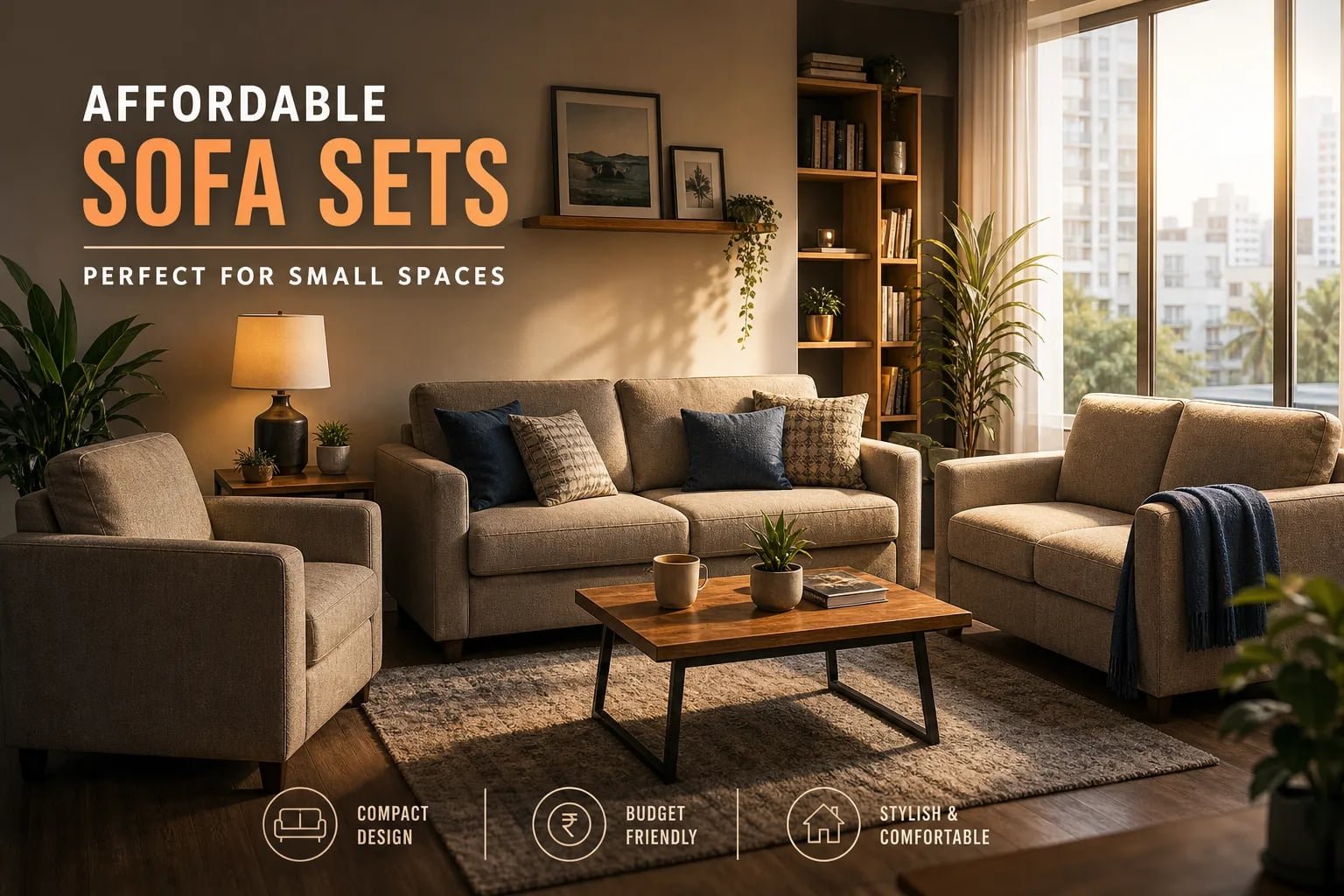
Showroom sofa sets are often sized for open-plan living rooms that simply don’t exist in the average UK flat or terraced house. The most cost-effective sofa options for compact spaces aren’t the ones filling a showroom floor, they’re the well-proportioned pieces that actually leave you room to breathe. If you’ve stood in a furniture store feeling like everything either swamps the space or looks too flimsy to justify the price, this article is for you.
By the time you finish reading, you’ll know exactly how to measure your room before you spend a penny, which sofa styles genuinely work in tight spaces, what realistic UK prices look like in 2026, and which retailers give you the best return on a modest budget. No vague interior-design advice. Just the practical detail that stops you making a £700 mistake.
How to measure your living room before you even look at sofas
Many buyers overlook this step, going straight to browsing and ending up with a sofa that blocks a doorway or turns the room into an obstacle course. Three measurements matter most: the full width of the room, the usable wall length where the sofa will sit (factoring in radiators, plug sockets, and door swings), and the depth of the room from the sofa’s back to whatever faces it, whether that’s a TV unit, a fireplace, or another chair.
Get these three numbers written down before you open a single browser tab. Without them, every sofa you look at is just a guess.
The two-thirds rule and why it works
The two-thirds rule is the simplest proportional guide you can apply to a small living room: your sofa should span no more than two-thirds of the wall it sits against. A 3.6 m wall means your sofa should be no wider than around 240 cm. That remaining third of the wall creates visual breathing room on either side, prevents the sofa from dominating the space, and keeps the route to adjacent doorways comfortable. It’s a useful designer rule of thumb that holds across most room shapes, and it’s the quickest way to rule out sofas that look fine online but would feel oppressive in your actual home.
Minimum clearance distances to plan around
Beyond the sofa’s width, clearance distances are the detail that trips people up. Aim for at least 90 cm of open floor in front of the sofa if that space doubles as a walkway; 75 cm is the absolute minimum where walking is occasional. Between the sofa and a coffee table, 35 to 45 cm is the practical target: close enough to reach your drink without leaning, far enough that you’re not catching your shins every time you stand up. Measure your door swing radius before committing to any sofa position, too. A door that grazes the arm of a sofa sounds like a minor inconvenience until you live with it every day.
How to test a layout without moving a single piece of furniture
Before you order anything, grab a roll of masking tape and mark the sofa’s exact footprint on your floor using the manufacturer’s listed dimensions. Live with that taped rectangle for a day: walk around it, sit in front of it, open the door past it. This costs nothing and takes ten minutes, but it tells you more about how a sofa will feel in your room than any showroom visit. It’s also the single best way to avoid paying a returns courier fee because the sofa “felt bigger in real life.”
The best affordable sofa set furniture options for small living rooms: five styles worth considering
There’s no single right answer here, because the best style depends on how you actually use the room. A young professional in a studio flat needs a different solution to a family cramming into a 3.5 m wide front room. Here is an honest breakdown of five styles worth considering, with the trade-offs laid out plainly.
Loveseats and two-seater sofas: the safe default for tight spaces
A two-seater sofa for small living rooms is usually the most practical starting point, and the numbers back it up. A standard two-seater runs between 130 and 180 cm wide and 85 to 95 cm deep, which leaves enough wall space and floor clearance in most compact UK rooms without the layout feeling squeezed. If you need more seating, a pair of armchairs placed opposite or to the side gives you extra capacity without the bulk of a three-seater. That configuration keeps the centre of the room open, which is what actually makes a small room feel liveable rather than just functional.
Modular sofas: the option that adapts to your room
Modular sofas are genuinely flexible, but they don’t automatically save space, and that’s the part most product marketing glosses over. A modular corner sofa for a small room only works if you choose a compact configuration and measure each module individually against your floor plan. Done well, a modular system like IKEA’s Vallentuna range offers an accessible way to get a sofa that fits an awkward room shape or one that you might reconfigure later. Done carelessly, it becomes a collection of oversized sections that consume every usable metre of floor. Plan it properly, and it’s one of the more future-proof purchases you can make on a budget.
Sofa beds and corner sofas: when they genuinely make sense
A sofa bed for a small flat is only worth its extra bulk when the room genuinely does double duty as a guest bedroom. If you have the occasional overnight guest and no dedicated spare room, a sofa bed earns its keep. If you’re buying one because it sounds like a clever space-saving idea but guests sleep there once a year, you’re paying for a heavier, slightly less comfortable sofa.
Corner sofas are worth considering when you have a clear underused corner and need the maximum seating from one footprint. They’re not the answer for narrow rooms, where the fixed L-shape tends to trap you and removes any flexibility to rearrange later. Wall-hugger recliners deserve a mention as a niche but genuinely efficient option for solo seating: they recline with minimal clearance behind the chair, which is a meaningful advantage in a narrow room where a standard recliner simply won’t open fully.
What dimensions should your sofa actually be for a small room?
Style preference is one thing; hard numbers are what you actually need when you’re standing in a retailer or reading a product listing. Screenshot this section and keep it to hand when you shop.
Two-seater and loveseat sizing: the numbers to aim for
For a two-seater or loveseat, target a width between 132 and 180 cm (roughly 52 to 71 inches) and a depth of 76 to 90 cm (30 to 35 inches). In rooms shallower than about 3 metres from the sofa back to the opposite wall or furniture, keep depth at or below 90 cm. A sofa deeper than 96 cm in a room that shallow will create a walkway so narrow that the space stops feeling like a living room and starts feeling like a corridor with upholstery in it.
Compact three-seater measurements for tight layouts
A compact three-seater typically runs between 183 and 213 cm wide (72 to 84 inches). In rooms under 3.2 metres deep, keep the sofa depth at 81 cm or under to maintain comfortable circulation. The case for a compact three-seater over a two-seater plus armchair comes down to budget and aesthetics: a matched three-seater is usually cheaper than buying two separate pieces and looks more intentional in a small room. Even so, a compact three-seater at 213 cm wide is a substantial piece of furniture, apply the two-thirds rule to check it against your wall before you commit.
Corner sofa sizing: what compact actually means
When retailers describe a corner sofa as “compact,” treat it as a conservative guide rather than a guarantee. As a rule of thumb, aim for a longest side of no more than 220 to 250 cm, and verify that figure against both your room width and the two-thirds rule. Anything stretching to 270 cm or beyond in a small room tends to dominate the layout and can make the occupant feel installed in the corner rather than sitting comfortably. If the longest dimension exceeds 240 cm, measure it against your room width before anything else.
Affordable sofa set furniture for small living rooms: UK price guide for 2026
The options below are organised by price band rather than brand, so you can go straight to what’s realistic for your budget. Each pick includes the dimensions and room type it suits best, not just a price and a product name.
Under £500: where to find genuine value
The Habitat Kota Large Sofa Bed, available from around £375, is the lowest-priced dual-function option for a small space that justifies serious consideration. It works best for rooms that need to serve as an occasional guest room, and the sofa bed format means you’re getting two functions from one footprint. The Dusk Hampshire 2-seater, currently discounted to £471 from £799, offers a compact footprint more suited to a straightforward living room setup without the extra mechanism of a sofa bed. At this price point, be realistic about the trade-offs: fabric quality and frame longevity are where budget sofas feel their budget-ness most acutely. You’re buying function over longevity, and that’s a perfectly valid decision as long as you go in with eyes open.
£500 to £900: the sweet spot for a proper small sofa set
This price band gives you the best balance of a matched-set aesthetic, decent upholstery, and dimensions that suit compact rooms. The Online Sofa Shop offers sofa suites from £549, with two-seater, three-seater, and four-seater configurations that let you mix and match based on your floor plan. Sofa Club’s 3+2 seater set at £899 is the clearest full-set option in this price range if you want a complete matched look from a single order. The Habitat Julien, currently available at £547.50 discounted from £1,095, is worth checking for availability as a mid-market option from a reliable UK retailer. Across this band, you’re generally getting better foam density, more consistent fabric quality, and frames that will outlast what you find under £400.
Flexible and modular picks worth considering
IKEA’s Vallentuna range remains a strong argument for modular flexibility at an affordable price point in 2026. It rewards careful planning and works particularly well for rooms that are awkward in shape, likely to change use, or where you might want to start with fewer sections and add more later. The honest caveat is that Vallentuna’s full potential only emerges if you map out the configuration against your floor plan before you order. Buy it impulsively and you risk building a setup that occupies more of your room than a straightforward two-seater would.
Fabric and frame: what to look for when buying on a budget
The upholstery fabric and frame construction are where budget sofas either justify themselves or fall apart within two years. Knowing what to look for before you buy is worth more than any sale discount.
The upholstery fabrics that hold up to daily life
Microfibre sits at the top of the list for budget sofas in family homes and for anyone with pets. It resists pet hair, wipes down easily, and holds up to daily use better than most fabrics at a comparable price. Polyester-blend performance fabrics come next: they’re specifically engineered for stain resistance and spill management, and an increasing number of affordable UK sofas now use them as standard.
For the easiest possible maintenance, faux leather and protected leather finishes win outright, though they tend to feel warmer in summer and less forgiving in cold rooms. Natural fabrics like linen and cotton-blend look attractive in photographs but wear less well in practice: they pill, stain, and show everyday dirt faster than most synthetic alternatives. For a family room or a home with pets, they’re a choice that often leads to regret. If durability matters, look for a Martindale rub count above 30,000 on the fabric specification; anything in the 15,000 to 25,000 range is average, and average wears out faster than you’d like in heavy daily use.
Frame construction: the detail most buyers ignore until it’s too late
A kiln-dried hardwood frame with corner blocks and reinforced joinery is the standard to look for, even on a budget sofa. Kiln-drying removes moisture from the wood, which prevents warping over time. Corner blocks and reinforced joins add lateral stability that keeps the frame from racking loose after a few years of regular use.
The warning signs of poor construction are easy to identify if you know them: lightweight flatpack-style frames where the joints are single-dowel only, very low-density foam seat cushions that tend to compress faster than higher-density alternatives, and staple-only construction at the joints. A sofa with a solid hardwood frame that lasts five years represents better budget value than two cheap sofas in the same period, regardless of which one costs less on the day you buy it.
Layout tricks that make a small living room feel bigger
These apply regardless of which sofa you choose. Getting the placement and visual balance right adds perceived space that no amount of clever furniture buying can substitute for.
Placement rules that immediately open up the room
Many designers recommend floating the sofa 5 to 10 cm away from the wall rather than pushing it flush against it. This creates a visual sense of depth behind the sofa and makes the room feel less compressed. Place the sofa perpendicular to the main window rather than directly blocking it: natural light is one of the most powerful tools for making a small room feel larger, and blocking it with the back of a sofa wastes it. Resist the instinct to push all furniture against the walls, it’s a natural response to a small room, but it paradoxically makes rooms feel smaller by emphasising the floor area as empty rather than as part of a considered layout.
Visual tricks using colour, scale, and leg height
Sofas with visible legs create a visual sense of floor continuity that makes rooms feel less heavy and more open. A sofa sitting directly on the floor or on a solid plinth base cuts the visual line of the room and can make the space feel lower and more closed-in. Light upholstery colours reflect light and feel less dominant in a tight room than dark fabrics, though they’re more demanding to keep clean. Finally, resist the temptation to pile oversized scatter cushions on an already compact sofa: they eat into seating depth and make a two-seater feel like a one-seater. A couple of well-proportioned cushions usually work better than many oversized ones in a small room.
Where to buy budget small-room sofas in the UK
The retailer landscape has shifted in 2026, with online-only players now covering the lowest price bands and physical retailers differentiating on quality and the ability to test products in person. Here’s how the market splits by approach.
Online retailers with the widest budget range
Wayfair UK covers the widest spread of options, with compact sofa sets running from under £400 up to around £1,080, and the broadest selection in the £500 to £1,000 band. Very is worth checking in the £250 to £750 range for budget-friendly furniture that ships quickly. Wowcher offers the lowest headline prices you’ll find in the UK market, with sofa-related deals from around £199, though availability and specification consistency vary more than at dedicated furniture retailers. The online-only route works best when you already know the exact dimensions you need and have done the masking-tape floor test described above.
High-street and specialist options worth visiting in person
Furniture and Choice offers solid mid-market value with transparent discount pricing and clear size specifications on most listings. Choice Furniture Superstore covers the straightforward budget end of the market with sofas ranging from around £200 to £850, and their compact sofa category is easy to filter by size. John Lewis is the place to go if you want greater confidence in quality: their compact picks, including the Fireside Small 2-seater, carry a higher price point but come with customer service and return policies that budget online retailers don’t match.
The specific reason to visit any of these in person, particularly if you’re buying a sofa bed or a deep-seated compact model, is to test seat depth and foam firmness yourself. Photographs and online descriptions don’t communicate how a sofa actually feels to sit in, and that information is genuinely important when you’re buying something that will absorb a significant portion of your daily leisure time.
How property developers and serviced flat operators reduce costs at scale
Everything above applies to a single living room. If you’re fitting out fifteen compact apartments, or thirty, or a boutique aparthotel, the retail route doesn’t make financial sense and wasn’t designed for the volume you’re dealing with.
Why retail pricing doesn’t work for furnishing multiple units
Run the numbers simply: a compact sofa set sourced through a UK retailer at £700 to £900 per unit, multiplied across 30 apartments, represents a spend of £21,000 to £27,000 on sofas alone, before you’ve bought a single bed, dining chair, or TV unit. That’s the retail model working exactly as intended for consumers buying one sofa at a time. It doesn’t reflect the value available to developers and operators who are buying at volume. Build-to-rent developers, serviced apartment operators, and boutique aparthotel owners increasingly bypass the retail layer entirely for this reason, sourcing directly from manufacturers where custom compact dimensions, branded fabric specifications, and co-ordinated full-room packages are available at substantially lower cost than retail.
What factory-direct sourcing actually looks like for compact sofa sets
YM Furniture, operating as Foshan Yauming Furniture and Construction Co., Ltd., is a worked example of what factory-direct procurement offers at this scale. As a manufacturer supplying hospitality and residential projects across more than 30 countries, including for globally recognised brands such as Marriott, Sheraton, and Pullman, YM Furniture produces custom sofa dimensions built to specific floor plans rather than standard retail sizes. For developers furnishing compact apartments or boutique hotel rooms where floor plans are fixed and consistent, that capability is significant: you’re not adapting your layout to what a retailer stocks, you’re ordering pieces built precisely for the space.
Factory-direct pricing across a full furniture package can represent meaningful savings compared to UK retail sourcing at volume, and the one-stop service model covering production, quality control, and international logistics removes the co-ordination burden that makes multi-supplier procurement so time-consuming for project managers. For developers and operators furnishing at scale, it is worth contacting manufacturers directly to understand what a custom compact furniture package would look like for your specific floor plans.
Bringing it all together
The action sequence here is straightforward. Measure first: room width, usable wall length, and room depth. Apply the two-thirds rule to establish your sofa’s maximum width, then check the clearance distances to confirm the depth that will work for your layout. Do the masking tape test before you order anything. Shortlist a style based on how the room actually functions, not just how a sofa looks in a photograph: a two-seater for straightforward living, a modular system if the layout is awkward or likely to change, a sofa bed only if overnight guests genuinely justify the extra bulk.
Match your shortlist to a budget band using the retailer guide above. In the under-£500 range, you’re buying function over longevity. In the £500 to £900 band, you’re getting a matched-set aesthetic with meaningfully better fabric and frame quality. Choose microfibre or a polyester-blend performance fabric over cotton or linen if the sofa will see daily family use: it pays back in years of easier maintenance and a sofa that doesn’t look worn out after eighteen months. Prioritise a kiln-dried hardwood frame even in budget products, and treat it as a non-negotiable rather than a nice-to-have.
For anyone furnishing at scale, the best affordable sofa set furniture options for small living rooms aren’t found on a UK retail website at all, they come from factory-direct procurement where custom dimensions, consistent quality across multiple units, and volume pricing are the standard rather than the exception. The tape measure is where everything starts, whether you’re buying one sofa for a flat or 50 for a development. Take it out today, mark your floor, and you’ll immediately know which size bracket to shop in.
Frequently asked questions
What are the best affordable sofa set furniture options for small living rooms in the UK?
The best affordable sofa set furniture options for small living rooms depend on your room dimensions, budget, and how the space is used. Two-seater sofas between 132 and 180 cm wide are the safest starting point for most compact UK rooms. In the under-£500 band, the Habitat Kota Sofa Bed and the Dusk Hampshire 2-seater are practical picks. Between £500 and £900, the Online Sofa Shop and Sofa Club offer matched sets with better frame quality. Always measure before you browse, and use the two-thirds rule to confirm maximum sofa width.
How do I know what size sofa will fit in a small living room?
Measure your room width, the usable wall length where the sofa will sit, and the depth from the sofa’s back to the opposite wall or furniture. Your sofa should be no wider than two-thirds of the wall it sits against. Keep at least 90 cm of clearance in front as a walkway and 35 to 45 cm between the sofa and a coffee table. Use masking tape on the floor to mark the sofa’s exact footprint before you order.
Is a modular sofa a good choice for a small room?
A modular sofa can work well in a small room, but only if you plan each module carefully against your floor plan. The IKEA Vallentuna range is a commonly cited option for compact, reconfigurable layouts. The risk is ordering too many sections: a poorly planned modular setup can consume more floor space than a straightforward two-seater. Measure every module individually and map the full configuration on your floor before committing.
What fabric is best for a budget sofa that will see daily use?
Microfibre is the most practical choice for family homes and pet owners: it resists hair, wipes down easily, and wears well at a modest price. Polyester-blend performance fabrics offer similar durability with better stain resistance. Avoid linen and cotton-blend options for high-traffic rooms, they show wear and staining faster than synthetic alternatives. If durability is a priority, look for a Martindale rub count above 30,000 on the fabric specification.