Sourcing outdoor furniture from China remains one of the most cost-effective strategies available to hospitality developers and commercial buyers in 2026. China leads global outdoor furniture manufacturing in both scale and cost competitiveness, and while other regions produce furniture, none currently match the combination of vertical integration, material variety, and factory-direct pricing that established Chinese manufacturers offer. But the gap between a reliable factory and a problematic one is genuinely hard to spot from a distance, especially when both look similar on a trade platform or in a catalog PDF. If you’re reading this, you’re not browsing. You’re evaluating, and that changes what you actually need from a guide like this.
The outdoor furniture manufacturing clusters in Guangdong’s Foshan and Shunde districts have raised the bar for hospitality buyers in particular. Vertically integrated suppliers operating in these areas, including manufacturers like YM Furniture (Foshan Yauming Furniture & Construction Co., Ltd.) that serve both indoor FF&E and outdoor furniture programs, have developed production systems designed for commercial-grade requirements, not retail volume. That distinction matters when you’re furnishing a resort terrace or a villa development, not a backyard.
By the end of this guide, you’ll know which materials to specify and why, which documents to request and how to verify them, how to read a price quote against your actual landed cost, and what questions to ask before committing to any outdoor furniture supplier from China. No filler. Just the framework a procurement-ready buyer needs.
Why China Still Leads Global Outdoor Furniture Manufacturing
The manufacturing clusters that drive output and pricing
China is not a monolithic supplier, and treating it as one creates confusion early in the sourcing process. Two clusters dominate the outdoor furniture space. Foshan and Shunde in Guangdong concentrate aluminum-frame and high-end rattan manufacturers. Linhai in Zhejiang dominates volume production for rattan and PE wicker categories, where cost competition is sharpest. These clusters exist because proximity to raw material suppliers, skilled labor, and established logistics infrastructure creates compounding efficiency advantages that newer manufacturing regions simply haven’t built yet.
Geography matters because it shapes what a factory actually produces, at what price point, and with what minimum order expectations. A Foshan aluminum manufacturer and a Linhai wicker producer are serving different market segments, even if both describe themselves as “outdoor furniture suppliers.” Knowing where a factory is located before your first inquiry helps you calibrate quality expectations, MOQ realism, and the type of customization they’re set up to handle.
Factory-direct vs. trading companies: why the distinction matters more than the price
A trading company and a factory can look identical on Alibaba, at a trade show booth, or in a product catalog. A trading company aggregates from multiple factories, adds margin, and has limited ability to control quality, lead times, or customization depth. A direct factory controls its production line, raw material sourcing, QC processes, and the customization options it can actually deliver.
For commercial buyers sourcing at scale, the difference is significant in practice, not just in principle. When a hotel developer needs 400 identical lounge chairs with a specific Pantone-matched powder coat and a 60-day delivery window, a trading company’s answer is often a version of “we’ll check with our supplier.” A direct factory either confirms it or doesn’t. The earlier you determine which type you’re actually dealing with, the more accurately you can plan your procurement timeline and your risk exposure.
Outdoor Furniture Manufacturing in China: Material Quality Explained
Aluminum frames: alloy grades, surface treatment, and what fails first
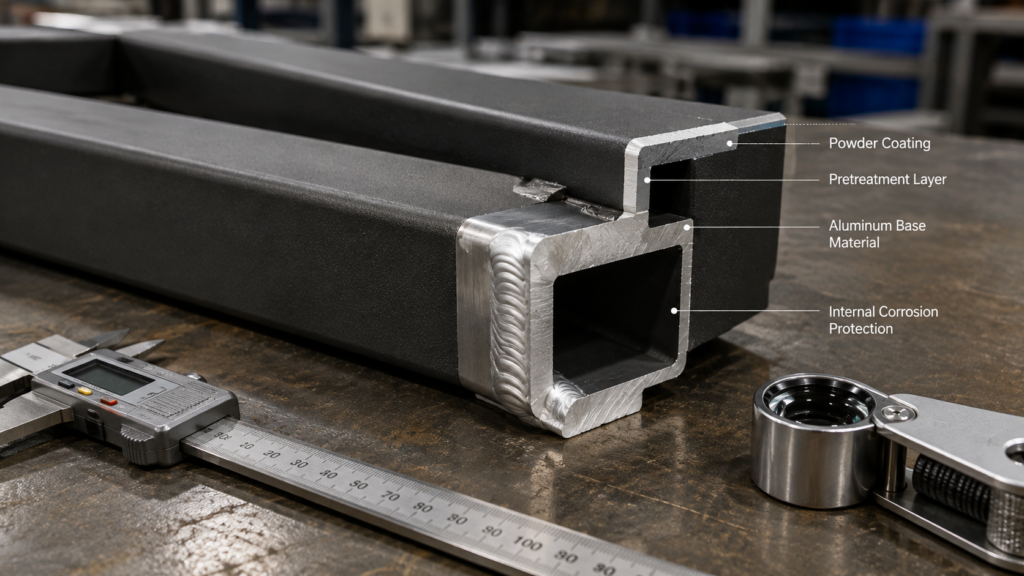
For commercial hospitality outdoor furniture, 6063 aluminum is the standard alloy for frame extrusion and visible components. It’s sometimes called the “architectural” alloy because it extrudes cleanly into complex profiles, anodizes well, and performs consistently in weather-exposed environments. 6061 offers higher tensile strength and works for more structural or load-bearing applications, but 6063 is the practical standard for chair frames, table bases, and lounger structures in outdoor hospitality settings.
Common failure modes on aluminum outdoor furniture, as reported by QA inspectors and commercial procurement teams, occur not at the alloy itself but at weld joints (insufficient penetration or improper MIG technique), at thin-wall tubing sections under load, and at the powder coating layer when applied at insufficient thickness. Industry guidance for hospitality-grade frames typically calls for a powder coat thickness of 60 to 80 microns for consistent weather performance, though buyers should confirm the exact specification with their supplier’s production documentation and request independent test lab results where available. When evaluating a supplier, request a cross-section inspection of a sample frame to check wall thickness, and ask for the specific powder coating spec on their production documentation.
PE rattan and wicker: what separates durable from disposable
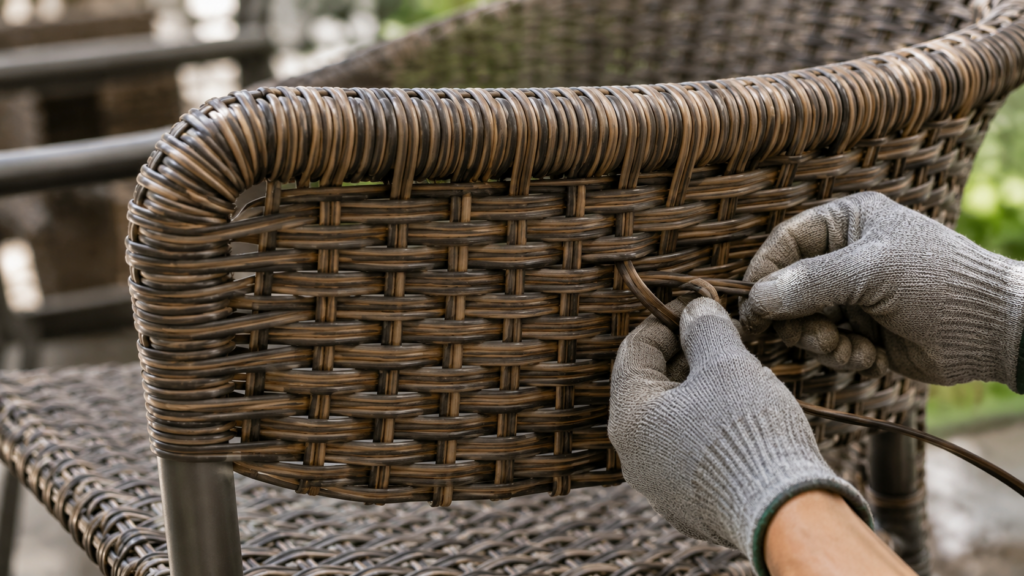
High-density polyethylene rattan (HDPE) is the premium version of synthetic wicker, and for commercial outdoor settings it performs meaningfully better than lower-grade PE alternatives. HDPE rattan is denser, more resistant to UV degradation, and holds its color and structural integrity through sustained sun exposure and poolside chemical contact. For hotel pool decks, resort terraces, and villa outdoor areas where replacement costs are high and brand consistency matters, the performance gap between HDPE and standard PE wicker typically becomes measurable over multiple seasons of commercial use, and that gap compounds over the full service life of the furniture program.
When evaluating rattan products, ask whether the weave is hand-woven or machine-woven. Hand-woven is denser, more durable, and better suited to commercial applications. Request color-fastness specifications for outdoor commercial use, particularly for properties in high-UV climates. A reputable supplier will be able to provide documented UV exposure test results. If they can’t, that’s useful information about their production standards.
Teak and solid hardwood: when the premium is justified
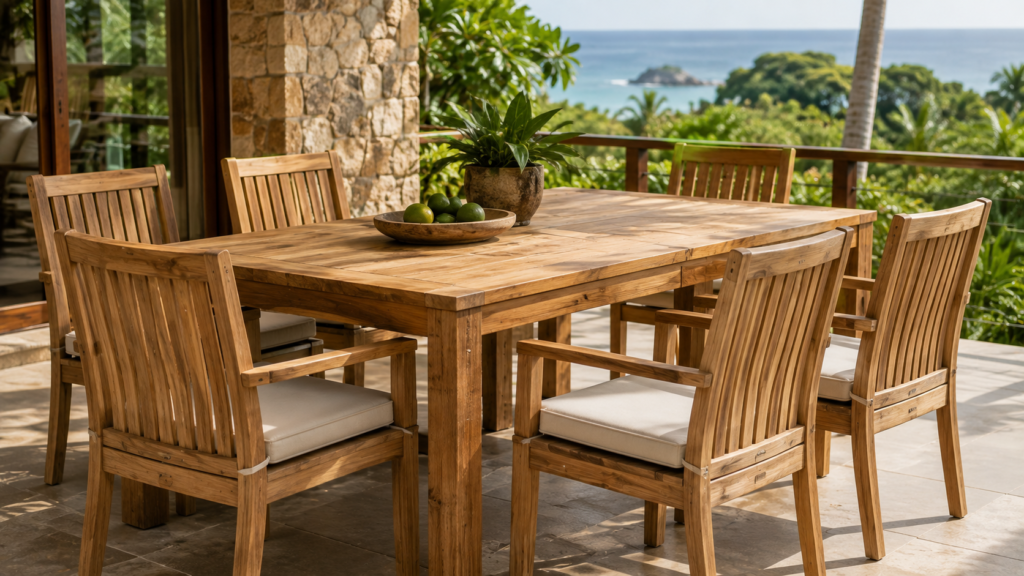
Teak from a Chinese outdoor furniture manufacturer is a real option, but it requires more verification than aluminum or PE rattan. FSC chain-of-custody certification confirms that the teak material and the production facility are within a verified sustainable sourcing system. A factory claiming “FSC teak” without a valid certificate number you can look up in the FSC public certificate database is making a marketing claim, not a verifiable one. Confirm the certificate scope includes furniture and the specific wood category before accepting the claim.
Teak is the right material for luxury resort outdoor programs and high-end villas where the aesthetic and longevity justify the cost and maintenance commitment. For hotel pool decks or high-traffic resort terraces where replacement cycles are shorter, aluminum-and-HDPE-rattan combinations typically deliver better ROI. Kiln-dried teak should arrive with a moisture content of approximately 8 to 12% for stable performance in most climates, a range consistent with standard wood-industry guidelines for furniture-grade hardwoods. Request the moisture content specification in writing when placing a teak order.
Working with China Outdoor Furniture Manufacturers: MOQs, Lead Times, and Price Benchmarks
Rattan and wicker: the most accessible entry point for smaller projects
For PE rattan and wicker outdoor furniture, typical factory MOQs for production orders run from 10 to 100+ units, depending on whether the product involves existing frames or requires custom tooling. Platform listings sometimes show MOQs as low as one unit, but those are usually stock items or conversation starters, not production commitments. Standard lead times for made-to-order rattan furniture run 15 to 45 days from order confirmation when materials are in stock.
Wholesale price ranges for outdoor rattan sets typically span US$100 to $1,800 per set, with significant variation based on configuration complexity, weave quality, cushion specification, and whether the order involves custom branding or packaging. Chairs and loungers are usually priced per piece; sofa and dining collections are more commonly quoted per set. The entry price for a single outdoor chair starts around US$20 to $50 per piece at volume for standard catalog items.
Aluminum: higher MOQs, longer custom lead times, broader pricing spread
Aluminum outdoor furniture programs operate on different MOQ expectations. Standard production runs for existing SKUs from aluminum-focused China outdoor furniture manufacturers typically require around 200 units per design. Custom OEM or ODM orders with new tooling, new silhouettes, or non-standard finishes carry longer lead times: 60 to 90 days is a realistic planning number for fully custom aluminum programs. Existing SKU orders from stocked production lines run closer to 30 to 45 days.
Entry-level wholesale pricing for aluminum outdoor furniture starts around US$80 per piece, but that floor reflects basic production items, not commercial-grade specifications. Hospitality-spec aluminum sets with verified wall thickness, appropriate powder coat specification, and commercial-load testing sit substantially above that number. When comparing aluminum quotes, confirm the alloy grade, wall thickness, and coating spec before treating price as the primary comparison metric.
Teak: premium pricing, longer sourcing lead times, and lower typical MOQs
Teak carries lower volume MOQs than aluminum because the tooling investment is different: established teak suppliers typically accept orders starting around 20 to 50 sets. Lead times run 30 to 90 days depending on customization depth and current wood inventory. Seasonal availability of quality kiln-dried teak can extend timelines, particularly for large orders, so build lead time buffer into teak-heavy projects.
Teak is quoted per set rather than per piece in most cases, especially for dining and lounge collections. Pricing sits at a significant premium over rattan and aluminum alternatives, which is expected for a material with the durability, aesthetic, and sustainability traceability that a properly sourced FSC teak product delivers. The premium is justifiable on the right project. On the wrong project, it’s cost you don’t recover.
At a Glance: MOQ, Lead Time, and Price by Material
| Material | Typical MOQ | Lead Time | Entry Wholesale Price |
|---|---|---|---|
| PE Rattan / Wicker | 10 to 100+ units | 15 to 45 days | US$20 to $50 per piece |
| Aluminum | ~200 units per design | 30 to 45 days (stock) / 60 to 90 days (custom) | From US$80 per piece |
| Teak | 20 to 50 sets | 30 to 90 days | Premium pricing, quoted per set |
Certifications and Documents Every Buyer Should Request
The core documents that confirm a factory is legitimate
Start with the business license (营业执照). This confirms the company’s legal registration, business scope, registered capital, and physical address. Cross-check the unified social credit code in China’s national enterprise registry to confirm the entity is active and the address matches what the supplier has told you. The export registration confirms the supplier can legally export goods, a separate confirmation from simply being a registered company.
Bank account verification is simple but often skipped. The bank account name on the payment instructions must exactly match the name on the business license. A mismatch, even a partial one, is a serious red flag. It is not an administrative oversight. This is the most common mechanism for payment fraud in cross-border furniture sourcing, and it costs buyers money they rarely recover.
ISO 9001, BSCI, and FSC: what each one actually verifies
ISO 9001 confirms that a factory has a documented quality management system, with processes, procedures, and documentation in place. It does not certify that their products meet any specific quality standard. BSCI is a social and labor compliance audit that tells you about working conditions and ethical practices, not about production capability or material quality. Both are useful context, but neither alone tells you much about what you’ll actually receive.
FSC matters specifically for wood-based products. If teak or hardwood is in your specification, FSC chain-of-custody certification is the mechanism that traces the material from certified forest through the supply chain to your product. Verify the certificate in the FSC public certificate search database using the certificate number, not a scanned copy provided by the supplier. Confirm the scope includes furniture and the relevant product group. For ISO certificates, IAF CertSearch allows verification by certificate number through the international accreditation network.
Product test reports tied to your destination market
For U.S. buyers, the compliance documentation that actually matters for outdoor furniture includes CARB Phase 2 formaldehyde emission limits for wood composite components, chemical safety requirements for materials in contact with users, and relevant ASTM standards for structural load and durability. These are product-specific and material-specific, which means a test report from five years ago on a different SKU does not satisfy your compliance requirements.
Request test reports that are recent, issued by an accredited third-party laboratory, and clearly tied to the specific product you’re purchasing. A supplier who can’t produce current, product-specific test reports for a product they describe as export-ready should prompt follow-up questions about how seriously they treat compliance documentation for their commercial clients.
How to Tell a Real Factory from a Trading Company
Live factory audits and video walkthroughs: what to look for
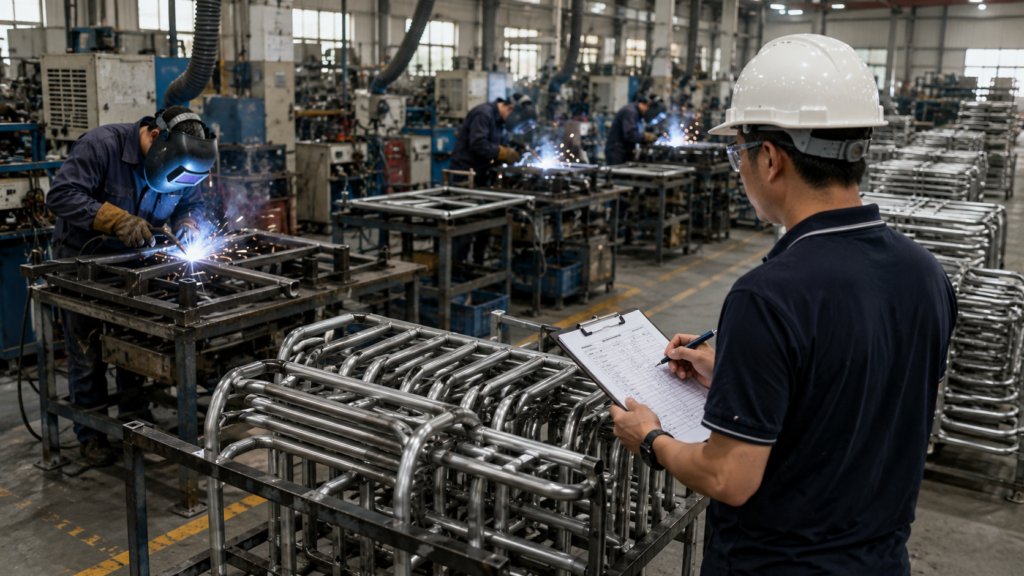
Request a real-time video walkthrough of the production floor, not a pre-recorded promotional video. What you’re looking for: CNC machining and metal cutting areas, welding stations with visible PPE and safety equipment, powder coating or finishing booths, rattan weaving workstations, foam and upholstery areas, and dedicated QC inspection rooms. A factory claiming both aluminum and teak production should have material processing facilities for both, not just a combined showroom with products from both categories on display.
Compare what you see against the factory’s stated production capacity and product categories. A factory claiming 10,000 units of monthly production but showing four welding stations in a video walkthrough has a capacity mismatch worth asking about. These inconsistencies are not always signs of fraud; sometimes they indicate a trading company operating a small assembly operation. Either way, they warrant direct questions before any order is placed.
Red flags that signal you’re dealing with an intermediary
Trading companies operating as factories share several common characteristics when you know what to look for. They’re often unable to identify raw material suppliers by name or provide material specifications with technical detail. Their answers on production capacity are vague or inconsistent across different product categories. They quote dramatically different lead times depending on the item, often because they’re checking with multiple sub-suppliers. And they resist third-party inspection, sometimes citing factory policy, sometimes citing supplier confidentiality.
Extremely low pricing is a warning, not an opportunity. If an outdoor furniture quote comes in significantly below what comparable quality should cost based on your material benchmarks, the gap is usually explained by one of three things: lower-grade materials than specified, a trading company marking up a cheap factory’s price while still undercutting you, or an error in the quote that will surface as a dispute later. Get clarity before you get excited about the price.
Verifying shipping history and production capacity
Ask for bills of lading or shipping records that confirm actual export activity. Established manufacturers ship regularly and have documentation to prove it. A factory that has completed projects across multiple international markets will have no hesitation sharing shipping records with a serious commercial buyer. Third-party audit firms including SGS, Bureau Veritas, and TÜV can conduct factory capacity assessments and pre-shipment quality audits on your behalf. For orders above a certain value threshold, the audit fee is almost always recovered through reduced quality risk and better production accountability.
OEM and ODM Customization: What’s Possible and What It Costs
What Chinese outdoor furniture factories can actually customize
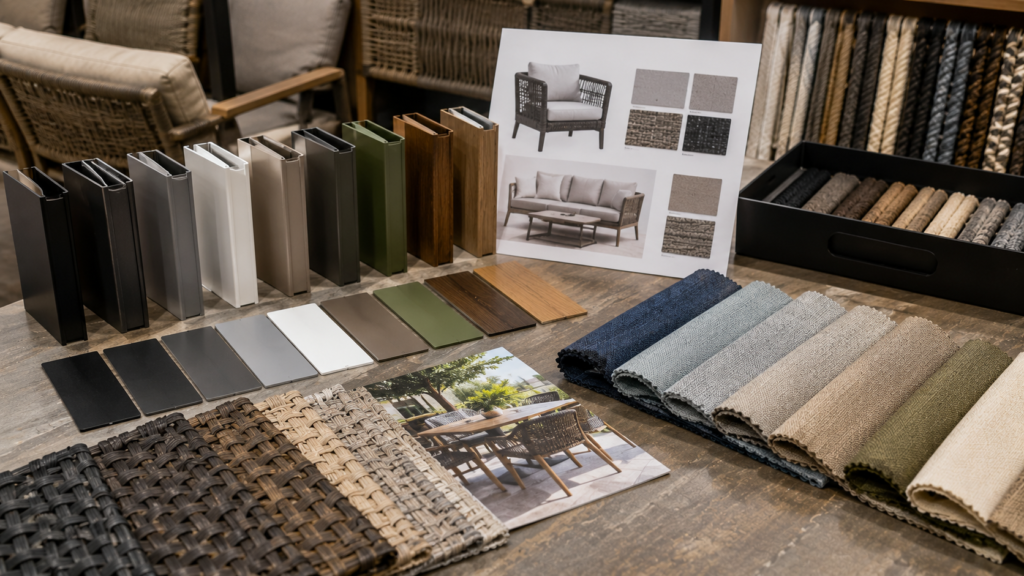
Established outdoor furniture manufacturers in China offer a wide range of customization across the full product specification. Frame material and alloy grade, rope and PE rattan weave patterns, cushion fabrics including premium outdoor options like Sunbrella and Dickson, foam density, frame colors with Pantone matching, surface finishes, private-label packaging, and logo placement are all standard customization territory. Factories with in-house design teams can also support custom silhouette development for branded hospitality collections, particularly relevant for hotel groups building proprietary outdoor furniture programs.
For resort developers and hotel ownership groups building a coherent outdoor furniture program across multiple properties, the customization capability of a vertically integrated factory is the differentiator that matters most. Off-the-shelf outdoor furniture from a catalog is available from dozens of suppliers. A manufacturer that can build to your brand specification, across material categories, with documented QC at each production stage, is a meaningfully different resource.
Sampling fees, tooling costs, and what’s negotiable
Stock samples are typically provided free or at low cost, sometimes with return shipping charged to the buyer. Custom samples involving new dimensions, non-standard finishes, or unique weave patterns carry a sample fee that is often refundable against the first bulk order. Sample lead times for stock items run 3 to 7 days; custom development samples can take 10 to 15 days or longer depending on complexity. Build this into your project timeline before the RFQ stage, not after.
Tooling or mold costs for entirely new product structures are handled case by case. Some factories amortize tooling costs into bulk order pricing when annual volume commitments are confirmed. Others quote tooling separately with a per-run recovery structure. The key is to get the tooling cost structure in writing before development begins, not during the first production invoice dispute. For hospitality buyers committing to a multi-property rollout, tooling cost recovery is almost always negotiable.
The sample approval process and why it sets your production benchmark
The approved sample, called the golden sample, is the legal production reference for your order. Every piece in the bulk production run should match the golden sample in dimensions, finish, material, and construction quality. Buyers should inspect and approve samples in writing, with specific sign-off on material finishes, cushion color and firmness, weave density, and structural integrity, before bulk production begins. A verbal approval or an email approval without documented specifications creates ambiguity that is expensive to resolve after production.
Confirm in your purchase agreement that the golden sample is retained by the factory throughout the production run and used as the on-floor QC reference. Also confirm the process for handling deviations: what constitutes an acceptable variance, what triggers rework, and who bears the cost. These aren’t hypothetical concerns. They’re standard terms that reputable commercial manufacturers address without friction.

Shipping Terms, Export Costs, and Your True Landed Cost
FOB vs. CIF: the practical difference for outdoor furniture buyers
Under FOB terms, the seller delivers goods to the named Chinese port and loads them onto the vessel. From that point, the buyer takes responsibility for ocean freight, marine insurance, destination port charges, customs clearance, duties, and final-mile delivery. Under CIF terms, the seller pays ocean freight and minimum insurance to the named destination port, but risk still transfers when the goods are loaded in China, not when they arrive. The seller’s insurance minimums under CIF are often lower than what a commercial buyer would want for a full container of hospitality furniture.
For commercial buyers who want control over freight booking, insurance coverage, and carrier selection, FOB is typically the better choice. Your own freight forwarder, booked under your account, gives you visibility into shipment status, better insurance options, and consistent carrier relationships across multiple orders. CIF simplifies the quoting process for comparison purposes, but the fine print on insurance minimums and the lack of freight visibility make it less suitable for high-value hospitality procurement.
Building your actual landed cost: what goes into the total
The FOB price from a Chinese outdoor furniture supplier is not the number that determines whether your sourcing decision works financially. Your landed cost is. That formula runs as follows: FOB price, plus ocean freight, plus marine insurance, plus destination port fees, plus U.S. customs brokerage, plus import duties based on the applicable HTS code, plus drayage or final-mile delivery to your project site.
For aluminum outdoor furniture and PE rattan patio furniture, both typically classify under Chapter 94 in the U.S. HTS schedule rather than Chapter 76, meaning they’re classified as furniture rather than as aluminum articles. HTS subheadings 9403.20 for metal furniture and 9403.70 or 9403.89 for rattan or other material furniture carry MFN duty rates that are often free, but confirm the specific subheading with your customs broker before finalizing your landed cost model. Container utilization also directly affects per-unit freight cost: a 40HQ container with roughly 65 to 68 CBM of usable cartoned volume spread across fewer sets means a higher freight cost per set. Pack efficiently and calculate by CBM per set, not by headcount.
What Hotels and Resorts Demand from Outdoor Furniture Suppliers
Why the hospitality outdoor furniture bar is higher than retail sourcing
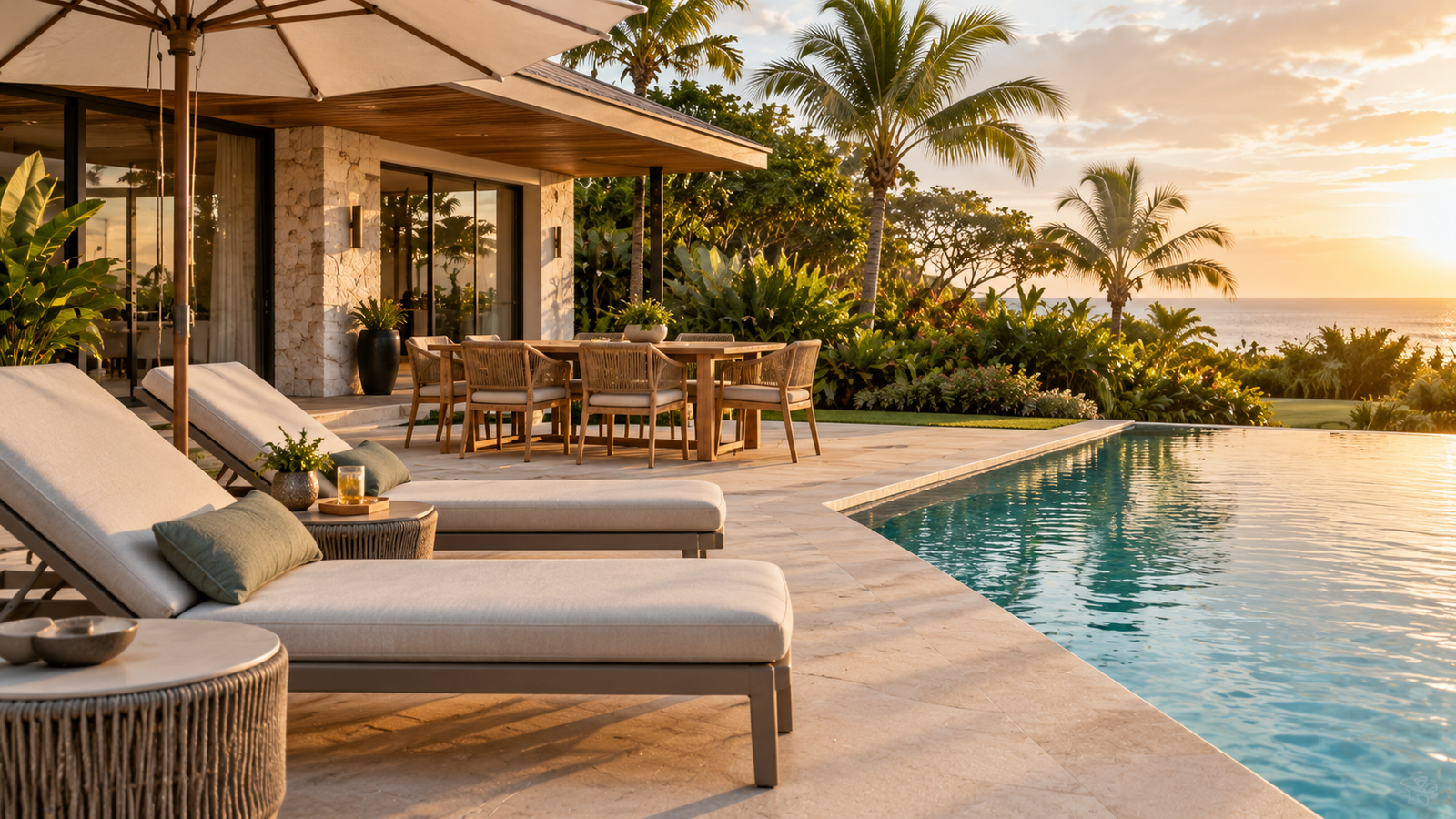
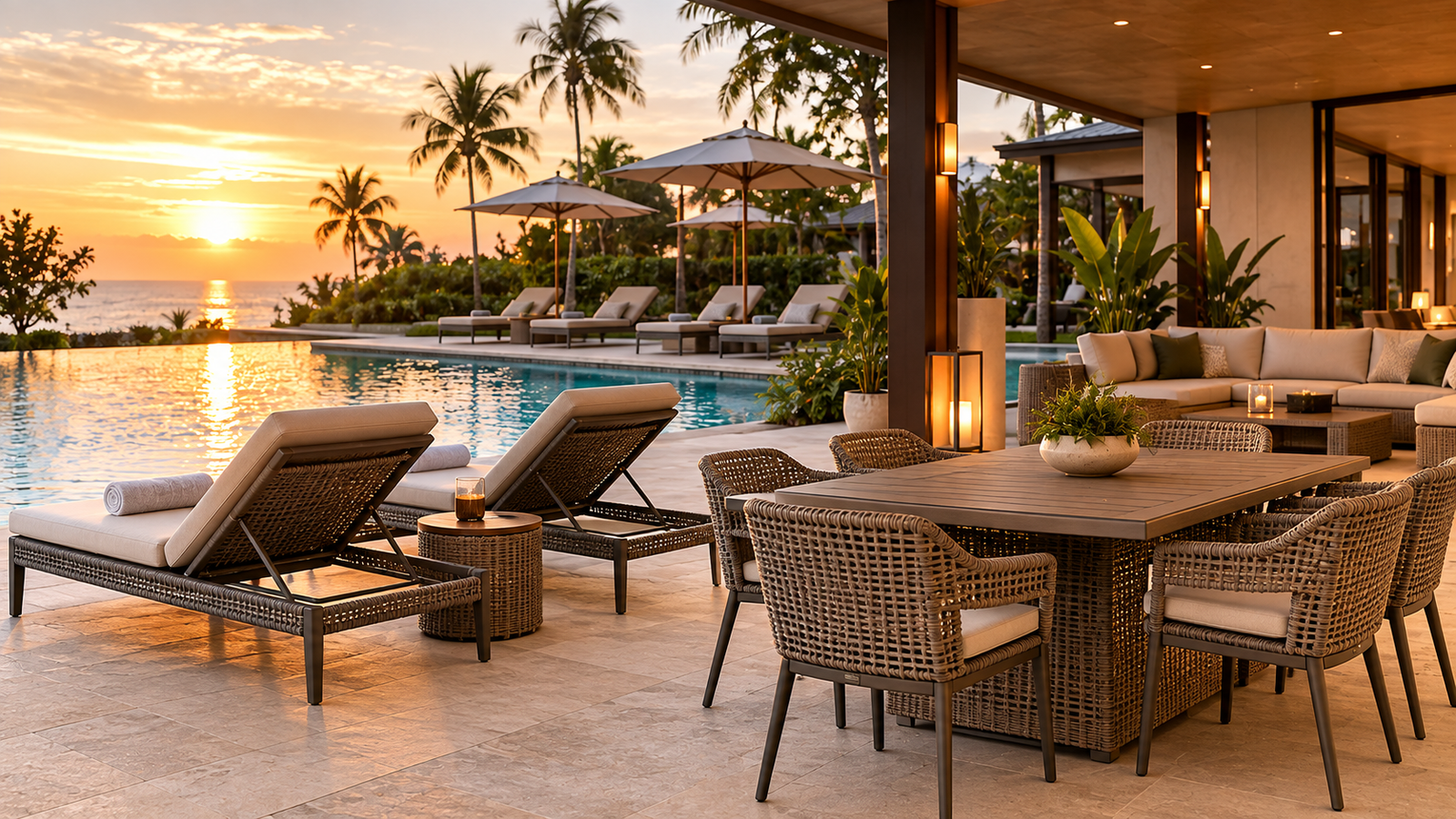
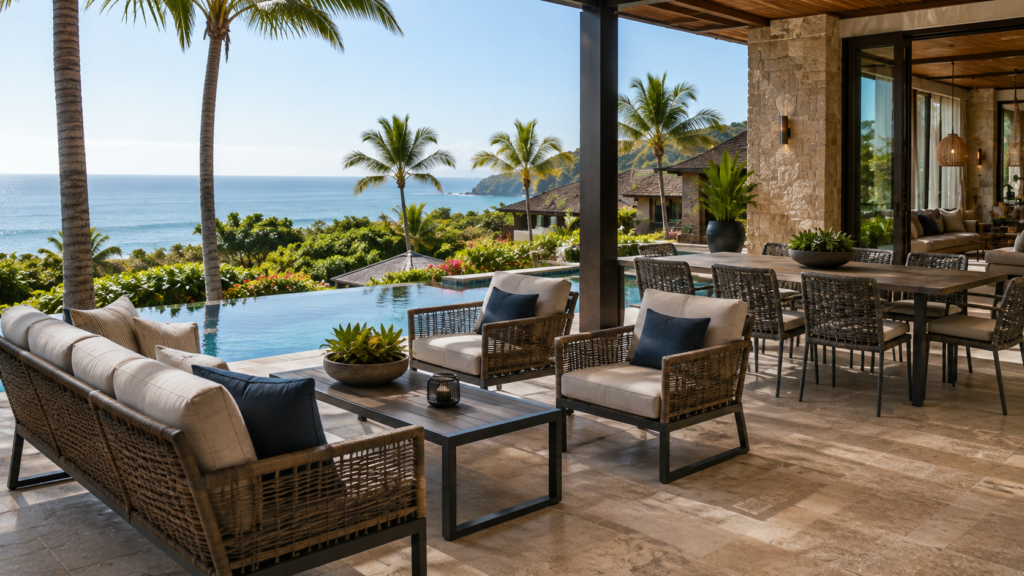
Hotel pool decks, resort terraces, and villa outdoor areas face fundamentally different use conditions than residential patios. Commercial-frequency use, prolonged UV exposure, poolside chlorine contact, saltwater environments in coastal properties, and brand consistency requirements across multiple locations are all factors that standard retail-grade outdoor furniture isn’t designed to withstand at scale. Failure modes on retail furniture in commercial settings aren’t gradual. They’re accelerated, visible, and damaging to a property’s presentation.
A hospitality buyer’s outdoor furniture specification needs to account for all of this upfront, not as an afterthought when replacement costs arrive two seasons in. That means specifying HDPE rattan rather than standard PE wicker, confirming wall thickness and alloy grade on aluminum frames, requiring powder coat thickness documentation, and sourcing from an outdoor furniture manufacturer in China with documented QC processes and proven experience delivering to commercial hospitality projects.
What a vertically integrated manufacturer brings to the table
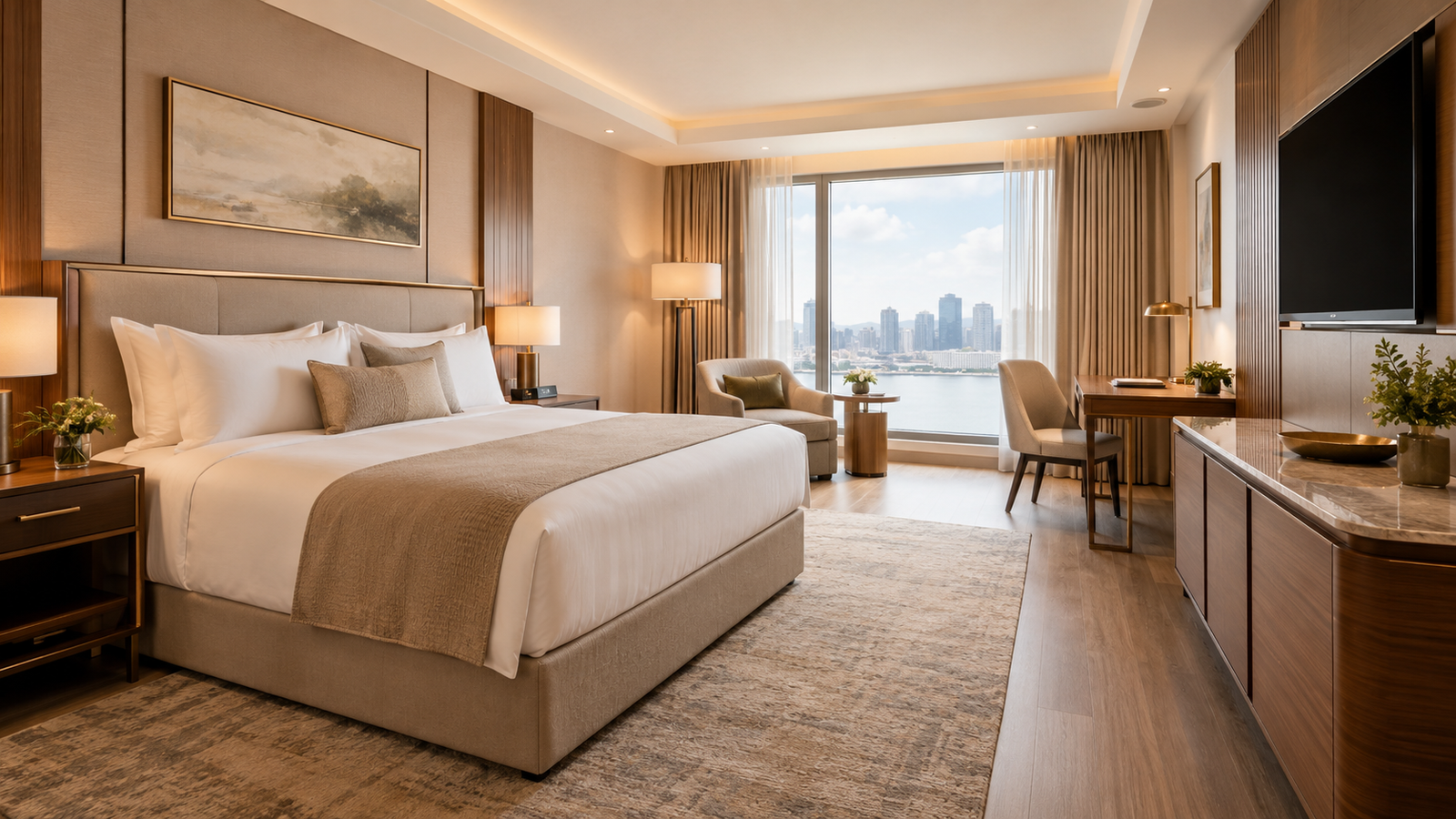
A vertically integrated manufacturer applies consistent quality standards across its entire product range rather than managing outdoor furniture as a separate, lower-priority category. At YM Furniture (Foshan Yauming Furniture & Construction Co., Ltd.), the same ISO-certified production standards and documented QC processes that govern indoor FF&E programs apply to outdoor furniture collections. Buyers sourcing both guestroom furniture and outdoor pool terrace furniture from a single manufacturer get consistent quality control documentation, coordinated lead times, and a single point of accountability through delivery.
YM Furniture reports 17+ years of manufacturing experience, 1,000+ completed projects across 30+ countries, and a 70,000 square meter factory, a scale and track record that positions the company to handle hospitality outdoor programs at the volume and quality level that four- and five-star properties require. The contrast with a standard export trading company or a small-scale wicker factory is material, particularly when the project involves multiple FF&E categories, a model room process, or a phased delivery schedule across a development timeline.
Project coordination for hotels, villas, and resort developments
Full project coordination at the manufacturer level means the buyer isn’t managing the supply chain alone. Design consultation, material specification support, custom sample or mock-up production for client approval, production QC checkpoints at defined manufacturing stages, export documentation, and delivery coordination for large-scale projects are all part of what a capable hospitality furniture manufacturer brings to the relationship. For developers managing a resort build or a villa community furnishing program, this level of coordination directly reduces project management overhead and risk on the buyer’s side.
The alternative is managing each of these steps through separate vendors, separate communications chains, and separate accountability structures. For a 200-room resort with both interior FF&E and extensive outdoor furniture requirements, consolidating those programs with one vertically integrated manufacturer is a meaningful operational advantage, not just a procurement convenience.
Questions to Ask Before Placing Your First Outdoor Furniture Order
Qualifying the factory on capacity, MOQ, and flexibility
Start with direct operational questions. What is the actual monthly production capacity for this specific product category? Is the stated MOQ for a production order or a platform listing? What is the realistic lead time if the order is placed today, accounting for current production commitments? Are the specified materials in stock or sourced separately after order confirmation? These questions separate factories that are ready to produce from those still quoting aspirationally or from inventory they don’t hold.
Vague answers or significant hesitation on capacity and lead times are informative. A factory running active production for commercial clients knows its capacity numbers, its current queue, and its material inventory status. A trading company, or a factory that’s newer to commercial-scale orders than their marketing suggests, often doesn’t have clear answers to these operational questions.
Quality control rights and inspection protocol
Confirm upfront that you have the right to hire a third-party inspector, specifically SGS, Bureau Veritas, or an equivalent accredited firm, to conduct a pre-shipment inspection. A reputable factory will cooperate fully. Resistance to third-party inspection, especially from a first-time supplier relationship, is a significant red flag. Confirm that the golden sample is retained by the factory and referenced by QC staff throughout the bulk production run, not just at the start.
Ask for documentation of the QC checkpoints built into the production process: in-process inspection at frame completion, at finishing, at upholstery assembly, and at final packing. Factories with serious commercial hospitality clients have this documented because their clients required it. If the supplier can’t describe their inspection process with any specificity, you’re looking at a gap that will eventually surface in a shipment.
Payment terms, deposit structures, and what’s standard
The standard payment structure for custom outdoor furniture orders from China is 30% deposit at order confirmation and 70% balance before shipment, typically after pre-shipment inspection clearance. Letter of credit arrangements may be available for larger orders with established factory relationships, and they add a layer of payment protection worth exploring on high-value programs. Full upfront payment on a first order from an unverified supplier is not a standard term. It is a serious red flag, regardless of how the request is framed.
Get all payment terms, deposit amounts, and balance timing in writing in the purchase contract before any payment is made. Confirm the bank account beneficiary name matches the business license exactly. Document the currency, the SWIFT details, and the payment schedule tied to specific production milestones. These aren’t bureaucratic details. They’re the contractual structure that protects your order and your project timeline.
Frequently Asked Questions
What is the minimum order quantity for outdoor furniture from China?
It depends on the material. PE rattan and wicker typically start at 10 to 100+ units per SKU, aluminum programs usually require around 200 units per design for standard production, and teak carries a lower MOQ of around 20 to 50 sets due to different tooling economics.
How long does it take to import outdoor furniture from a Chinese manufacturer?
Made-to-order rattan furniture typically ships in 15 to 45 days. Aluminum runs 30 to 45 days for stock designs or 60 to 90 days for fully custom programs. Teak generally takes 30 to 90 days depending on customization and current wood inventory.
How can I tell if a supplier is a real factory or a trading company?
Request a live, real-time video walkthrough of the production floor rather than a promotional video, and compare what you see against their stated production capacity. Vague answers on material sourcing, inconsistent lead times across product categories, and resistance to third-party inspection are common signs of an intermediary rather than a direct manufacturer.
Is FSC-certified teak worth the premium for hospitality projects?
For luxury resorts and high-end villas where longevity and aesthetics justify the cost, yes. For hotel pool decks or high-traffic terraces with shorter replacement cycles, aluminum and HDPE rattan combinations typically deliver better ROI. Always verify the FSC certificate number in the public database rather than accepting a supplier’s claim.
What payment terms are standard for custom outdoor furniture orders from China?
The standard structure is 30% deposit at order confirmation and 70% balance before shipment, typically after pre-shipment inspection clearance. Full upfront payment on a first order from an unverified supplier is not standard practice and should be treated as a red flag.
Putting It All Together Before You Commit
You now have a practical framework for evaluating outdoor furniture manufacturers in China before making a commitment. The core actions are straightforward in sequence: shortlist factories by manufacturing cluster and integration level, request the full certification and documentation package, verify with a live factory audit or a commissioned third-party inspection, build a complete landed cost calculation rather than comparing FOB prices in isolation, and treat the sample approval process as your binding production contract. Each step removes a category of risk that otherwise shows up after money has been spent.
Sourcing outdoor furniture from China is a viable, cost-effective strategy for hospitality developers, resort operators, and residential project teams when executed with the right factory and the right vetting process. The cost advantages are real. The production scale across China’s outdoor furniture manufacturing clusters is real. And the customization capability at established manufacturers is genuinely competitive. The risks are also real, but they’re manageable risks when you know what to look for and what to ask.
If you’re sourcing outdoor furniture for a hotel development, resort program, villa community, or large-scale commercial project, YM Furniture (Foshan Yauming Furniture & Construction Co., Ltd.) is built to support the full scope: hospitality-grade production standards, custom outdoor furniture manufacturing programs, project coordination from specification through delivery, and factory-direct pricing that reflects actual manufacturing costs. Reach out with your project brief and let the conversation start from there.