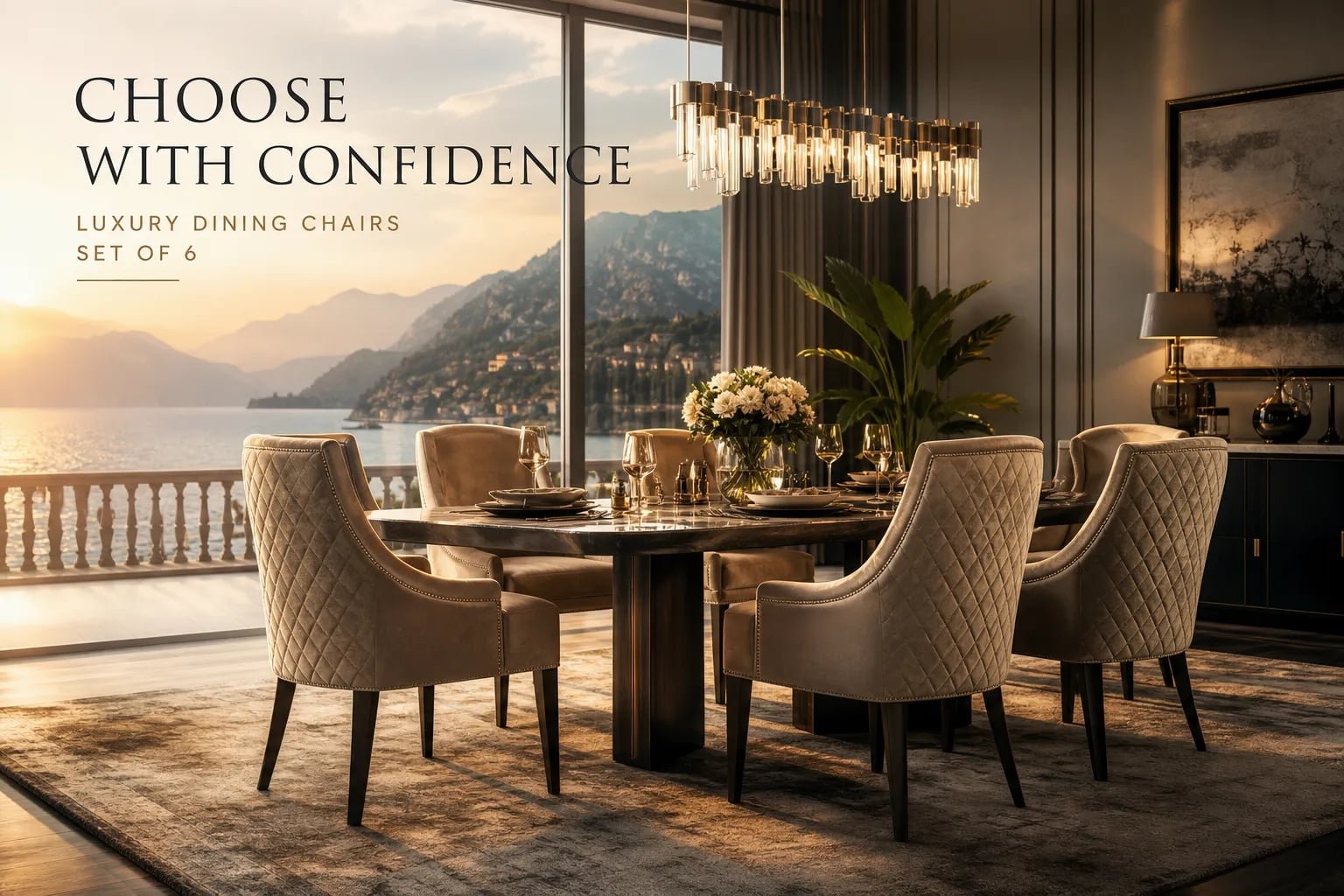
The dining table anchors a luxury room, but the chairs are what your guests actually touch, settle into, and remember hours after the meal ends. Anyone furnishing a premium residence knows that selecting a luxury dining chairs set of 6 gets more scrutiny than almost any other furniture decision in the room: it involves aesthetics, ergonomics, material performance, and the way six individual pieces read as a single cohesive unit at once. It requires dimensional precision, honest material evaluation, and an understanding of how construction quality separates a chair that holds up for a decade from one that starts wobbling within a year.
At YM Furniture, we produce custom dining furniture for luxury villa developments, five-star hotel projects, and premium residences across more than 30 countries. That production experience gives this guide a trade-level perspective that most retail buying guides don’t carry. Whether you’re furnishing a single villa dining room or specifying dining chairs across 20 residential units, the decision framework is the same. Get the fundamentals right, and the result holds up in daily use, in property photography, and in the judgment of every guest who pulls a chair out and sits down.
This guide walks you through every variable that matters: table compatibility, upholstery selection, frame construction, design cohesion, price tiers, and procurement. By the end, you’ll know exactly what to look for, what to avoid, and how to source smartly at any scale.
Why the dining chair set carries the most design weight in a luxury room
The dining room as the most-used formal space in a villa
Unlike a formal sitting room that sees occasional use, the dining space in a luxury villa is where real life happens: family dinners, long entertaining evenings, business meals, and celebrations. Chairs that look impressive but feel mediocre will be noticed within the first course of the first meal. This is the critical point many buyers miss when they prioritize visual appeal over seated comfort, the dining room is tested daily in ways that a formal living room simply isn’t.
Aesthetics and function carry equal weight in this decision. A chair that photographs beautifully but lacks proper lumbar support or adequate seat depth will generate complaints from guests and family members alike. Set your expectations accordingly before you start evaluating options.
Why a set of six creates unique cohesion challenges
Six chairs arranged around a dining table create a repetitive visual pattern that magnifies any inconsistency. A slight variation in seat height across chairs, a fabric shading difference between two units, or a finish that doesn’t match uniformly across the set becomes immediately obvious when all six pieces are in view at once. This is fundamentally different from buying a single accent chair, where minor variation reads as character rather than defect.
A well-selected 6-seat dining chair arrangement creates symmetry and visual flow. A poorly selected one introduces visual noise that no amount of table styling can fix. The goal is choosing a set where every unit reads as intentional and consistent, not just technically matching by product code.
The impact on property value and first impressions
High-end dining furniture plays a specific role in how premium properties are perceived and valued. In staged property photography, the dining room is widely regarded among interior designers and property stylists as one of the spaces that most directly shapes perceived quality in listing images. In villa rental programs, dining chair quality can influence guest satisfaction and the premium pricing a property can sustain. The return on a well-chosen premium dining chair set tends to be disproportionate to its share of the total furniture budget.
How to match your luxury dining chairs set of 6 to your dining table
The 10-to-12 inch clearance rule and why it matters
Standard dining chair seat heights run 17 to 19 inches from the floor. The target legroom gap between the seat top and the underside of the tabletop is 10 to 12 inches. Apply that formula to your table: a 30-inch dining table pairs well with an 18-inch seat height, leaving a comfortable 12-inch clearance. A 28-inch table works with a 17 to 18-inch seat. A 36-inch counter-height surface requires a seat in the 24 to 26-inch range. Getting this measurement wrong is one of the most common and most frustrating purchasing mistakes in dining furniture, one that no amount of visual appeal can compensate for.
Before evaluating any chair, measure your table height from the floor to the underside of the tabletop, not the top surface. That single number determines your viable seat-height range before any other variable enters the conversation. Skipping it is the fastest route to an expensive return.
Chair width, table length, and seating six comfortably
Each person at a dining table needs roughly 24 to 26 inches of table-edge space to sit without bumping elbows into their neighbor, a standard referenced across major space-planning guidelines. For a 6-piece dining chair set arranged around a rectangular or oval table, that math sets the minimum table length you need. Two chairs at each long side require at least 48 to 52 inches of table length per side, which means a table shorter than 72 inches will feel cramped with six adult-sized chairs and standard-width seats. Chair seat width typically runs 16 to 20 inches, but overall chair width including any side structure can be wider, and that’s the number that determines actual spacing.
Check overall chair width, not just seat width, against your available table perimeter before ordering. This step gets skipped constantly in online purchasing and accounts for a significant share of post-delivery disappointment.
Armchairs vs. side chairs: when to mix and when to match
Many upholstered dining chair sets of six include two armchairs at the table heads and four armless side chairs along the long sides. This configuration exists for practical reasons: armchairs at the table ends sit comfortably without interference from the table apron, while armless side chairs allow closer spacing and easier movement in and out of the seat. For rectangular tables in formal villa dining rooms, this mixed configuration adds visual hierarchy and works well ergonomically.
Round or square tables have no defined head position, so a uniform set of six armless chairs typically works better. Mixed-chair configurations on round tables can look unresolved unless the armchair placement is clearly intentional. Match the configuration to the table shape before you decide whether to mix or match.
Upholstery choices for a luxury dining chairs set of 6
Velvet and bouclé: high-drama materials with specific trade-offs
Velvet dining chair sets deliver the deepest color saturation and the most tactile sense of luxury of any upholstery material available. Standard velvet, however, flattens at pressure points over time and attracts pet hair and lint at a level that requires consistent maintenance. Performance velvet changes the equation substantially. Engineered from synthetic fibers such as polyester or nylon, it typically achieves 30,000 to 100,000+ double rubs of abrasion resistance on the Wyzenbeek scale, well above the 15,000 to 25,000 range common for standard velvet, and it repels moisture rather than absorbing it. Standard velvet typically rates at the lower end of that scale and absorbs spills rather than shedding them. For dining use, performance velvet is the version worth specifying.
Bouclé offers a softer, more contemporary luxury look, but its looped texture traps crumbs and requires more attentive maintenance than any smooth-surface material. Both velvet and bouclé are statement choices best suited to dining rooms whose primary function is formal entertaining rather than daily family meals with children present.
Leather and faux leather: the practical luxury choice
Full-grain and top-grain leather remain the easiest upholstery materials to wipe down after meals. They age well, develop character over time, and read as classic and formal in premium dining rooms. Faux leather (PU or PVC) offers easy cleaning at a lower initial cost but can crack or peel within a few years on lower-quality chairs, particularly at seating pressure points. For villa dining rooms that see regular use from guests or tenants, genuine leather is the more honest long-term investment despite the higher upfront cost.
The practical test is simple: if the dining room will be used daily or will serve guests on a rental program, leather wins on maintenance and longevity. If the room is primarily for special occasions and visual impact is the priority, performance velvet delivers a richer aesthetic result.
Performance fabrics and what “contract grade” actually means
Performance woven fabrics are the go-to specification for luxury residential projects where durability cannot be compromised. “Contract grade” is an upholstery designation indicating the fabric has been engineered to meet commercial-use durability standards, typically 30,000 double rubs or higher, along with resistance to fading, staining, and repeated cleaning. Villa developers and property managers increasingly specify contract-grade upholstery for dining chairs in properties that will serve tenants or guests rather than owners exclusively. The fabric costs more at the specification level but significantly extends the maintenance cycle and reduces replacement frequency.
Frame materials and construction quality worth paying for
Solid hardwood vs. engineered wood vs. metal frames
Solid hardwood frames in oak, beech, or rubberwood are the standard for high-end dining chairs because of their strength, repairability, and ability to hold upholstery fasteners reliably over decades. Engineered wood frames reduce manufacturing cost but can delaminate under stress and don’t hold fasteners as securely over time. Metal frames offer a clean modern aesthetic and strong structural durability, though welding quality varies significantly between manufacturers, and a poorly welded joint is not repairable in the field. Based on our manufacturing experience across 1,000+ furniture projects, frame material is where the most meaningful cost difference between price tiers actually lives, even when two chairs look nearly identical at the surface level.
Joinery and cushion construction as quality signals
Mortise-and-tenon joinery at the leg-to-rail connections, particularly when drawbored or pegged with a hardwood pin, is the clearest indicator of a frame built for longevity. Corner blocks glued and screwed into the inside corners add racking resistance and help the chair remain square under the lateral forces of daily use. High-density foam in the seat cushion, along with quality webbing or pocketed spring support where specified, indicates a chair built for sustained comfort rather than display-only use. Eight-way hand-tied spring systems, while a recognized quality indicator in upholstered sofas, are less common in dining chair construction; seat support in dining chairs is more reliably evaluated through foam density ratings and webbing specifications.
When evaluating high-end dining chairs, ask manufacturers for joinery and cushion density specifications directly. Retailers rarely volunteer this information, and the difference between a chair that lasts 15 years and one that starts wobbling after 18 months almost always comes down to these details. Request documented load-capacity test results, many quality manufacturers test to 250 lb or higher per seat in accordance with BIFMA or equivalent standards, rather than relying on uncertified weight-capacity claims.
Weight capacity and long-term stability under daily use
Chairs that wobble after one year of use almost always have inadequate joinery or seat foam that has compressed unevenly because it was under-specified at the outset. Low-density foam feels acceptable in a showroom but compresses permanently within months under daily seating. Ask for the foam density specification, measured in pounds per cubic foot, and confirm the joinery type before committing. These two questions alone will separate quality manufacturing from decorative-grade furniture that can’t sustain daily dining room use.
Design cohesion across a luxury villa dining space
Aligning chair finish, fabric color, and table material
Design cohesion doesn’t mean matching every element to the same tone. It means creating a finish relationship that feels intentional and considered. A walnut dining table pairs beautifully with chairs in warm cream, sage green, or cognac leather. An all-white lacquered table benefits from contrast through darker velvet or natural linen upholstery. The chair finish should relate to the flooring and wall color as much as it relates to the table, because the chair is the visual connector between the table surface above and the floor plane below.
Work with your full finish schedule before selecting chair fabric. Pin down the flooring material and wall finish first, then evaluate chair options against the complete room palette rather than against the table alone.
Contemporary, transitional, and classic chair profiles for villa dining rooms
Each architectural style of villa dining room calls for a different chair silhouette. Contemporary spaces favor clean lines, low-profile backs, and monochromatic upholstery with minimal surface ornamentation. Transitional rooms allow more decorative detail, curved backs, and mixed material combinations of wood and upholstery. Classic or traditional villas call for button tufting, carved legs, and rich fabric choices in jewel tones or warm neutrals.
Identify your room’s architectural language before specifying a designer dining chairs set. The most common mistake at this stage is choosing a chair silhouette from a different stylistic register than the room, which creates a visual tension that reads as unresolved rather than eclectic. A Chesterfield-tufted chair in a minimalist contemporary dining room isn’t a bold design choice, it’s a mismatch.
When to mix armchairs and side chairs within a single set
In formal villa dining rooms, two upholstered armchairs at the table heads add hierarchy and visual anchoring that a uniform set of six armless side chairs cannot replicate. The armchair positions signal intentional seating designation and add a layer of formality consistent with luxury residential entertaining. In casual or family-oriented dining spaces, a uniform set of six side chairs creates a cleaner, more relaxed visual rhythm. The choice between these approaches should follow the room’s intended use and social register, not personal preference alone.
Understanding price tiers in the luxury 6-chair dining market
Entry luxury to true luxury: where the quality break happens
The dining chair market segments into clear tiers. Sets priced at $500 to $1,500 for six offer upholstered frames and reasonable material quality at accessible retail price points. The quality break into true luxury happens between $1,500 and $3,000, where solid hardwood frames, performance-grade upholstery, and more refined manufacturing tolerances become standard. Above $3,000, buyers are paying for designer provenance, bespoke customization, or exceptional materials such as full-grain leather or hand-applied lacquer finishes. Understanding where these breaks occur helps you evaluate what you’re actually getting at each price point rather than relying on marketing language.
Cost-per-chair as the more honest metric
Break the set price down to per-chair cost for a clearer mental anchor. A $2,400 set of six works out to $400 per chair, a useful number to evaluate against materials, frame quality, and expected lifespan. A $400-per-chair dining seat built on a solid oak frame with performance fabric and proper mortise-and-tenon joinery represents strong value. The same price point on an engineered wood frame with standard polyester upholstery and butt-joint construction does not. The per-chair number forces an honest conversation about what you’re actually buying.
What drives pricing up and what signals poor value at a high price
Legitimate cost drivers in luxury dining chairs include hardwood species, upholstery grade and abrasion rating, cushion construction, hand-finishing and applied lacquer, and the country of manufacture. Poor value at a high price looks different: overly decorative surface details that mask low-quality joinery underneath, brand markup without substantive manufacturing quality, and thin seat foam beneath premium fabric that compresses within months. A chair should justify its price through construction quality, not through how much ornamentation has been applied to the surface.
What villa developers and multi-unit projects need from a dining chair supplier
Why retail works for one home and fails for twenty
Retail furniture sources work well for individual homeowners buying a single set. Developers furnishing 10, 20, or 50 luxury villa units encounter a different reality entirely. Stock availability is inconsistent across production runs, meaning finish and fabric shading can vary visibly between units. Delivery scheduling is unpredictable and rarely aligns with construction timelines. Retail pricing at scale doesn’t reflect the volume a villa development actually represents.
The visible result of retail sourcing at project scale is dining chair sets that look slightly different across units, creating inconsistency that sophisticated buyers and guests notice immediately. For branded villa developments or luxury rental portfolios, that inconsistency carries real commercial consequences.
Custom manufacturing partners and what factory-direct really means
Working with a custom furniture manufacturer changes both the economics and the quality outcome for multi-unit villa projects. A factory-direct manufacturer produces each batch of dining chairs to a single approved specification, ensuring the same frame tolerances, upholstery shading, and finish quality across every unit in the project. At YM Furniture, our team has completed over 1,000 hospitality and residential furniture projects across more than 30 countries, with 17+ years of experience producing custom dining furniture for luxury villa developments, five-star hotels, and branded residences. Factory-direct pricing removes the retail markup layer entirely, which can reduce FF&E furnishing costs significantly on large-scale orders while maintaining the material and construction standards a luxury project requires.
When ordering a luxury dining chairs set of 6 at project scale, MOQs from Chinese manufacturers typically range from 20 to 100 sets per design for custom fabric or finish variations, the exact threshold depending on factory size, customization complexity, and order timing. Standard production lead times generally run 35 to 45 days for project-grade furniture, with 60 to 90 days total once pre-shipment inspection and ocean freight are factored in. These timelines are manageable when procurement planning starts early in the project schedule, which is standard practice for well-run villa developments.
Consistency, MOQ, and the mock-up room process for developers
The procurement process for custom dining chair sets at project scale follows a clear sequence: sample chair approval against the specification, material sign-off from the design team, mock-up room setup for developer or ownership review, and bulk production with factory-level quality control before shipping. This process exists specifically to catch any issues before 50 sets are in production, not after they’ve arrived on site.
YM Furniture’s fast-track mock-up room capability means developers can review and approve a complete furnished dining room setup before committing to bulk production. This process-driven approach resolves consistency problems at the source, rather than after delivery. Reach out to our project team to discuss your unit count, specification requirements, and timeline, and we’ll walk you through what factory-direct procurement looks like for your specific development.
Care, cleaning, and long-term maintenance by material
Fabric-specific cleaning routines that protect your investment
Velvet and bouclé require gentle vacuuming with a soft brush attachment and immediate blotting of spills, never rubbing. Rubbing a spill into velvet pushes it deeper into the pile and spreads the stain. Leather benefits from periodic conditioning with a leather-specific product to prevent drying and surface cracking, particularly in climate-controlled environments where air conditioning removes moisture from both the room and the furniture. Performance fabrics can handle water-based cleaning and mild soap solutions, which is part of what makes them the practical specification choice for high-use dining rooms. Match your cleaning routine to your upholstery material from the first day of use.
Wood frame and leg maintenance
Solid wood legs and frames benefit from occasional waxing or oil treatment, particularly in villa environments with strong air conditioning that can dry out wood over time. The appropriate product varies by finish: lacquered frames typically need only a dry wipe and periodic polish, while oiled or waxed frames benefit from a light re-oiling annually. Check the joinery each year for any loosening at the leg-to-rail connections and address it promptly. A loose joint is an easy fix in its early stages and a costly structural failure if left unattended through a full rental season.
Protecting premium dining chairs from daily wear patterns
Felt pads under chair legs protect hardwood and stone flooring and also prevent the minor rocking that accelerates joint wear. Rotating seat cushions periodically extends fabric life evenly across the full set. Velvet dining chair sets in luxury villa dining rooms benefit from periodic professional cleaning and brush-out to keep the pile upright and maintain color depth. These small habits collectively extend the usable life of a premium dining chair set by years, preserving the investment through multiple rental seasons or resale cycles.
Mistakes to avoid before you commit to a set
Skipping the dimension check before ordering
The most expensive mistake buyers make is ordering without measuring. Seat height mismatches with the dining table create immediate ergonomic problems that no amount of visual appeal compensates for. Measure your table height, calculate the clearance to the floor, confirm the available floor width per chair position around the table perimeter, and verify the chair’s overall dimensions, not just seat dimensions, before placing any order. These measurements take 10 minutes. The consequences of skipping them can take months to resolve.
Choosing visual impact over material durability
A velvet dining chair set may photograph beautifully in a showroom and still be the wrong specification for a villa dining room that hosts young children, frequent guests, or an active rental program. The mood board version of a furniture decision and the real-use version of that same decision are often different. Match material selection to the actual use frequency and maintenance capacity of the specific property, not to the visual reference you fell in love with during the design phase.
Buying online without verifying construction specifications
Online dining chair purchases carry real risks: delivery damage, assembly issues from missing hardware, and product quality that doesn’t match the photography. When buying a premium dining chair set online, request the full specification sheet, confirm the frame material and joinery type explicitly, and verify the return and damage policy before purchase. For multi-unit villa projects, always work from a factory-approved sample chair before placing bulk production orders. The sample approval step is not optional at project scale, it’s the quality checkpoint that protects the entire project budget.
The decision framework that makes this choice straightforward
A well-chosen luxury dining chairs set of 6 is one of the longest-lasting furniture investments in a premium residence. Dining chairs are used daily, seen constantly, and central to every social occasion the home hosts. Begin with dimensional requirements, table height clearance and perimeter spacing, then move to material selection based on actual use frequency and maintenance capacity. From there, align the chair silhouette to the room’s architectural register before evaluating price against construction quality rather than brand name or visual complexity. Applied in that order, the framework removes most of the friction from what can otherwise feel like an overwhelming decision.
Homeowners and interior designers buying a single set will find strong retail options across multiple price tiers, with the real quality break occurring around the $1,500 to $3,000 range for a set of six. Developers furnishing luxury villa projects at scale will get better outcomes, in consistency, cost, and timeline control, through a custom manufacturing partner who delivers uniform quality across every unit, factory-direct pricing that reflects volume, and project-level coordination from design sign-off through final delivery.
If you’re specifying a luxury dining chairs set of 6 for a villa development, a luxury residential project, or a hospitality property, get in touch with our team at YM Furniture. We’re glad to walk through your specifications, discuss sample approval options, and provide a production timeline that fits your project schedule.