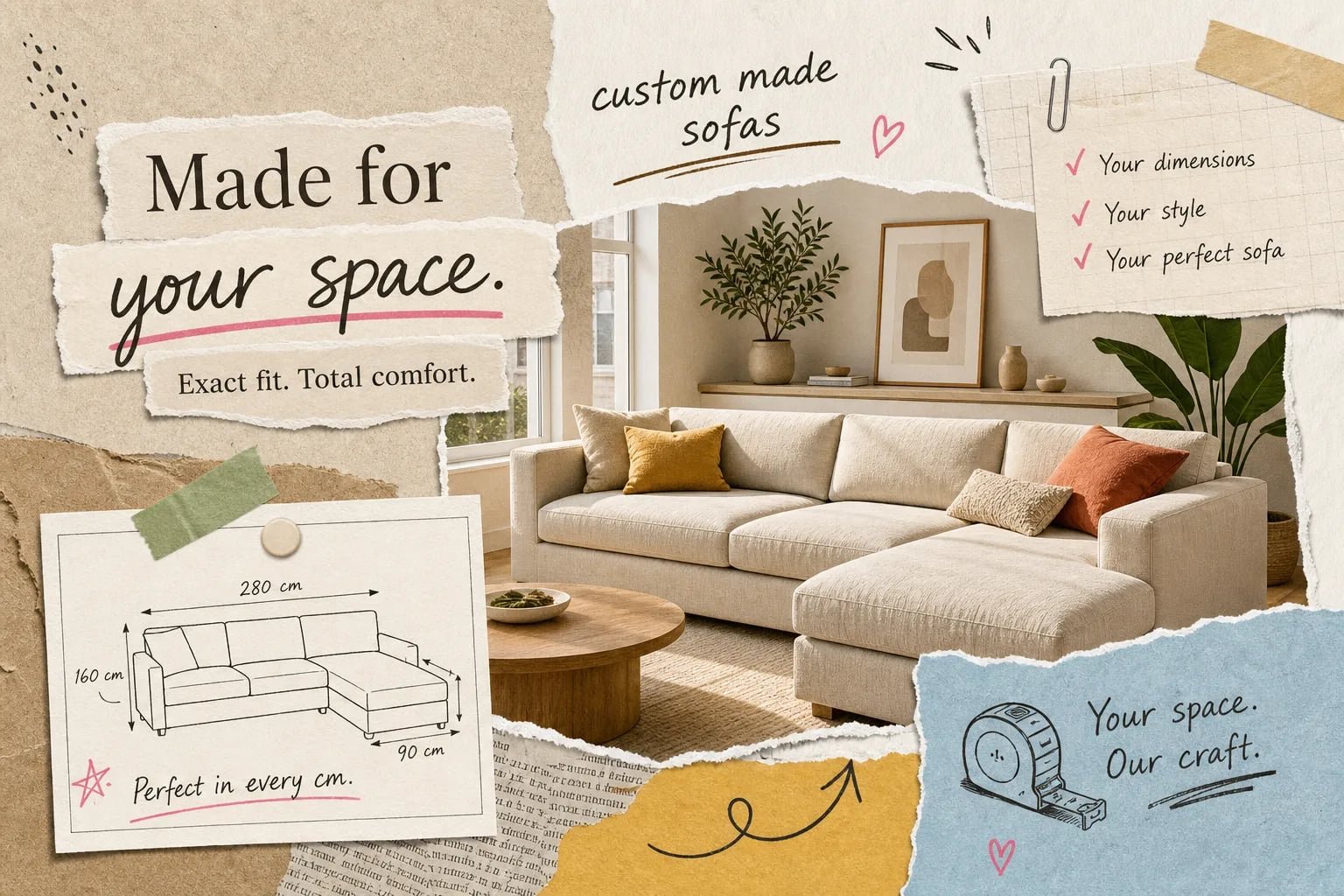
You find the perfect sofa online, fall in love with the silhouette, and then realize it’s 98 inches wide and your living room wall is 84 inches. Or you’re furnishing a boutique hotel lobby where every centimeter of the floor plan is spoken for and standard dimensions simply won’t work. Off-the-shelf sofas are designed for average spaces. If your space isn’t average, you need one of the best companies offering custom made sofas with specific dimensions, builders who work from your measurements, not theirs.
The challenge is that “custom sofa” has become a marketing phrase covering everything from fabric swaps on a preset frame to truly made-to-measure production from a hand-drawn sketch. Knowing which companies actually build bespoke sofas to exact dimensions, what that process looks like, and what it costs is the work this article does for you. You’ll also learn how to prepare your brief, what to expect on lead times and warranties, and when factory-direct manufacturers make more financial sense than a local Canadian workshop.
The market runs from small craft studios in Ontario and BC all the way to large-scale factory-direct manufacturers in China serving multi-property hotel rollouts. The right choice depends entirely on your project size, budget, and timeline. By the end of this article, you’ll have a clear framework for shortlisting the right supplier and the questions to ask before you commit.
What separates a real custom sofa company from a “semi-custom” retailer
Before you reach out to any company, you need to understand what “custom” actually means in the furniture industry. The word is used loosely, and if you don’t know what to look for, you’ll waste time getting quotes from companies that can’t actually do what you need.
The difference between “choose your fabric” and true dimension control
Most retailers calling themselves custom only offer configuration changes and fabric selection from a preset menu. You pick from three seat depths, two arm heights, and a fabric library, then call it custom. A genuinely made-to-measure sofa company does something fundamentally different: it accepts your measurements, builds the frame to those specs, and accommodates non-standard widths, depths, heights, and arm configurations that don’t exist in any catalog.
The test is simple: ask the company whether you can submit your own dimension sheet and have them build from it. If the answer is yes, and they ask for a sketch or specification document, you’re talking to a real custom manufacturer. If they redirect you to preset size options with minor adjustments, you’re looking at a semi-custom retailer. Both have their place, but they serve very different needs. Vendors like Sixtrend, Sofa Studio, and similar dimension-forward builders explicitly accept customer-provided sheets, which is exactly the behavior that distinguishes them from standard retailers.
Precision engineering versus decorative flexibility
True made-to-order sofa production involves CAD drawings, documented tolerances (often expressed in millimeters for precision builds), kiln-dried hardwood frames cut to your dimensions, and production drawings tied to your approved sketch. A company operating at this level will ask you to sign off on a production drawing before any material is cut, a step that protects both parties and signals a professional process.
Decorative flexibility, by contrast, means choosing velvet instead of linen or adding a chaise to the right side instead of the left. That’s useful for residential buyers with standard-sized rooms. It doesn’t help you if your condo living room is 7 feet wide and you need a sofa that’s exactly 74 inches across with a 21-inch seat depth.
Minimum order quantities and who they affect
High-precision manufacturers, especially factory-direct producers, often require minimum order quantities. This structure makes them ideal for commercial projects: hotel renovations, multi-suite residential developments, and office fit-outs. Large Foshan factories operating at high monthly capacity typically set container-level MOQs for fully custom OEM production, making them poorly suited to single-unit residential orders.
Smaller Canadian workshops, on the other hand, typically work on single-unit orders and are well suited for residential buyers or designers specifying one or two statement pieces. Identifying which category your project falls into before you start comparing companies saves a lot of time on both sides.
How to find the best companies offering custom made sofas with specific dimensions
Walking into a conversation with a custom sofa company without a measurement brief is like calling a contractor without a floor plan. The more precise your submission, the faster and more accurate your quote will be. And knowing how to evaluate suppliers, not just what to measure, is what separates a smooth project from an expensive revision cycle.
The six measurements every custom sofa order needs
Every made-to-order sofa specification starts with six core measurements. Rather than listing them as disconnected facts, think of them in two groups: the outer envelope and the comfort zone.
The outer envelope covers overall width (arm to arm), overall depth (front cushion edge to sofa back), and leg height (which sets ground clearance and visual weight). The comfort zone covers seat height (floor to top of seat cushion), seat depth (front cushion edge to back cushion face), and arm height (floor to top of arm).
Leaving any one of these vague forces the manufacturer to make assumptions, and those assumptions introduce revision rounds that push your lead time out by weeks. Submit all six from the start, note which dimensions are fixed and which can flex, and you’ve already given yourself a timeline advantage over buyers who don’t.
Sketching your brief: what to include and what not to overthink
You don’t need a professional drawing. A hand-drawn sketch on graph paper with labeled dimensions works fine for most Canadian custom makers and factory-direct suppliers. Indicate the configuration clearly: straight, L-shaped, curved, armless on one end. Add a front view and a side view, each with labeled dimensions. Most manufacturers also accept photos of inspiration pieces alongside your sketch, which helps communicate style intent beyond the numbers alone.
Don’t overthink it. The goal is to give the manufacturer enough information to produce an accurate quote and a production drawing. They’ll refine the details with you during consultation. What they need upfront is the basic shape, the critical dimensions, and any non-negotiable constraints like maximum width or minimum seat depth.
Common measuring mistakes that delay production
The most frequent error buyers make is measuring the room space rather than the sofa itself. Your room might be 90 inches wide, but you also need clearance for walkways, so the sofa should be 82 inches. Those are two different numbers, and confusing them costs weeks. The second common mistake is forgetting delivery constraints: doorways, hallways, and stairwell widths all need to be checked before production begins, since a sofa built to exact specifications is useless if it can’t get into the room.
A third mistake is not accounting for cushion compression affecting seat depth perception. A 24-inch seat depth in compressed foam feels shorter in use than a 24-inch seat depth in high-density foam. If you’re replicating the feel of an existing sofa, measure both the frame and the cushion, and communicate both to your manufacturer.
Top Canadian companies building sofas to your exact measurements
The Canadian market has a solid group of makers who genuinely accept customer dimensions and build from them. Here’s a practical breakdown of the standout options by region and channel.
Workshop-based makers in Ontario and BC
Ideal Sofa Canada in Mississauga is one of the clearest examples of a true made-to-measure operation. They explicitly accept drawings, photos, and sketches and will build from a customer-provided brief. The workshop model means you’re dealing directly with the people building your sofa, which speeds up communication on revisions. Sofa Studio in Brampton operates its own factory and accepts custom orders by phone consultation, making it a strong option for GTA buyers who want to verify production firsthand.
FLO Furniture builds fully made-to-order pieces in a Canadian workshop, which means no preset frame constraints. In Vancouver, Elite Sofa Designs offers custom furniture built locally, a meaningful advantage for BC buyers who want to visit the facility and approve samples in person. Muse and Merchant, which partners with Stylus, also serves BC-based buyers with a made-to-order collection built specifically to customer dimensions.
National and online-first custom options
The Chesterfield Shop is one of Canada’s more established tailored sofa options, offering dimension adjustments alongside arm style, seat depth, and configuration customization. CouchHaus explicitly positions itself as a made-to-measure option alongside standard sizing, which makes it worth contacting for spaces needing precise fits. Everyroom, Sixtrend, and Furniture Box all advertise dimension customization and are accessible nationally, typically starting the process with an online form or design consultation call.
Online-first companies vary in how deeply they customize. Some accept full customer-provided dimension sheets; others work within adjustment ranges around preset sizes. The right opening question when you contact any of them is: “Can I submit my own dimension sheet and have you build from it?” The answer tells you immediately whether you’re dealing with a true custom builder or a semi-custom retailer.
What most Canadian makers have in common
Across the Canadian custom sofa market, a few patterns hold consistently. Most workshops operate on 8, 12 week production timelines from design approval, a timeframe supported by standard industry practice across domestic upholstery shops. Many work on single-unit orders, which is a genuine advantage for residential buyers. Most makers use a deposit-before-production model, where the deposit triggers the start of the production drawing and material sourcing. Most also offer either an in-person or virtual design consultation before any money changes hands.
The factory-direct option for commercial and bulk custom orders
Canadian workshops are excellent for residential buyers and small commercial projects. For large-scale hospitality or development projects, the economics shift dramatically, and factory-direct sourcing from a specialized manufacturer becomes the more logical choice.
When Canadian workshops aren’t built for scale
A boutique workshop that produces beautiful single-unit sofas is not equipped to deliver 50 matching sofas for a hotel renovation on a construction schedule. Per-unit pricing at Canadian retail scale, combined with limited capacity for simultaneous production runs, makes it difficult to furnish an entire property from a single domestic source without straining the FF&E budget. For hotel developers and property managers running multi-room rollouts, the math points in a different direction.
YM Furniture: factory-direct custom sofa production for hospitality projects
YM Furniture (Foshan Yauming Furniture & Construction Co., Ltd.) is a factory-direct manufacturer with 17 years of experience producing custom sofas and seating for 4- and 5-star hotel projects across more than 30 countries. Their client list includes Marriott, Sheraton, and Pullman, the kind of reference point that matters to procurement teams doing due diligence. They operate from a 70,000 square meter manufacturing facility with over 100 precision machines, providing the capacity to run large parallel production orders while maintaining consistency across units.
The ordering process is designed for commercial accuracy. You submit your dimensions and design brief, receive a production drawing for sign-off before any cutting starts, then approve a model room piece delivered within 20 days. That physical prototype eliminates multiple revision rounds and confirms the spec is correct before full production begins. Factory-direct pricing delivers up to 70% savings compared to Western suppliers at equivalent quality levels, figures supported by the company’s ISO 9001, ISO 14001, and ISO 45001 certifications and its established export track record.
If you’re specifying sofas for a hotel renovation, furnishing 50 or more suites for a residential development, or managing a multi-property procurement rollout, get in touch with the YM Furniture team to discuss your project brief and timeline.
Who this option actually makes sense for
Factory-direct sourcing from a manufacturer like YM Furniture suits interior designers specifying sofas for full hotel renovations, property developers furnishing dozens of branded residences, and hospitality procurement managers handling multi-property contracts. It is not the right call for a homeowner who needs one sofa for a condo living room, single-unit residential buyers are better served by the Canadian workshop options listed above. Matching the supplier to the project scale is the most important sourcing decision you’ll make.
What custom sofas actually cost in Canada by size
Price ranges for custom sofas in Canada vary widely based on size, construction, and configuration. Here are realistic benchmarks to use when budgeting.
Price ranges by sofa category
Two-seaters from Canadian custom makers typically start around $1,500, $2,000 for straightforward builds. Standard three-seaters fall in the $2,000, $3,500 range, with examples from established Canadian makers listed at $2,129 to $2,699. Larger sectionals and modular configurations start around $3,500 and run to $6,000 or higher for complex layouts. Premium custom builds with high-grade fabric, down-blend fills, and specialty construction can reach $9,000 or more for larger pieces.
The main cost drivers are fabric grade, cushion fill quality, frame construction, and configuration complexity. A non-standard frame dimension adds cost because it requires custom cutting rather than running a preset frame template. High-grade performance fabric and down-blend cushion fills also add meaningfully to the final price.
What drives the price up and what doesn’t
Non-standard frame construction, performance fabric upgrades, down-blend cushion fills, and modular reconfiguration all add real cost to a custom sofa build. These are worth paying for when they serve a specific functional need: performance fabric for a household with pets, down-blend for a luxury residential project where comfort is the primary spec, modular configuration for a space that changes use over time.
Lower-impact changes typically include leg material, arm style, and cushion arrangement on a standard frame, these affect the look without significantly affecting the price in most cases. Note that exotic leg materials or complex arm constructions can be exceptions. If you’re working within a tight budget, prioritize your non-negotiables (frame dimensions, cushion fill for your use case) and stay flexible on the decorative elements.
Factory-direct pricing versus Canadian retail for commercial volumes
At Canadian retail custom pricing, furnishing 50 matching hotel sofas could easily reach $150,000, $200,000 before delivery costs. Factory-direct production at commercial volumes changes the entire project budget, leaving room for higher-grade fabric or finish upgrades without exceeding the FF&E allocation. For a 200-room hotel renovation, that difference isn’t a rounding error, it’s the kind of saving that determines project feasibility.
Customization options worth paying for
Not every upgrade on a custom sofa spec sheet is equally valuable. Here’s how to prioritize the decisions that actually affect performance and longevity.
Frame construction: what actually matters
Kiln-dried hardwood is the benchmark for sofa frame construction. Kiln drying removes moisture from the timber, which prevents warping and joint failure over time. Ask specifically about joinery: corner blocks, dowels, and glued joints all contribute to a frame that holds its shape after years of use. A sofa advertised as having a “solid wood” frame may still use softwood or engineered wood in secondary areas, so get specifics on the timber species and where it’s used in the frame structure.
Frame construction is the one area where you should not compromise on a commercial project. In a hotel guestroom, sofas take more wear than residential pieces. A frame that fails at year three creates replacement costs that dwarf the original savings on a cheaper build.
Seat depth, cushion fill, and firmness
Seat depth is the most impactful dimension for comfort, and it’s also one of the most commonly underspecified. A seat depth of 20 inches is upright and formal; 24 inches is relaxed and lounge-oriented. Know what posture you’re designing for before you lock in that measurement. The standard range for most custom Canadian sofas runs from about 20 to 24 inches, and most makers can accommodate measurements within and slightly outside that range.
For cushion fill, high-density foam outperforms down-blend in commercial settings because it holds its shape longer under heavy use. Down-blend cushions feel luxurious but degrade faster and require regular maintenance. For residential luxury projects where comfort is the primary goal and maintenance is manageable, down-blend is worth the upgrade. For hospitality projects running at high occupancy, high-density foam is the more practical specification.
Fabric grades and what the tiers actually mean
Most custom sofa companies use a fabric grading system from Grade A through Grade E or similar. What moves a fabric up a grade is its double-rub count (a measure of abrasion resistance), stain resistance, cleanability, and fiber content. A Grade A fabric might have a double-rub rating of 15,000; a Grade D performance fabric might rate at 100,000 or more. For commercial or hospitality applications, performance fabrics at the higher grades are worth the price premium because they dramatically extend the replacement cycle.
Always request a physical swatch before confirming your fabric choice. Colors and textures render differently on screens, and approving a fabric from a photo is one of the most common sources of after-delivery disappointment in custom sofa orders.
Lead times: what’s realistic and what causes delays
Lead time expectations for custom sofas vary significantly by order type and complexity. Setting accurate expectations at the start of a project prevents schedule conflicts later.
Standard production windows by order type
For Canadian made-to-order sofas, 8, 12 weeks is the standard production window after design approval. Smaller, lightly customized local builds can sometimes be completed in 2, 8 weeks, but heavily configured orders or large sectionals typically push past 12 weeks. One critical clarification: lead time starts after design approval, not after your initial inquiry. The consultation and brief review process happens before the clock starts, and that can add 1, 3 weeks to the overall timeline.
What adds weeks to your timeline
Multiple revision rounds on the design brief are the single biggest delay trigger. Incomplete dimension specifications, vague fabric selections, and back-and-forth on configuration changes all extend the pre-production phase before the official lead time even starts. Fabric out-of-stock situations are another common delay; if your chosen fabric is on backorder, production waits. Production backlog during peak renovation seasons, particularly late summer and early fall in many Canadian markets, can also add weeks to already-quoted timelines.
The most effective timeline protection is submitting a complete brief on first contact: all six core dimensions, a clear sketch, your fabric grade preference, your cushion fill choice, and your delivery deadline. A manufacturer working from a complete brief can produce an accurate production drawing and lock in materials immediately, protecting your schedule from the start.
Factory-direct timelines for commercial projects
Factory-direct manufacturers operate differently for bulk orders. YM Furniture’s 20-day model room delivery gives commercial buyers a physical prototype for approval before full production begins. That step, while it adds time upfront, typically replaces multiple revision rounds and catches specification errors before they’re replicated across 50 or 100 units. For a hotel project, the model room approval stage often results in a faster overall timeline than managing iterative revisions with a smaller workshop, because the spec is locked before production scales.
Warranties and return policies for made-to-order sofas
Custom sofas carry a fundamentally different after-sale relationship than stocked furniture. Understanding this before you sign anything protects you from expensive surprises.
What standard warranty coverage looks like in Canada
Frame warranties from Canadian custom makers vary considerably. A 1-year general warranty is common on entry-level builds; 3, 5 years is a stronger offer; 10 years or lifetime on the frame is a premium commitment. Foam, fabric, seams, and mechanisms carry shorter coverage, usually 1, 3 years. Most warranties cover manufacturing defects under normal residential use only, and most are non-transferable to secondary owners, which matters for developers planning to sell properties.
The return policy reality for custom sofas
Most made-to-order sofas are final sale once production begins. This is a firm industry standard, not an unusual policy: a sofa built to your specific dimensions can’t be resold to another buyer. Some retailers allow returns for defective items within 7 days of delivery; others have a 30-day window but explicitly exclude custom pieces from refund eligibility. Understand the return terms before you place your deposit.
A strong warranty offer includes frame coverage of 5 years or more, at least 1, 2 years on foam and fabric, a clear repair or replacement process for defective items, and a stated claims timeline. A baseline offer is 1 year on everything with repair-only remedies. Know the difference before you sign.
Questions about warranty before you sign
Get these answers in writing before production starts. Specifically, you want to know what is covered, for how long, and whether the remedy is repair or replacement. Ask whether the warranty transfers if the property is sold, for developers selling furnished units or hospitality buyers handing over a managed property, this is a material question. Find out whether replacement parts are available if a mechanism or cushion fails, or whether the remedy is repair-only. And confirm whether incorrect self-assembly voids coverage, since some manufacturers exclude damage from improper installation, relevant for projects where the delivery team isn’t responsible for setup.
Questions to ask any custom sofa company before you commit
A structured set of questions applied consistently across every company you contact lets you compare responses directly and identify suppliers who operate with real transparency.
Questions about precision and production process
Ask directly: do you build from customer-provided dimension sheets? Can you share a production drawing for my approval before cutting starts? What tolerances do you work to, and how are they documented? For commercial orders: do you offer a physical prototype or model room piece before full production begins? A company that hesitates on production drawings or can’t specify its tolerances is operating at a decorative flexibility level, not a precision manufacturing level.
Questions about materials and sourcing
Ask about the frame timber: what species, and is it kiln-dried? Ask about the double-rub rating on your chosen fabric before you commit. Ask whether you can receive a physical fabric swatch for approval before confirming. Ask which cushion fill options are covered under the warranty and which aren’t, since some fills are excluded from foam coverage if they’re proprietary blends. These questions surface quality differences that won’t be visible in a showroom photo.
Questions about timelines, logistics, and after-sale support
Ask when the lead time officially starts: at initial inquiry, at design approval, or at deposit payment? The answer changes your project planning significantly. Ask what triggers a delay and how customers are notified when one occurs. Ask whether white-glove delivery is included in the price or billed separately, since delivery terms vary widely across Canadian custom makers. For commercial buyers: ask directly whether the company can produce 50 or more matching units with documented quality control across the full run. The answer tells you whether you’re talking to the right supplier for your project scale.
How to make the right shortlist decision for sofas built to exact dimensions
Identifying the best companies offering custom made sofas with specific dimensions comes down to a few clear evaluation criteria: whether the company accepts customer-provided dimension sheets, its realistic lead time after design approval, its price range relative to your project budget, and its warranty structure for the type of use you’re specifying for.
For single-unit residential orders, Canadian workshops like Ideal Sofa Canada, FLO Furniture, Elite Sofa Designs, and CouchHaus are well suited to the task. They work from sketches, accept tailored sofa dimensions, and deliver within realistic timelines for a one-off order. For hospitality developers, interior designers managing hotel projects, and procurement managers handling multi-property rollouts, factory-direct manufacturers with precision production infrastructure and commercial-scale capacity are the stronger fit. YM Furniture’s combination of dimension-precise manufacturing, 20-day model room delivery, and significant cost advantages at commercial volumes gives that category of buyer a meaningfully different set of options. Reach out to the YM Furniture team directly to discuss your project specifications and get a production timeline estimate.
Prepare your dimension sheet and sketch first, then approach three to five companies with the same brief so you’re comparing equivalent proposals. The right supplier, whether it’s a Canadian workshop or a factory-direct manufacturer, saves you the rework costs, delay penalties, and budget overruns that come from ordering a sofa that doesn’t fit the space or the project requirements.
Frequently asked questions about custom made sofas with specific dimensions
Can I submit my own measurements to a custom sofa company?
Yes, but only if you’re working with a true made-to-measure manufacturer. The clearest way to confirm this is to ask directly: “Can I submit my own dimension sheet and have you build from it?” Companies that accept customer-provided sheets and issue production drawings for sign-off are genuine custom builders. Companies that redirect you to preset size options with minor adjustments are semi-custom retailers, regardless of how they market themselves.
What are standard lead times for made-to-measure sofas in Canada?
For most Canadian custom workshops, the production window runs 8, 12 weeks from design approval. Lighter builds can sometimes be completed in 2, 8 weeks; complex sectionals or heavily configured pieces may push past 12 weeks. Note that lead time starts after design sign-off, not at initial inquiry, factor in 1, 3 weeks for the consultation and drawing stage on top of the production window.
What is the minimum order quantity for factory-direct custom sofas?
Factory-direct manufacturers serving hospitality and commercial markets typically set container-level MOQs for fully custom OEM production. This makes them well suited for hotel renovations, multi-suite developments, and other projects ordering 50 or more units. Single-unit residential buyers are better served by Canadian workshop-based makers who routinely accept one-off orders.
How much does a custom made sofa cost in Canada?
Pricing depends on size, construction, and configuration. Two-seaters typically start around $1,500, $2,000; three-seaters run $2,000, $3,500; sectionals and complex layouts start at $3,500 and can exceed $6,000. Premium builds with high-grade fabric and specialty construction can reach $9,000 or more. For commercial volumes, factory-direct sourcing can reduce per-unit costs substantially compared to domestic retail pricing.