If you want to know how to choose a sofa that fits a modern minimalist style, start with proportion, everything else follows from there. A minimalist interior is one of the hardest rooms to furnish well. Every piece sits fully exposed, without the visual buffer of layered accessories, patterned wallpaper, or collected objects to absorb the eye. Add the wrong sofa and there’s nothing in the room to soften the mistake. The spare room that looked so composed suddenly looks unfinished.
Most buyers shop by feel. They walk into a showroom, find a sofa that looks great surrounded by complementary pieces, warm lighting, and a perfectly placed rug, then bring it home to discover it’s too deep, too tall, or too visually loud for the room they’re actually working with. The showroom sold them the experience; what they needed was a specification.
This minimalist sofa guide walks through four decisions in a specific order: proportion, silhouette, material, and color. Get proportion wrong and the other three won’t save you. Get all four right and the sofa anchors the room without competing with it. Each decision gets specific numbers and practical criteria. For homeowners navigating standard retail options, this gives you a clear filter. For interior designers and developers sourcing at scale, where retail choices rarely hit the exact specification, manufacturers like YM Furniture (Foshan Yauming Furniture & Construction Co., Ltd.) handle fully custom minimalist sofa production with complete control over every variable.
What a minimalist sofa actually is (and what it isn’t)
The most common misconception about minimalist sofas is that they’re simply plain or inexpensive. A minimalist sofa is defined by restraint in design, not a reduction in quality. Every element that isn’t there is a deliberate choice. In a room with almost nothing else competing for attention, the details on the sofa carry the entire design load.
The core design language of a minimalist sofa
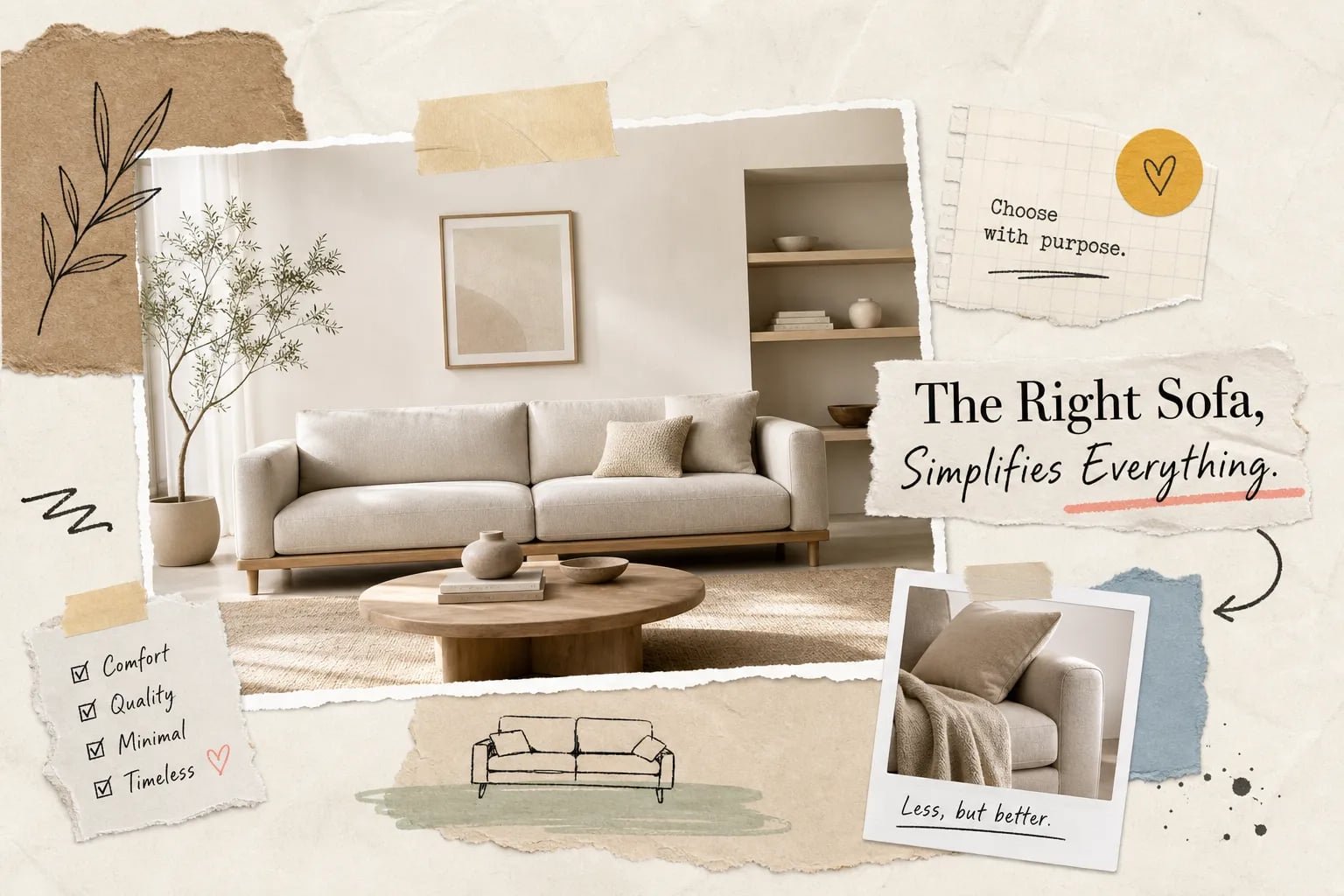
Three traits define the minimalist sofa silhouette. The first is clean, unbroken lines: no carved wood frames, no turned legs, no ornamental molding along the back rail. The second is a low-to-the-ground profile, which keeps the upper portion of the room visually open and maintains the sense of horizontal calm that minimalism depends on. The third is tight, unfussy upholstery with no button tufting, no nail-head trim, and no ruffled skirts that obscure the base.
These aren’t stylistic preferences that vary by personal taste. They’re the visual grammar of the form. Any sofa that hits all three reads as minimalist regardless of price point. Any sofa that breaks even one starts to compete with itself in a room that offers no distractions to absorb the inconsistency.
What kills the minimalist look on an otherwise good sofa
A sofa can have clean bones and still fail on the details. Rolled arms are the most common offender: they add visual bulk and a traditional, almost club-like character that works directly against modern minimalism. Skirts that hide the legs are a close second, since they ground the sofa too heavily and block the floor plane beneath it. Deep button tufting introduces ornament and shadow that the eye can’t stop tracking, while contrasting welt cords on cushion seams break the upholstery surface into visible segments.
When you’re scanning sofas during your search, train yourself to disqualify on these details quickly. A sofa that passes all four criteria, no rolled arms, no skirt, no button tufting, no contrasting welt, is a starting candidate. From there, filter on proportion.
How to choose a sofa that fits a modern minimalist style: getting proportion right first
Proportion is where most minimalist sofa purchases fail, not because the buyer chose a bad sofa, but because they chose the right sofa for the wrong room. A perfectly designed minimalist piece becomes a problem if it’s 4 inches too long, 3 inches too tall, or 5 inches deeper than the space can absorb. Before looking at a single showroom photo, establish the numbers your room actually allows.
Standard compact sofa dimensions that work in minimalist spaces
For most modern minimalist living rooms, the practical dimensional targets are: 72 to 90 inches in length, 20 to 22 inches of seat depth for a clean upright profile, 16 to 18 inches of seat height, and 22 to 26 inches of arm height. Each dimension controls something specific in how the room reads.
Seat height directly affects how “light” the sofa looks. A sofa sitting at 16 to 18 inches off the floor reads as floating and open. Arm height determines whether the frame presents a clean horizontal line across the room or a series of bulky peaks. Lower arms, in the 22-inch range, let the eye travel across the room uninterrupted. For a more relaxed, lounge-oriented profile, push seat depth to 23 to 25 inches, but keep everything else at the lower end of the range to maintain visual balance.
Matching scale to your room without guessing
The sofa’s length should occupy roughly two-thirds of the wall it sits against, not the full width. A sofa that fills a wall edge to edge removes the breathing room that minimalist rooms depend on and turns the piece from an anchor into a barrier. The room ends up feeling smaller and more compressed, which is the opposite of the intended effect.
The 18-inch clearance rule for traffic paths is the one measurement most buyers skip. You need at least 18 inches of clear floor on any side of the sofa where people need to pass, and 30 to 36 inches on primary walkways. Measure those paths before committing to a length. A sofa that’s 4 inches too long can eliminate the traffic path entirely, and no amount of design skill fixes that problem after delivery.
Silhouette details that carry the whole minimalist look
Once you’ve established the proportional limits for your room, the next filter is silhouette. This is where the difference between a generic low-profile couch and a sofa that genuinely anchors a minimalist room becomes visible. The specific details of arm style, back height, and leg treatment determine whether a sofa reads as deliberately minimal or just unremarkable.
Low backs, slim-arm sofa profiles, and what they do for visual space
Low-profile backs clear the sightline entirely, which extends the perceived ceiling height and gives the room more vertical breathing room. The eye can travel over the back of the sofa to the wall behind it, making ceilings feel taller and walls feel farther away. This effect is particularly valuable in smaller living rooms and open-plan layouts, where the sofa has to function as both a seating piece and a zone divider without turning into a visual wall.
Slim arms reduce the sofa’s visual footprint without reducing its physical size. The eye reads the sofa as occupying less space because there’s less upholstered mass to process at each end. In an open-plan layout, slim arms allow the sofa to define a seating zone without cutting the room into two separate spaces. These aren’t decorative preferences; they’re optical mechanics with measurable effects in compact rooms.
Exposed legs: why they matter more than they seem
Exposed legs create a “float” effect by revealing floor space beneath the sofa, which extends the sightline and increases the perceived room size. In small and open-plan spaces, every inch of visible floor adds to that perception. The choice of leg material also shifts the overall character of the sofa in ways that matter in a room with few other competing elements.
The most common leg choices for minimalist sofas split between warm wood tones, oak, walnut, and ash in natural or matte finishes, and matte black metal. Oak and walnut legs add warmth without introducing ornament. Matte black metal reads as cleaner and more architectural. The choice often comes down to whether the rest of the room leans warm or cool. A flat plinth base, with no legs at all, is the most severe minimalist option. It gives the sofa a sculptural, monolithic presence, but it can make a smaller room feel heavier, so reserve it for spaces large enough to carry that visual weight without feeling compressed.
Upholstery materials that hold up in Canadian homes
The showroom is not a reliable test environment. A sofa that looks pristine under controlled lighting faces a different reality in a Canadian home with dry winter heating, high-traffic daily use, and the occasional spill. Material selection is where aesthetics and practicality have to reach an agreement before you buy.
Performance fabrics: the strongest all-around choice for everyday use
Performance fabrics, with Sunbrella and Crypton as widely recognized examples, are the most practical choice for a neutral upholstery sofa used in everyday household conditions. They’re engineered for stain resistance and abrasion resistance, with typical ratings of 50,000 or more double rubs (per manufacturer specification standards) compared to the 15,000 to 30,000 range common in most bouclé fabrics. They clean up with soap and water, hold their color under heavy use, and maintain the smooth, tight surface that minimalist upholstery requires visually.
Tight weave is the key criterion when identifying a performance fabric. A loose weave, even if labeled performance-grade, will trap debris, snag more easily, and lose its clean surface appearance faster under daily use. When shopping, ask for the abrasion rating and inspect the weave density before any other specification. In Canadian homes with dry winter heating, performance fabrics also outperform many natural fibers that can become brittle or distort over repeated humidity cycles throughout the year.
Leather and polyester blends as practical alternatives
Top-grain leather is the second-strongest material choice. It wipes clean easily, ages well, and its naturally smooth surface fits the minimalist aesthetic without any styling effort. The one real maintenance commitment in Canadian conditions is periodic conditioning: dry winter heating accelerates leather cracking if you skip this step. It’s a manageable requirement, not a dealbreaker, but factor it into your decision before choosing leather over fabric.
Polyester and microfiber blends sit at the practical, affordable end of the spectrum. They resist wear, clean up easily, and perform well in high-traffic family rooms. What to avoid entirely in a minimalist room used daily is loose-weave fabric like untreated linen or bouclé. Bouclé’s looped surface is visually appealing, but it traps pet hair and crumbs, snags under regular contact, and is significantly harder to clean than any performance fabric. To add texture to a minimalist room, use cushions and rugs, not the sofa’s primary upholstery surface, where the clean look does all of the visual work.
Color palette and finish: how to choose without second-guessing
Color is the decision most buyers overthink, and it’s also the one most responsible for whether a minimalist room feels calm or cold. The framework is simpler than most design content suggests: the palette is small, the trade-offs are clear, and the choice comes down to your room’s light level and your honest maintenance tolerance.
Neutral foundations and when each one works
The minimalist sofa palette runs from white through cream, warm beige, greige, taupe, and into charcoal and black. White and cream create the most openness and light, particularly valuable in north-facing rooms with limited natural light. The trade-off is upkeep: these shades show wear, transfer from clothing, and require more consistent cleaning than anything in the mid-tone range.
Charcoal, greige, and warm taupe are the practical anchors for everyday family use. They read as calm and restrained, they hide minor wear between cleanings, and they work across a wide range of wood tones and floor finishes. If you’re furnishing a family room or a rental property and want the minimalist look without the maintenance anxiety of a white sofa, greige or warm taupe is the honest answer for most Canadian households.
Earth tones for warmth without visual noise
Soft earth tones, including sage, olive, camel, terracotta, and mushroom, have moved firmly into the minimalist vocabulary and are holding strongly in 2026. They solve the specific problem of pale neutrals reading as sterile in rooms without much natural warmth or texture. A camel or warm mushroom sofa adds visual temperature without introducing pattern or ornament, which is exactly what the minimalist constraint requires.
For finish, the principle is straightforward: matte over glossy. A matte upholstery surface keeps attention on the sofa’s form and silhouette. A glossy or high-sheen surface pulls attention to itself, which works against minimalism’s core intention of letting form carry the room. Whether you’re choosing fabric or leather, look for finishes that absorb light rather than reflect it. The sofa should be present without announcing itself.
Modular or fixed sectional: which actually fits a minimalist interior
The modular versus fixed question comes up constantly in minimalist interior planning, and the answer isn’t universal. It depends on your room type, lifestyle, and whether the sofa is a permanent fixture or a piece you’ll move again within a few years.
When a modular minimalist sectional is the smarter call
Modular sectionals offer real advantages for renters, open-plan apartments, and irregular room layouts. Individual pieces are easier to move through narrow hallways and stairwells, you can scale the configuration up or down when you relocate, and you can work around corners or architectural features that would make a fixed sectional impractical. For anyone renting in a Canadian city, where moving every two to three years is common, modular flexibility often outweighs its visual trade-offs.
The main visual trade-off is worth stating directly. Visible seams between modules interrupt the seamless upholstery surface that gives minimalist sofas their clean reading. Lower-quality modular systems also drift and separate over time, which introduces ongoing maintenance and undermines the composed look. If you go modular, invest in a system with strong connectors and tight module alignment. The quality of the joinery matters as much as the design of the individual pieces.
When a fixed sectional or two-piece sofa serves the look better
A fixed sofa or L-shaped fixed sectional delivers a cleaner, more unified silhouette with no visible module breaks across the cushion line. In a minimalist room where the sofa is the central visual anchor, that seamless surface carries significant design weight. The room composition stays consistent, the sofa reads as a single object rather than an assembly, and there’s no risk of pieces shifting out of alignment during use.
The constraint is practicality. Fixed pieces are harder to move through tight building entries, they don’t adapt when your room layout changes, and they’re a less rational choice for renters. They suit homeowners who are confident in their room dimensions, their layout, and their intention to stay put for several years. When those conditions are met, a fixed sofa almost always reads better in a minimalist room than a modular equivalent at the same price point.
How to measure your space so the sofa works before it arrives
No sofa decision should happen without a measured floor plan. The biggest source of buyer regret isn’t a bad design choice; it’s a piece that physically overwhelms the room or blocks the traffic path that makes the room functional. Measuring first eliminates that risk before it costs you a return shipping fee and a month of living with the wrong piece.
The four measurements your room needs before you shop
Before opening a single product page, record four numbers: the wall length where the sofa will sit, the total room width, the clearance distance on each open side of the sofa where people will walk, and the narrowest point in your delivery path (doorway, hallway, stairwell turn). The first two set your maximum sofa dimensions. The third tells you whether your planned footprint leaves functional traffic paths. The fourth tells you whether the sofa can physically get into the room.
The tape-on-the-floor method is simple and more people should use it. Before purchasing, lay tape on the floor in the exact footprint of the sofa you’re considering, marking both the length and the full depth. Live with it for a day. Walk around it, move between rooms, sit at nearby furniture. You’ll immediately know whether the clearance is comfortable or whether the sofa claims more space than the room can afford.
Using clearance and negative space as a design tool
In minimalist interiors, the empty space around the sofa is a design element, not a problem to fill. The standard minimum traffic clearance is 30 inches for secondary paths and 36 inches for primary walkways. Between the sofa and the coffee table, leave 16 to 18 inches: close enough for comfortable use, far enough to prevent the grouping from feeling tight and crowded.
The sofa’s relationship to the rug matters as much as its relationship to the wall. A common and effective approach is to have the front legs of the sofa sitting on the rug while the back legs remain off it, which anchors the seating group without requiring an oversized rug. This placement makes the negative space around the sofa read as intentional rather than accidental, exactly what minimalist composition requires. When you plan the rug size alongside the sofa footprint at the measurement stage, you’ll get a far more accurate picture of how the finished room will actually feel.
Off-the-shelf or custom: which option actually gets you the look
Most minimalist sofas available from Canadian retailers fall into a predictable range of dimensions, fabrics, and finishes. For a single living room with standard dimensions, that range is often sufficient. But interior designers working to an exact FF&E specification and developers furnishing multiple units of a luxury property encounter a consistent problem: the seat depth is 2 inches off the spec sheet, the leg finish doesn’t match the hardware throughout the suite, or the fabric weight isn’t rated for commercial use. Off-the-shelf retail can’t resolve those variables without compromise.
When off-the-shelf is enough
Retail and direct-to-consumer options serve the need well when you’re furnishing a single room, working within a standard residential budget, and your dimensions and color requirements fall within the mainstream product range. For this scenario, the key evaluation criteria are: frame construction (kiln-dried hardwood is the benchmark, while particleboard frames represent a long-term durability risk), cushion density (higher-density foam holds its shape significantly longer under daily use), fabric abrasion rating, and the brand’s return window and warranty terms. A sofa that passes on all four criteria is a solid purchase for a residential application.
Why designers and developers go custom for precision results
When every variable matters, custom manufacturing is the more practical choice, not the luxury one. Factory-direct manufacturers like YM Furniture (Foshan Yauming Furniture & Construction Co., Ltd.) produce fully customizable minimalist sofa designs built to the buyer’s exact specifications: frame dimensions, upholstery fabric and grade, leg finish, cushion firmness profile, and fire-rating compliance for commercial applications. For an interior designer managing a hotel suite rollout, a branded residence, or a multi-unit villa development, custom production eliminates every compromise that retail inventory can’t resolve.
Factory-direct pricing often means a spec-built custom piece lands at a lower cost than a premium retail option that still doesn’t fully fit the brief. YM Furniture’s production model, backed by over 17 years of hospitality furniture manufacturing and more than 1,000 completed projects for globally recognized brands, is built precisely for this type of project requirement. Designers and developers sourcing minimalist sofas for commercial or multi-unit developments can contact the YM Furniture team directly, it’s the most efficient first step in the process.
Making the final decision with confidence
Now you know how to choose a sofa that fits a modern minimalist style: work through proportion, silhouette, material, and color in that order. Proportion comes first because no amount of design detail rescues a sofa that’s the wrong size for the room. Silhouette comes second because the arm style, back height, and leg treatment determine whether the piece reads as genuinely minimal or just unremarkable. Material third, because the upholstery has to perform in your actual household conditions. Color last, because the palette only matters once the other three decisions are right.
Measure your space before you shop, not after you’ve committed to a piece. Use tape on the floor to test the footprint. Shortlist silhouettes that fit your room’s scale, then narrow down on material and finish. Most homeowners with a well-measured room and a clear sense of their proportional limits will find what they need from a strong retail or direct-to-consumer option. The framework in this guide gives you the criteria to evaluate any sofa quickly and confidently, without relying on showroom atmosphere to make the decision for you.
For interior designers, FF&E specifiers, and developers with exact project requirements, a factory-direct custom option removes every compromise retail can’t resolve. YM Furniture handles custom minimalist sofa production with full specification control, from frame dimensions and upholstery grade to leg finish and commercial compliance documentation. Contact the YM Furniture team to discuss your project specifications and request samples.