Furnishing a villa is one of the most consequential design decisions a developer or owner will make. The stakes are real: a poorly specified sofa in a 6,000-square-foot Living Room Furniture”>living room doesn’t just look wrong. It undermines every other decision in the space. Getting luxury villa furniture right requires a clear process, not just a good eye and a showroom visit.
This guide covers the four decisions that matter most: which materials to specify, how to build a coherent style across rooms, which durability benchmarks to hold suppliers to, and whether bespoke or ready-made is the right call for your project. It also addresses sourcing directly, because the options have expanded significantly. Manufacturers like YM Furniture (Foshan Yauming Furniture & Construction Co., Ltd.) now supply fully customized luxury villa furniture directly from the factory, offering designers and developers a practical alternative to Italian showroom pricing without sacrificing specification quality.

Why Material Selection Is the Most Important Decision in Any Luxury Villa Furniture Project
Every downstream decision in a villa furnishing project flows from material choices. Style, durability, sourcing channel, and budget all depend on what you specify first. Get the materials right and the rest of the process gets easier. Skip this step and you spend the rest of the project compensating.
Natural Stone, Solid Wood, and Premium Metals for Interior Spaces
The 2026 villa interior palette is built on travertine, dark-veined marble, solid oak, and walnut with darker staining. These materials work across casegoods, dining tables, and accent pieces because they carry visual weight and age authentically. Many experienced designers and buyers consider material honesty a key differentiator between villa-grade furniture and hotel-budget furniture. Real stone and solid wood read differently than veneered composites, and seasoned buyers notice the difference immediately.
For upholstery, bouclé and mohair are strong interior choices in 2026. Both textures read warm and tactile, which aligns with the broader shift away from cold minimalism toward what designers are calling “lived-in luxury.” For pieces near outdoor transitions, specify performance-rated fabrics that handle humidity and light exposure without degrading.
What to Specify for Outdoor Terraces and Pool Areas
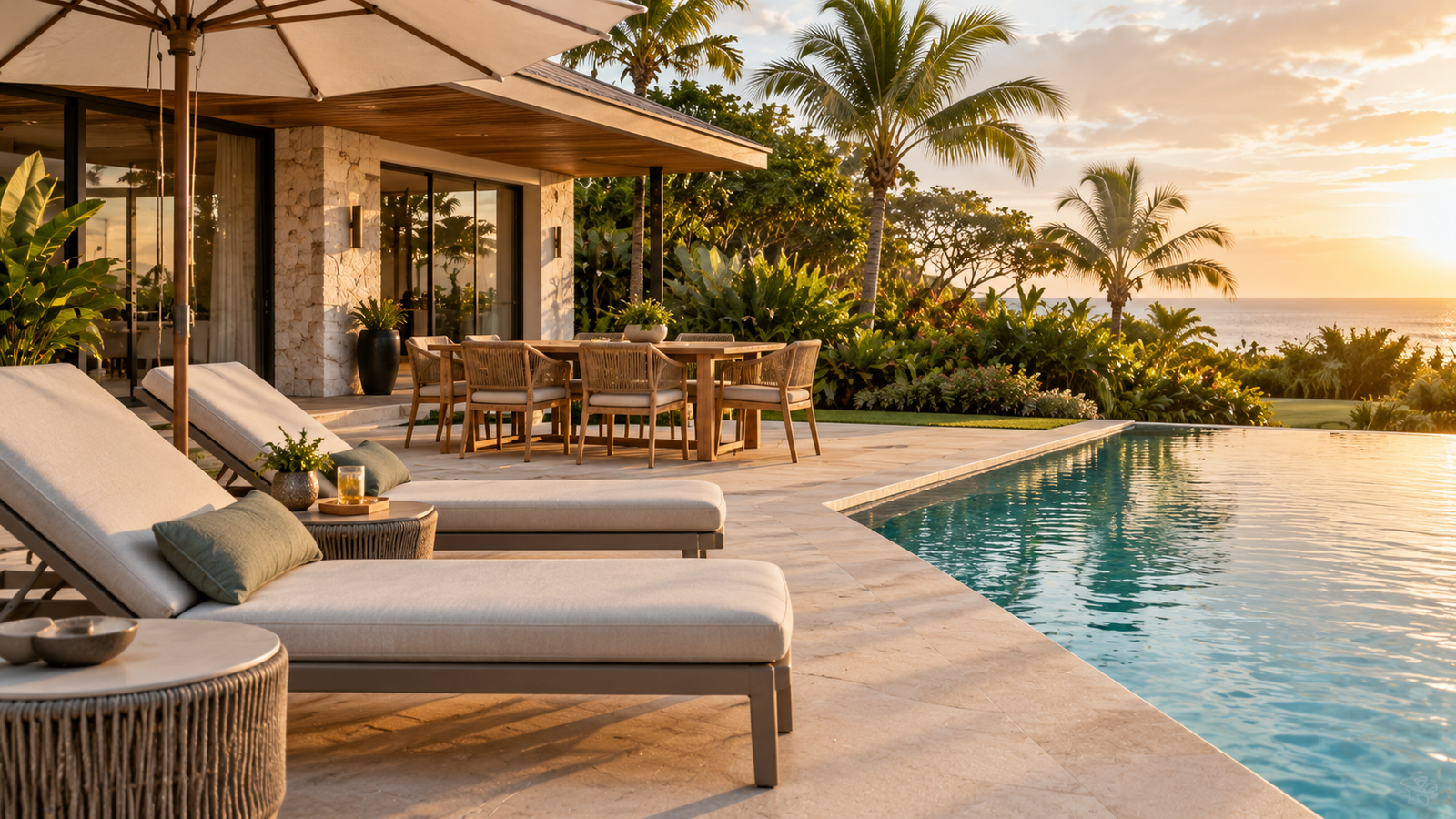
Powder-coated aluminum is the most practical frame material for coastal and high-humidity environments. Specify a super-durable polyester powder coat with a dry film thickness of 70 to 100 microns minimum, and for extreme coastal or oceanfront installations, consider specifying 80 to 120 microns alongside 3,000-plus hours of salt-spray resistance. These are recommended procurement targets based on coastal performance guidance rather than universal mandated standards, but they reflect the real-world threshold where finishes begin to fail. Teak works well for dining tables and benches where a warmer natural look is a priority; its natural oils resist moisture, insects, and decay without heavy intervention. For a detailed overview of recommended finishes and materials in seaside settings, see this guide to the best materials for coastal outdoor furniture.
For pool loungers, Batyline or open-weave PVC-coated mesh outperforms solid upholstery because it dries quickly and resists mildew. Quick-draining reticulated foam in cushion systems is strongly recommended for pool-adjacent pieces. Standard foam retains moisture and increases mildew and mold risk over time. These are finish-schedule specifications, not marketing preferences; put them in writing before you request a quote from any supplier.

Building a Coherent Design Language Across Every Room
Luxury villa furniture has to function as a system. A collection of individually beautiful pieces that don’t speak to each other reads as expensive but unplanned. The goal is for every room to feel designed, not assembled.
The 2026 Villa Design Directions Worth Paying Attention To
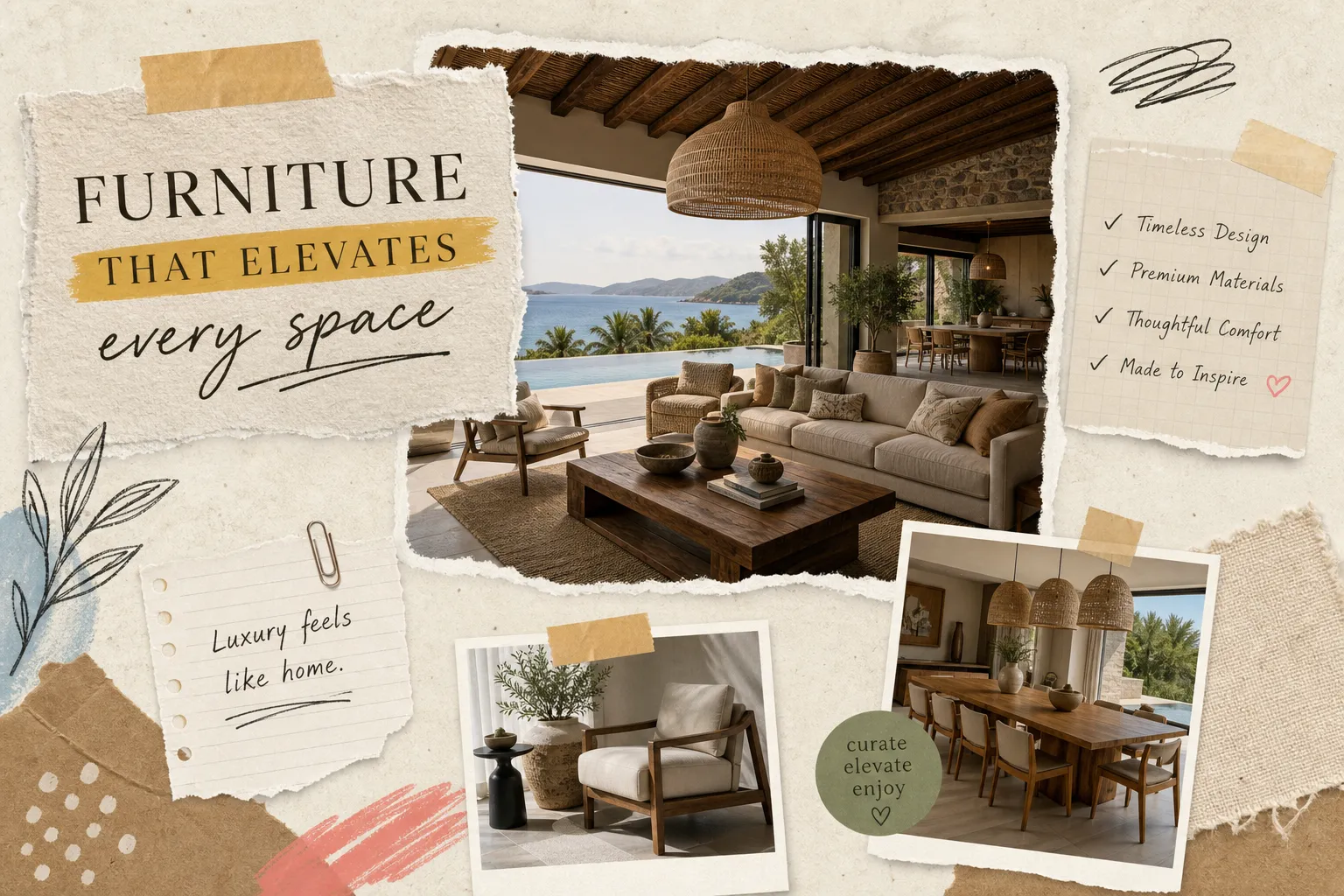
Midimalism is the clearest 2026 direction: a middle ground between minimalism and maximalism, using layered textures and selective statement pieces rather than either sterile emptiness or visual overload. Mediterranean influence is running strong in villa settings specifically, with an emphasis on artisan details, indoor-outdoor flow, and materials that reference place. The dominant color palette centers on earth tones, terracotta, ochre, dusty olive, warm beige, and deep wood finishes. Muted greens, particularly olive and herb tones, are appearing frequently as secondary palette choices.
How to Connect Indoor and Outdoor Spaces Without Losing Coherence
Repeat one or two materials across both interior and exterior zones. Teak inside and out, consistent stone, or matching frame finishes create visual continuity without requiring an identical look. Color temperature matters as much as material: if the interior reads warm and earthy, cold-grey outdoor furniture will break the experience for anyone moving between the two spaces.
A unified finish schedule is the practical tool that makes this work. Specify the same tones across joinery, upholstery, and outdoor frames before the project goes to any supplier. This step costs nothing and saves significant budget on corrections later.
Anchoring the Style With a Few Signature Pieces
One or two statement pieces per main room do more for design coherence than filling every corner. A sculptural dining table, an upholstered bed with real visual presence, an oversized sectional in a villa-scale living room, these anchor the space and make every surrounding decision easier. Brands like Minotti, Meridiani, and Giorgetti achieve coherence through material consistency rather than matched sets, and that principle applies whether you’re sourcing Italian ready-made or commissioning bespoke villa furnishings.

The Furniture Pieces That Matter Most, Room by Room
Not all furniture decisions carry equal weight. A few pieces in each room determine the design tone for everything else. Spend your specification energy and budget on these first.
Primary Suite: Bed, Upholstery, and Nightstands
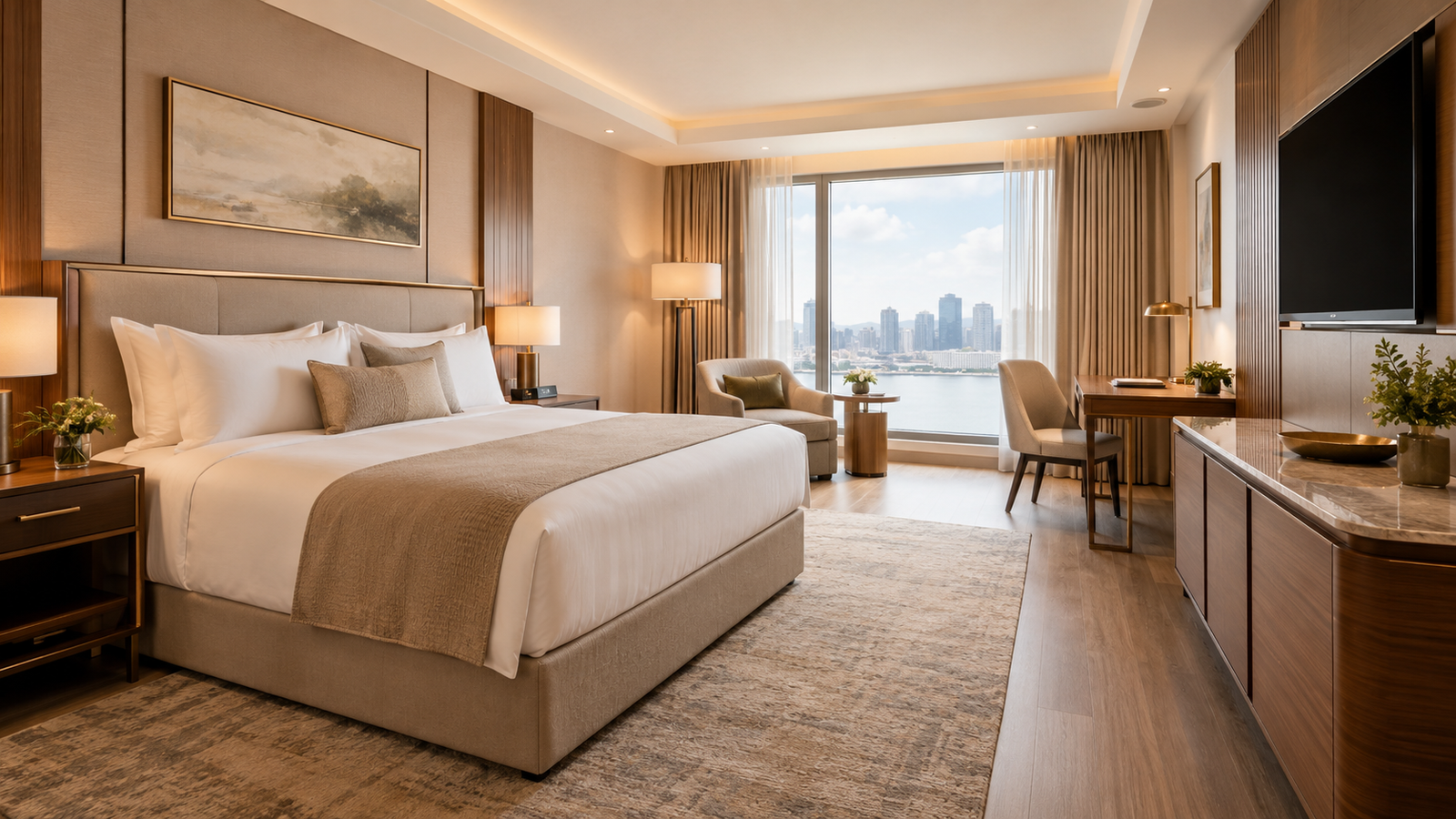
The upholstered bed is the visual anchor of any villa bedroom/” title=”Luxury Bedroom Furniture”>bedroom suite. Specify solid wood or metal frame construction, a substantial upholstered headboard panel, and a finish that ties directly to the room’s material palette. Flou’s Nathalie and Yuna beds are repeatedly specified for villa bedrooms, alongside pieces from Bonaldo and Meridiani. A bench at the foot of the bed and a well-chosen lounge chair complete the suite without overcrowding a space that should feel generous.
Living Areas: Sofa, Coffee Table, and Accent Seating
Scale is the first decision in any villa living room. A sofa configuration needs to match the room, not the showroom floor. B&B Italia, Minotti, and Roche Bobois are well-regarded options for the main seating statement at villa scale. Accent chairs from Cassina or Poltrona Frau work well as counterpoints to a larger sectional. Coffee tables in travertine or solid wood add material weight and ground the room in a way that glass or lacquered surfaces rarely achieve at this scale.
Dining and Outdoor Terrace Priorities
Dining table sizing matters more than any other dining room decision. A table that reads small in a villa-scale room undermines the entire space. For outdoor terraces, treat the dining zone and the lounge or pool zone as separate functional areas, each needing its own furniture specification. Teak dining tables with powder-coated aluminum chairs and a well-specified shading system cover the dining zone. As a reference point for 2026 US market pricing, quality dining tables typically run $3,000 to $6,000-plus, and a full high-end villa furniture specification for an outdoor dining and lounge terrace commonly falls between $8,000 and $20,000.

Durability Standards for Luxury Villa Furniture
A villa’s furniture has to perform over years of use, not just photograph well on delivery day. Evaluating suppliers against objective construction criteria, rather than aesthetics alone, is the discipline that separates a well-specified project from an expensive maintenance problem.
What Hospitality-Grade Construction Actually Means
Frame joinery should be mortise-and-tenon or dowel-and-glue construction in solid wood frames. For high-use villa and hospitality contexts, reinforced joinery significantly outperforms stapled or pinned alternatives in long-term durability. For upholstery, contract-grade benchmarks typically cite 50,000-plus Wyzenbeek rubs or 30,000-plus Martindale cycles for heavy hospitality use. For designer villa furniture with regular residential use, specifying a minimum of 25,000 Wyzenbeek rubs provides a meaningful durability threshold. Seat cushions should use high-density foam in the range of 30 to 40 kg/m³ (roughly 1.9 to 2.5 lb per cubic foot) as a baseline for seating that holds its shape over time. Sinuous spring or 8-way hand-tied construction adds further resilience in high-use seating.
Finish and Material Certifications to Request
For any imported furniture entering the US market, specify CARB Phase 2 compliance (governed by TSCA Title VI under EPA rules) for composite wood components. Documentation takes the form of product labeling showing compliance and import records, including bills of lading and invoices with a written compliance statement, kept for a minimum of three years per EPA and CARB guidance. ISO-certified production facilities run consistent quality control processes rather than batch-checking; ask for documentation of the certification, not just a claim. Powder coating thickness on exterior metal frames should be specified at 70 to 100 microns minimum, with UV-resistant topcoats on wood among the most commonly overlooked specifications on any finish schedule.

Bespoke vs. Off-the-Shelf: The Honest Comparison for Villa Projects
The right answer depends on project scale, budget, and how much specification control you actually need. There are three distinct routes worth understanding: ready-made luxury, fully bespoke, and factory-direct custom manufacturing. Each has legitimate use cases.
When Ready-Made Luxury Works Well
Single-villa projects with a clear design brief and the budget for Italian retail pricing can work well with brands like Minotti, Poltrona Frau, or Century Furniture, provided the lead times fit the project schedule. Italian configured orders typically run 12 to 20 weeks; fully bespoke commissions from the same tier of maker can extend to four to six months. Ready-made also works when a specific piece carries brand provenance that matters to the design narrative: a Roche Bobois modular sofa or a Cassina heritage chair is a deliberate design statement in a way that a generic equivalent is not. The limitation is customization; dimensions, finishes, and fabric options are constrained by each brand’s configuration system.
What Fully Bespoke Unlocks for Large or Multi-Unit Projects
When furnishing a villa development, a branded residence cluster, or a multi-suite property, bespoke manufacturing allows total specification control: exact dimensions, proprietary finishes, custom joinery details, and consistent execution across every unit. Italian bespoke makers like Turri, Modenese Luxury Interiors, and Giorgetti offer this capability, but pricing reflects the full retail supply chain markup.
Why Factory-Direct Custom Manufacturing Changes the Equation
For developers and procurement professionals managing large villa projects, factory-direct custom manufacturing delivers comparable bespoke specification capability without the showroom, distributor, and retail margin stack. YM Furniture (Foshan Yauming Furniture & Construction Co., Ltd.) operates on this model, with a dedicated hospitality furniture factory supplying hotel and villa projects internationally, ISO-certified production, and model room capabilities that allow project teams to review and approve physical samples before full production begins. For procurement professionals who have been sourcing exclusively through retail channels, a direct comparison on a multi-room or multi-unit villa furnishing project is worth running before the budget is committed. Factory-direct pricing on custom villa furniture orders can represent a meaningful reduction versus retail, particularly as project scope increases.

Budgeting, Lead Times, and Building Your Sourcing Plan
Good sourcing decisions start with realistic numbers. Here are the 2026 benchmarks to build your project budget and schedule around.
Realistic 2026 Price Ranges by Furniture Category
- Sofas: $1,000 to $3,500 for quality residential; $4,000 to $8,000+ for large-format or premium villa-scale pieces
- Dining tables: $800 to $2,500 standard; $3,000 to $6,000+ for solid-wood, large-format, or designer pieces
- Beds: $1,500 to $4,000 for a quality bedroom setup; $4,000 to $10,000+ for villa or custom upholstered configurations
- Outdoor sets: $2,000 to $7,000 for quality patio configurations; $8,000 to $20,000+ for luxury villa outdoor dining groups and lounge zones
These are US market benchmarks for 2026. Factory-direct sourcing for bespoke villa furnishings can shift these ranges materially, particularly on custom or high-volume orders where per-unit cost decreases as project scope grows. For additional context on overall furnishing budgets and how they break down by room, see this practical guide on the cost to furnish a house.
Lead Time Expectations by Sourcing Channel
Italian luxury brands typically require 12 to 20 weeks for configured or made-to-order pieces, with fully bespoke commissions often running three to six months or longer. Factory-direct manufacturers generally work within 45 to 90 days for standard production, depending on complexity and order volume, though lead times vary by supplier and specification, so confirm timelines directly before committing. Model room or sample approvals can often be turned around faster, giving project teams a physical reference point for sign-off before full production begins. Build lead times into your project schedule from the first design meeting, not after contracts are signed. When planning delivery and installation milestones, consult typical manufacturer lead times for realistic scheduling.
How to Build a Prioritized Sourcing Checklist
Start with anchor pieces: the beds in primary suites, the main living room sofa configuration, and the primary dining table. These set the design tone for every other decision, and locking them first prevents the most common and expensive mid-project corrections. Specify all materials and finishes in a finish schedule before requesting quotes from any supplier. Then get at least two quotes per major category, one from a branded retail option and one from a factory-direct or direct-import manufacturer. The comparison will sharpen both your budget expectations and your decision criteria more effectively than any single quote can.

The Framework That Holds Everything Together
The sequence matters. Material selection comes first because it determines every other decision. Style cohesion follows because it shapes which pieces to prioritize and how they relate to each other. Durability specifications give you an objective framework for evaluating any supplier, regardless of brand. And the sourcing decision, ready-made, fully bespoke, or factory-direct custom, should be made based on project scale and budget, not habit or familiarity with a particular channel.
The most expensive decisions in a luxury villa furniture project are the ones made late. Changing a dining table specification after production has started, or discovering that an outdoor upholstery choice doesn’t meet coastal performance requirements after installation, costs multiples of what the original decision would have cost. Decisions made before design is locked consistently deliver better results at lower total project cost.
For villa developers or designers considering factory-direct custom manufacturing, engaging a specialist like YM Furniture at the design stage, rather than the procurement stage, gives your team access to model room capabilities, technical specification support, and factory-direct pricing before budget decisions are locked. Have that conversation early. By the time procurement begins, the choices that matter most have already been made.