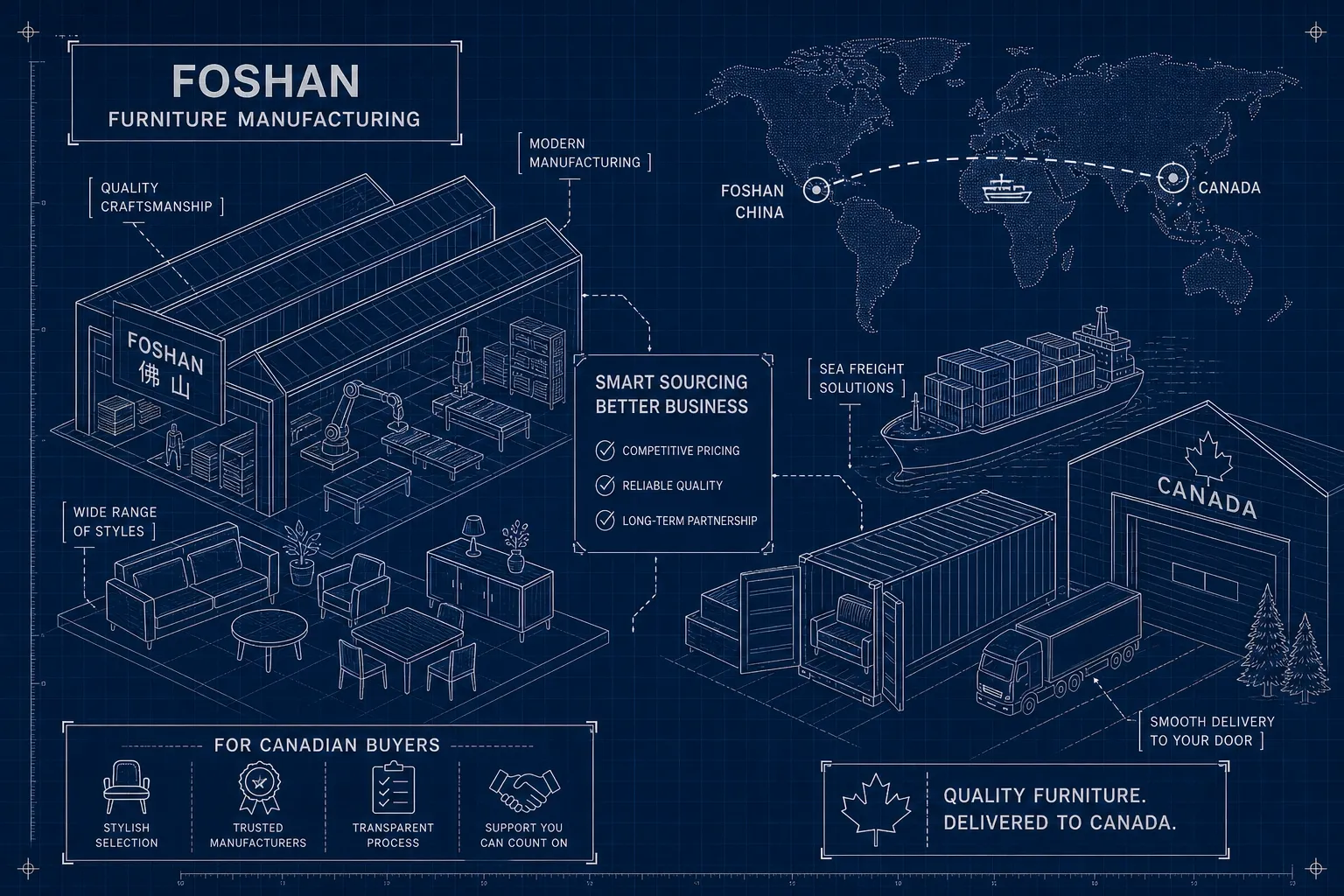
If you’re wondering where to buy outdoor furniture directly from Chinese manufacturers, this guide maps the entire process so you can move through it with clarity. Sourcing patio furniture direct from Chinese factories can substantially reduce unit costs compared to buying through North American distributors, but the path has real obstacles. Fake factories, inconsistent quality, surprise import fees, and minimum order quantities that don’t fit a mid-sized project all stand between you and a successful first shipment.
By the time you finish reading, you will know which platforms list verified Chinese outdoor furniture suppliers, how to vet a factory’s credentials before you send a dollar, what realistic MOQs and FOB prices look like by material, and how to handle Canadian import rules without guessing. Foshan alone hosts numerous legitimate factory-direct operations, from small rattan workshops to established manufacturers like YM Furniture (Foshan Yauming Furniture & Construction Co., Ltd.) that supply 4- and 5-star hotel projects across 30 countries. The difference between a successful first order and a costly mistake usually comes down to process.
Where to Buy Outdoor Furniture Directly from Chinese Manufacturers: Platforms and Trade Shows
Your search for patio furniture manufacturers in China will almost certainly start on one of three platforms: Alibaba, Made-in-China, or Global Sources. Each has a different character, and knowing how to read them saves you weeks of back-and-forth with the wrong contacts.
Alibaba: still the largest directory, but filter carefully
Alibaba’s outdoor furniture category is enormous, which makes filtering essential. Start by applying the Verified Supplier badge filter and opening the associated audit report for any factory you are considering seriously. That report tells you whether the supplier has actually been inspected or just self-reported their profile. The second thing to check is whether you are looking at a factory or a trading company. Both list on Alibaba, but a trading company adds a margin on top of the factory price and often has less control over production quality. In the garden furniture category, narrow results by material (aluminum, rattan, teak, sling) to avoid browsing thousands of irrelevant listings.
Made-in-China and Global Sources as serious alternatives
Made-in-China skews toward manufacturers rather than traders, which is genuinely useful early in the search. Global Sources targets trade buyers specifically and tends to attract suppliers with export experience and English-speaking sales teams. When a factory appears on both Made-in-China and Global Sources with matching company details, treat that as a positive signal. It suggests the business has been operating long enough to maintain multiple directory presences. Across all three platforms, look for certifications listed directly in the supplier profile: BSCI, SEDEX, ISO, and FSC are the ones that matter most for outdoor furniture.
How to build your initial shortlist efficiently
Apply a consistent filter sequence: material category first, then minimum order, verified status, years in operation, and response rate. Aim for a shortlist of five to eight suppliers before sending any RFQ. When you do reach out, keep the initial inquiry concise. State the product type, approximate quantity, target materials and finishes, destination country, and required lead time. Factories with capable export teams respond quickly to structured inquiries; vague messages get deprioritized or ignored entirely.
Why trade shows like Canton Fair and Furniture China still earn a trip
Trade shows give buyers an efficient alternative to the slow grind of online sourcing: you touch the product, meet the factory rep face to face, and compare dozens of suppliers in the same hall. For buyers planning a meaningful commercial order, attending at least one trade show before committing is a sound investment.
Canton Fair: timing, registration, and which halls matter for outdoor furniture
The Canton Fair runs in two annual sessions. The Spring 2026 session ran April 15 to 19 for Phase 1, with Phase 2 covering outdoor furniture and garden categories. The Autumn 2026 Phase 1 opens October 15. Check the official Canton Fair website for current phase dates and on-site registration fees, as these details are updated each session. Before you arrive, bring business cards, a printed product spec sheet, and a prepared question list covering certifications, current production capacity, and client references. Collect physical samples at the booth rather than catalog PDFs.
Furniture China (CIFF Shanghai): a specialist alternative
CIFF runs annually in Shanghai and skews toward higher-end commercial and hospitality furniture suppliers. If your project involves hotel-grade outdoor collections, villa terraces, or resort pool decks, the CIFF exhibitor mix is more relevant than Canton Fair’s broader base. Factories that exhibit at CIFF typically have stronger design capabilities and are more accustomed to working with FF&E specifiers and hotel developers. The show timing relative to Canton Fair means serious buyers can attend both in the same sourcing cycle. For a deeper dive on sourcing hotel furniture specifically, see the How To Source Hotel Furniture From China: Complete 2026 Guide | YM Furniture.
How to use a trade show visit to vet suppliers on the spot
Treat a trade show visit as a two-day audit, not a shopping trip. Photograph product labels and certifications at each booth so you have documentation to cross-check later. Ask every factory rep for a factory visit invitation; genuine manufacturers almost always say yes. Request the names of current major project clients, not just brand logos printed on a banner. Factories that give you specific, verifiable references are the ones worth following up with seriously.
How to vet factory credentials before you request a single quote
Skipping verification is where buyers lose money. A strong profile photo and a competitive price quote mean nothing if the “factory” is a one-person trading shell with no production capacity. The credential-check process is straightforward, but it needs to happen before any money moves.
The document checklist every serious supplier should provide
Ask for these documents upfront, without apologizing for being thorough:
- Business license with manufacturing explicitly listed in the business scope
- ISO 9001 quality management certificate
- ISO 14001 or ISO 45001 where relevant to the factory’s operations
- BSCI or SEDEX social audit report
- FSC certification for any wood-based outdoor furniture
- Product test reports relevant to the specific materials (UV resistance, load ratings)
One rule applies to every document: the company name on the certificate must match the registered legal entity name exactly. Mismatches are a common sign that documents belong to a different company and have been borrowed or fabricated.
Cross-checking company registration with Chinese business registries
Get the supplier’s full Chinese legal name and Unified Social Credit Code (USCC) from their business license, then search the National Enterprise Credit Information Publicity System (GSXT) or Tianyancha using that USCC. Confirm the registered status is active and not dissolved, revoked, or flagged with abnormal-operation status. Compare the registered address against the factory location the supplier claims; a residential address or virtual office in a furniture manufacturing inquiry is a serious red flag. This five-minute check can save buyers from sending deposits to shell operations that would never deliver a single piece.
What the gold standard looks like in practice
When shortlisting any outdoor or commercial furniture supplier, it helps to benchmark their transparency against what an established factory-direct manufacturer looks like. YM Furniture (Foshan Yauming Furniture & Construction Co., Ltd.) is a useful reference point: ISO 9001 certified, with 17 years of hospitality-focused manufacturing, over 1,000 completed hotel projects, and client references including Marriott, Sheraton, and Pullman. The company operates a 70,000 m² production facility and a 5,000 m² showroom with full mock-up rooms. That level of transparency, documented credentials, and verifiable project history is what any credible Chinese outdoor furniture supplier should be willing to share upfront, without you having to chase them for it. For an overview of the factory-side process and how a structured supplier relationship typically runs, see How YM Furniture Works | Custom Furniture Process China.
MOQs, FOB pricing, and lead times across the main outdoor furniture materials
Buyers who enter factory negotiations without reference numbers are at a disadvantage. The benchmarks below by material category are illustrative ranges drawn from common manufacturer listings, use them as a starting framework, not as fixed market prices, and always confirm current figures directly with suppliers.
Rattan/wicker and aluminum: the most common starting points
For rattan and wicker sofa sets, typical MOQs run from 1 to 50 sets depending on factory scale and design complexity. Established operations often set minimums at 10 to 50 sets, while smaller workshops may accept single-set trials. FOB prices for rattan sofa sets generally fall between $200 and $800 per set, with premium designs reaching above $1,000. Aluminum dining and lounge sets typically carry MOQs of 1 to 30 sets and FOB prices of $100 to $500 per piece or set. Production lead times for bulk orders vary by factory backlog and customization level, many suppliers quote 30 to 60 days as a working estimate, but confirm the current timeline before finalizing your schedule. Custom OEM designs push MOQs higher because setup costs are real: tooling, sample approval, and small-batch inefficiency all hit the factory’s margin.
Teak, sling, and specialty outdoor collections
Teak lounge sets carry FOB prices from roughly $280 to $1,000 per set depending on joinery complexity and finish specifications. Sling furniture (aluminum frames with woven fabric) commonly runs $150 to $450 per piece and is one of the more durable options for commercial outdoor applications. Complex items like premium chaise lounges, canopy swings, and resort-style daybeds can range from $200 into the high hundreds or above $1,000 for fully custom configurations. For any category with custom finishes, stain colors, or fabric choices, minimum quantities often apply per SKU rather than per total order, which affects how you structure a mixed-item purchase order.
Reading FOB quotes correctly and spotting padding
FOB pricing ends at the origin port in China. It does not include international freight, insurance, Canadian customs duties, GST, or local delivery. Common padding tactics to watch for include inflated freight estimates bundled into the unit price, “packing fees” added per carton that were not disclosed upfront, and tooling charges applied to standard catalog designs that require no actual tooling investment. Always request an itemized quote breakdown. A factory that resists providing line-item pricing is telling you something about how they manage the relationship.
How to request samples and use them as your production benchmark
Samples are not a formality. A physical sample is the closest thing you have to a binding production agreement before the PO is signed. The way you order and manage samples determines whether you can enforce quality on the bulk run.
What to specify before ordering a sample
Put every requirement in writing before the sample is produced: dimensions, material grade, finish and color reference, hardware specifications, packaging requirements, and any compliance standards such as UV resistance ratings or weight-load thresholds. Do not rely on chat messages. A structured spec sheet sent via email, with the factory’s written acknowledgment, is the baseline document you will reference when the bulk goods arrive. Vague verbal agreements about “matching the sample” are meaningless without a defined tolerance. For step-by-step guidance on the sample ordering process, review this practical guide on how to order a sample from a manufacturer.
How many samples to order and what to do with them
Order at least two samples from each shortlisted factory. Keep one sealed as your reference standard and use the second for independent testing or real-use-condition evaluation. Comparing samples from three factories simultaneously is far more informative than evaluating one in isolation. Price differences that look significant on paper often disappear or reverse once you hold the products side by side and test the joinery, finish, and hardware quality.
Sample costs, refund policies, and protecting the reference standard
Chinese factories typically price samples at or slightly above the FOB unit price, plus freight. Before ordering, confirm whether the sample fee is credited toward a bulk order, most factories will agree to this for serious buyers. Put the reference standard agreement in writing: bulk production must match the approved sample within defined tolerances. That phrase “match the sample” needs a specific meaning before production begins, not after goods arrive at a Canadian warehouse and you are trying to make a claim.
Negotiating MOQs and structuring your first wholesale patio furniture order
Buyers who try to order below a factory’s stated MOQ without addressing it often get ignored. Buyers who understand why MOQs exist and frame the conversation accordingly get flexibility.
How factories think about MOQ flexibility
Factories set minimum order quantities to recover setup costs, not to exclude buyers. A buyer who pays a slightly higher unit price in exchange for a lower trial-order quantity is often welcome. Position the request as a “trial order” and be direct about your intent to scale: explain that you are evaluating suppliers for a larger ongoing relationship and want to confirm production quality before committing to full volume. That framing is credible and signals you are a serious buyer, not someone looking to squeeze one cheap shipment out of them.
OEM vs. ODM: which is right for your first order
OEM means you bring the design and the factory executes it. ODM means the factory has an existing design that you brand or modify. For buyers new to importing wholesale patio furniture from China, ODM is usually the safer starting point: tooling costs are lower, lead times are shorter, and the factory already knows what the product should look like. OEM makes more sense for large repeat orders, proprietary designs, or hospitality brand-compliance requirements where an existing factory model cannot be adapted to meet specification.
The written spec sheet and purchase order as your legal protection
Verbal agreements and chat confirmations are not enforceable in international trade. A proper purchase order includes: product description, quantity, unit price, FOB term, production timeline, sample approval reference, packaging specifications, and a payment schedule with milestones tied to production checkpoints. The PO is your primary document if a dispute arises, and the more specific it is, the stronger your position.
Factory inspections and payment terms that keep your money safe
The period between sending your final payment and receiving goods that match what you ordered is where nearly all financial risk concentrates. Managing that window systematically is essential for international commercial orders.
Pre-production sign-off and during-production checkpoints
A pre-production sample approves what goes into mass production. A pre-shipment sample from actual bulk production confirms the goods match the approved standard. For large orders or complex OEM designs, schedule a mid-production inspection as well. Each checkpoint catches problems at the lowest possible cost: a defect found during production is a correction; the same defect found after the container is loaded is a loss.
Using a third-party inspection company in China
Third-party inspection companies operating in Guangdong province include QIMA, Pro QC International, Tetra Inspection, V-Trust, AQF, and Bureau Veritas. A standard pre-shipment inspection report covers quantity count, appearance check, dimension verification, functional testing, and a packaging audit. Book the inspection before you release the final payment. The cost of a single inspection is typically a fraction of one percent of a commercial order value, one of the highest-return risk management tools available to international buyers. For a broader comparison, consult this list of trusted third-party inspection companies in China.
Staged payment structure that protects both sides
The standard payment structure for an established supplier relationship is 30% T/T deposit to start production and 70% balance, released only after the pre-shipment inspection passes. For sample payments with a new factory, PayPal is reasonable because it offers dispute protection for small transactions. Avoid full upfront payment on any bulk order unless you have a documented multi-year relationship and consistent delivery history with that specific factory. The deposit structure gives the factory confidence to begin production; the inspection-gated balance gives you confidence before funds are released.
Canadian import rules, duties, and how to estimate your landed cost
A delivered FOB price from a Chinese factory is not your real cost. Many Canadian buyers significantly underestimate their total landed cost by overlooking duties, GST, brokerage fees, and freight, and the gap between factory price and true cost can be larger than expected. Running this calculation before you sign the PO is a step you cannot afford to skip.
HS codes and duty rates for outdoor furniture entering Canada
Outdoor furniture falls under Chapter 94 of Canada’s tariff schedule. Aluminum-frame outdoor furniture typically classifies under HS 9403.20, with a Canadian MFN duty rate of approximately 8%. Teak and other solid wood outdoor furniture classifies as wooden furniture, often under HS 9403.60, with a Canadian duty rate of approximately 9.5%. Seats and chairs may fall under HS 9401 depending on construction and use. An incorrect HS code can result in delayed clearance or unexpected costs at the port. Work with a licensed Canadian customs broker from the start of the project, before the purchase order is placed.
Wood material requirements and phytosanitary compliance
Processed wood products (plywood, laminated board, fiberboard) follow a simpler import path into Canada. Solid and unprocessed wood, including teak and acacia outdoor furniture, triggers CFIA requirements under Directive D-02-12.
You will need a phytosanitary certificate issued by China’s National Plant Protection Organization (NPPO) that explicitly identifies the wood species, confirms treatment details (method, chemical agents, dosage, duration, temperature), and verifies the treatment was carried out before shipment. A separate fumigation certificate does not substitute for these details on the phytosanitary certificate. You also need to apply for a Plant Protection Import Permit from CFIA before the shipment leaves China. Furniture retaining bark faces near-certain rejection at the border; ensure all wood is bark-free before ordering. For species with CITES implications, check restriction status before committing to a teak or specialty hardwood order.
How to calculate your actual landed cost from China to Canada
The formula is: product cost + international freight + insurance + Canadian duty + GST (plus provincial HST or PST) + customs brokerage + local delivery. Here is a worked example using illustrative figures. Product cost: CAD 2,000. Freight and insurance: CAD 600. Customs value: CAD 2,600. Duty at 8% for aluminum outdoor furniture: CAD 208. GST at 5% on customs value plus duty (CAD 2,808): approximately CAD 140. Estimated landed cost before brokerage and local delivery: approximately CAD 2,948. Add brokerage fees (typically CAD 150 to 300 for a standard commercial shipment) and local delivery, and a seemingly low factory price has landed at a 30 to 40 percent premium by the time goods reach a Canadian facility.
Bringing it all together
Understanding where to buy outdoor furniture directly from Chinese manufacturers is only the first step. The buyers who get it right combine platform research, rigorous credential verification, sample-first ordering, staged payments, and a full landed cost calculation before they commit. Each section of this guide represents a checkpoint in that process.
Start with two or three shortlisted factories from Alibaba, Made-in-China, or Global Sources. Run the GSXT registry check on each. Request samples with a written spec sheet. Arrange a third-party pre-shipment inspection. Work out your Canadian landed cost before the PO is signed. That sequence converts what can be a risky international purchase into a repeatable, cost-efficient sourcing channel for import outdoor furniture Canada-wide. For additional reference materials, see our Sourcing Guides | YM Furniture.
If your project requires hospitality-grade outdoor furniture at commercial scale, with verified certifications and a track record across major hotel brands, contact YM Furniture (Foshan Yauming Furniture & Construction Co., Ltd.) with your spec sheet and project scope. With 17 years of factory-direct manufacturing, ISO certifications, and 1,000+ delivered projects across 30 countries, YM Furniture represents the kind of transparent, fully documented supplier relationship that makes international sourcing work reliably. Use the standards in this guide to evaluate every response you receive, and you will know exactly where to buy outdoor furniture directly from Chinese manufacturers, and how to do it well. For a deeper walkthrough of hotel-specific sourcing and contract considerations, consult How To Source Hotel Furniture From China: Complete 2026 Guide | YM Furniture.