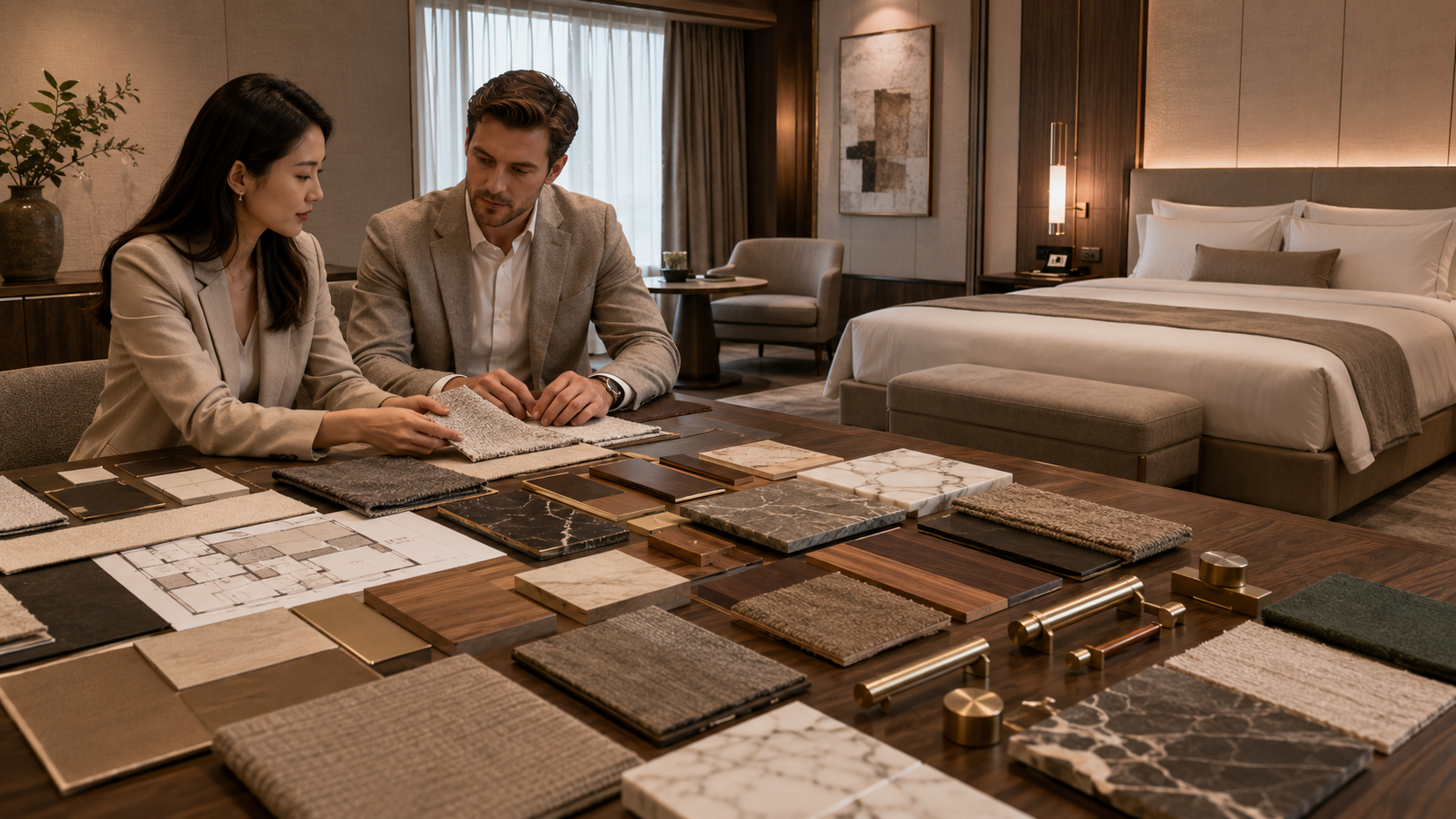
Home luxury furniture should mean more than a showroom label; it should be built to last. Walk through any high-end furniture showroom in Toronto or Montreal and you’ll see the word “luxury” attached to nearly everything above C$2,500. The problem is that the label means nothing on its own. It describes a price point, not a construction standard. It reflects a showroom aesthetic, not a durability commitment. For buyers spending serious money on furniture they expect to live with for decades, that gap between perception and reality is expensive.
The clearest standard for what luxury home furniture should actually deliver doesn’t come from retail. It comes from the hospitality industry, where companies like YM Furniture (Foshan Yauming Furniture & Construction Co., Ltd.) have spent nearly two decades building custom furniture durable and refined enough for Marriott, Sheraton, and Pullman properties across 30-plus countries. In a commercial guestroom environment, accelerated daily use puts far greater stress on furniture than typical residential conditions, which is why hospitality procurement standards are a useful measuring stick for anyone furnishing a high-end home, whether you’re sourcing locally or evaluating a custom piece from overseas.
This guide gives you a practical framework for every stage of that decision: what materials and joinery methods to look for, which design styles are defining Canadian luxury interiors right now, how to evaluate a piece in person before you commit, and where to find retailers and manufacturers worth your time and money.
What “luxury” actually means in home furniture (and why the label lies)
Retailers often apply the term “luxury” across a wide price range, sometimes starting as low as C$1,500, without any consistent construction standard behind it. Aspirational language and showroom staging manufacture a perception of quality that the actual product rarely supports. Buyers pay premium prices and get furniture that looks right for two years before the drawer runners start sticking and the sofa cushions lose their shape.
A cleaner definition works like this: true luxury home furniture is constructed to last decades, uses premium materials throughout (not just on the surfaces a buyer can see), and holds its structural and aesthetic integrity under sustained daily use. This is the standard applied in commercial hospitality environments. A hotel owner sourcing furniture for 200 guest rooms has no tolerance for pieces that look good on day one but start degrading by year three. The replacement cost at scale makes getting the specification right upfront far cheaper than cutting corners.
Reframe the purchase from decoration to asset. A C$8,000 dining table that lasts 30 years and holds its character is a fundamentally different financial decision than a C$3,500 table that looks similar in a showroom but needs replacing in a decade. Evaluating furniture the way a hotel developer evaluates FF&E (furniture, fixtures, and equipment) gives residential buyers a much sharper lens: focus on materials, joinery, and production standards first, and let aesthetics be the second conversation.
Materials that separate investment-grade home luxury furniture from everything else
Hardwood species matter more than showroom presentations typically suggest. Walnut is prized for its grain density and rich chocolatey tones, and it ranks among the toughest hardwoods available. White oak is the current benchmark for contemporary luxury design, favored by European manufacturers for its durability and elegant open grain. Ash is flexible and visually light, making it well-suited to refined Scandinavian-influenced profiles. Beech is commonly used for frames in high-end European upholstered furniture, valued for its hardness and dimensional stability. For a more detailed primer on species and their suitability, see this guide to the best types of wood for furniture.
The contrast you need to understand is solid hardwood versus veneered MDF. The self-test is simple: lift one end. Solid hardwood feels substantially heavier than a veneered or MDF piece of similar dimensions, produces a dull thud when tapped rather than a hollow knock, and shows consistent grain on edge profiles rather than a thin layer over composite. These cues work in a showroom without any special tools.
Leather and upholstery grades
In upholstery, the leather hierarchy is straightforward once you know it. Full-grain leather uses the outermost layer of the hide with no sanding or buffing, preserving the densest fibers and the natural grain. It develops a patina over decades and is the grade best suited to long-term use. Top-grain leather is sanded to remove surface imperfections, which creates a more uniform look but seals the pores, prevents patina, and reduces durability. Bonded leather is a composite of shredded leather scraps and synthetic material: it looks acceptable in a showroom and typically peels or cracks within three to five years. At the C$5,000-plus tier, most specialists consider full-grain leather the only grade worth accepting.
For upholstery fabrics, the benchmark used in luxury hospitality is a Martindale rub count of 40,000 or above for occasional-use areas, and 80,000 to 100,000 for high-traffic zones. A residential sofa used daily by a household with children or pets warrants fabric rated at a minimum 30,000 to 40,000 Martindale. Solution-dyed acrylics, performance velvets, and high-rub-count linens are the fabric categories worth specifying for premium home furnishings. If a retailer can’t tell you the rub count on the upholstery, that’s useful information about how seriously they take construction quality.
Hardware and accents
Hardware tells you whether a manufacturer’s commitment to quality runs all the way through a piece or stops at the visible surface. Drawer runners should be full-extension, soft-close metal, not plastic. Stone tops need to be properly sealed and edge-treated. Brushed brass and matte black hardware should be solid metal, not zinc with a plated finish that wears through within a few years. These details are small individually, but they reveal whether a piece was designed to perform or just to photograph well.
Craftsmanship hallmarks worth knowing before you shop
Joinery is the most reliable indicator of long-term structural quality, and it’s something you can ask to see directly. Dovetail joints in drawer construction are the clearest signal: the interlocking wedge-shaped tails and pins create a bond that resists pulling apart without mechanical fasteners. Tight, hand-cut dovetails are a near-certain sign that the rest of the piece was built with the same care. Mortise-and-tenon joinery in chair and table frames provides structural integrity under the racking forces those pieces face daily. Corner blocks in upholstered frames, typically visible when you look underneath a sofa, indicate a properly braced structure. If a manufacturer hides all construction details behind panels, ask why.
For upholstered pieces, the visible fabric is the least important quality indicator. What matters is the frame: kiln-dried hardwood, green wood retains moisture and warps after production, and eight-way hand-tied spring suspension are the marks of a sofa built for serious longevity. Sinuous springs and webbing bases are cost-reduction choices that show up over time through sagging and loss of support. Manufacturers supplying 5-star hotel rooms specify kiln-dried frames and proper spring systems because replacement cost at scale makes cutting corners expensive. That same logic applies to a sofa you plan to own for 20 years.
Finishing quality is easiest to assess in person. Look at edge routing on tabletops: sharp, machined edges suggest mass production, while hand-sanded transitions suggest craft. Examine drawer interiors for sanding quality and finish consistency. Check that veneer or lacquer edges are sealed uniformly on all sides, not just the front face. On a piece priced above C$5,000, uneven staining, visible brush marks, or rough undersurfaces are reliable indicators that production standards didn’t match the showroom price tag.
Design styles shaping Canadian luxury interiors in 2026
The dominant aesthetic in Canadian luxury showrooms right now combines what designers are calling “organic luxe” and “warm minimalism”: sculptural silhouettes, rich tactile textures, and earthy color palettes. Rigid, boxy profiles have been replaced by gently rounded sofa backs, arched cabinet forms, and circular coffee table bases. Bouclé is everywhere, expanded now into oversized sectionals and upholstered headboards. French oak dining tables with thick tops and sculptural pedestal bases are the current benchmark for dining room material quality. These trends were confirmed at the 2026 Interior Design Show in Toronto and the fall 2025 High Point Market; industry roundups and commentary on furniture trends to look out for in 2026 reinforce this reading. The practical implication for buyers is that this style demands manufacturing precision: gaps, misalignments, or uneven finishes are immediately visible on clean, curved profiles.
Not every luxury buyer wants their home to read like a design installation. Transitional design blends classical proportions with contemporary materials and finishes, producing spaces that feel refined without feeling sterile. This is the category where Canadian manufacturers like Huppé, Jaymar, and Verbois work well, offering solid wood construction, customizable finishes, and designs that age gracefully rather than trend out within a decade. For developers furnishing properties intended to appeal to broad buyer taste, transitional design typically delivers the best long-term value.
The most expensive luxury furniture for the home can still be the wrong purchase if it doesn’t fit the architecture of the space or the lifestyle of the occupant. Ceiling height affects case-good proportions in ways that look right in a showroom and wrong at home. Floor material influences whether upholstered bases or exposed legs read as more grounded. Natural light levels change how material tone registers throughout the day. Style is a preference; fit is a skill. It’s worth spending time with a designer or doing careful room measurements before committing to any significant piece, a general rule of thumb is to do this for anything above roughly C$4,000 to C$4,500, where misalignments become costly to correct.
How to evaluate luxury furniture quality on the spot
Most showroom visitors sit on a sofa and move on. A more useful approach takes about five minutes and tells you considerably more. Sit and shift your weight repeatedly to feel for frame flex. Push down on the cushion edge to test foam density and resilience. Open drawers with one hand to check runner smoothness. Look at the piece from below if you can. Weight is a useful proxy: a solid hardwood dining table should feel substantially heavier than a veneered or MDF alternative of similar dimensions. These quick physical tests reveal more than visual inspection because they engage the materials directly, not the finish layer on top of them.
Buyers should be comfortable asking direct questions before any deposit changes hands. What species of wood is used in the frame? What is the rub count on this upholstery fabric? Is this leather full-grain or top-grain? What are the lead times on custom orders and what happens to the deposit if you need to change the specification? Retailers who can’t answer these questions clearly are usually selling on aesthetic impression rather than substantive quality. Manufacturers who supply 5-star hospitality projects field these questions routinely because their buyers demand it. Residential buyers deserve the same transparency. If you’re sourcing seating for a home office or dedicated workspace, the Luxury Office Desk Chair: What To Look For Before You Buy | YM Furniture article offers a concise checklist for evaluating task and executive seating.
Some red flags are reliable across price points. Watch for “solid wood construction” applied to pieces with MDF panels and hardwood legs only. “Italian-inspired” language applied to domestically produced pieces with no European material sourcing. Return policies that exclude custom orders the moment any deposit is placed. Lead times under four weeks on made-to-order pieces, which suggest batch production rather than genuine custom fabrication. These signals matter at every tier, but they’re especially costly to ignore when you’re spending C$5,000 or more.
Price tiers in the Canadian luxury furniture market
The Canadian luxury furniture market breaks into three practical tiers. Entry luxury (C$2,500 to C$4,500) covers solid construction and reasonable material quality, but often uses engineered wood cores, standard upholstery grades, and imported hardware that doesn’t match the frame quality. This is where many buyers overpay because the showroom presentation is sophisticated but the construction underneath it isn’t. Mid-tier luxury (C$4,500 to C$8,000) is where solid hardwood frames, full-grain leather, and European-made furniture start appearing consistently. A quality custom sofa from Jaymar or a solid walnut dining table from Verbois sits in this range and is worth the price. True investment tier (C$8,000 and above) covers bespoke commissions, limited-edition designer pieces, and full custom work with production lead times that reflect genuine handcraft.
Customization costs are additive at every tier. A standard sofa configuration may list at C$5,000, but a custom fabric, non-standard seat depth, or different leg finish adds meaningfully to the final number. Lead times for custom orders from Canadian retailers typically run eight to twelve weeks. Retailers like ref. in Montreal, EQ3, and Acre Made in Toronto build their model around this customization premium. The key question to ask before placing any deposit is what the base price actually includes and exactly what triggers a surcharge.
Some of the most expensive retail furniture in Canada is priced to reflect brand prestige, showroom real estate, and logistics overhead as much as construction quality. Buyers who pay investment-tier prices need to verify investment-tier quality, using the construction and material criteria covered earlier in this guide, not the retailer’s marketing language or the showroom address.
The factory-direct approach residential developers are quietly using
Hotels don’t buy furniture from showrooms. They work directly with manufacturers who produce to exact specifications, provide samples before full production begins, and manage delivery logistics at scale. The quality bar is high because hotel owners understand that replacement costs in a guestroom environment are far more expensive than getting the specification right from the start. This procurement logic, direct, specification-driven, and quality-certified, is something residential developers and serious homeowners are starting to apply to their own projects.
YM Furniture (Foshan Yauming Furniture & Construction Co., Ltd.) is a Foshan-based manufacturer that has spent 17 years producing custom furniture for 4- and 5-star hotels across more than 30 countries, with completed projects for Marriott, Sheraton, and Pullman properties. What makes them relevant for residential buyers is the direct equivalence: the same factory, the same materials, and the same quality certifications (ISO 9001, ISO 14001) that produce furniture for a 200-room hotel property are available for private villa and residential projects at factory-direct pricing. That translates to savings of up to 70% compared to what Canadian high-end furniture retailers charge for comparable quality. The 20-day model room customization capability means buyers can see a full prototype before committing to full production, a level of proof-of-concept almost no Canadian retailer can offer. For a deeper look at why beds specified for hospitality matter in this context, see What Makes A Luxury Bed Worth The Investment For Hotels | YM Furniture.
This approach suits developers furnishing multiple units who need consistency and volume, homeowners with renovation timelines who can plan eight to twelve weeks ahead, and designers who need precise dimensional and material control for high-end residential commissions. It requires more lead time than walking into a showroom, but the result is furniture built to hospitality durability standards, fully customized to specification, and backed by verifiable quality certifications. For anyone spending C$30,000 or more furnishing a home, comparing factory-direct pricing against retail quotes is worth the additional planning time.
Where to find quality luxury furniture for the home in Canada
Toronto has the deepest concentration of premium home furnishings showrooms in the country. Hollace Cluny carries De La Espada and Carl Hansen and Son, both representing the European benchmark for precision joinery and material quality. Kiosk’s three-floor showroom features Poltrona Frau and Glas Italia, architectural pieces built to high European production standards. South Hill Home specializes in one-of-a-kind pieces with handcrafted origins and precious materials. These are the designer furniture retailers worth visiting in person to apply the quality evaluation framework covered earlier in this guide: the showroom visit is where you assess joinery, test upholstery construction, and compare what the piece actually is against what it costs. For a broader list of reputable Canadian outlets, see this roundup of favourite Canadian furniture stores.
Montreal and Quebec offer the strongest concentration of Canadian-made options. Maison Corbeil is the largest luxury furniture retailer in the province and a practical starting point for breadth of selection. Jaymar, with over 60 years of production experience, is the Quebec benchmark for high-end upholstered furniture. Huppé produces solid bedroom and living room furniture in designs that hold their relevance well over time. Verbois builds contemporary dining and bedroom pieces in solid walnut, birch, and complementary materials, with a level of material quality that competes with European imports at comparable price points. If you’re specifically researching Canadian-made brands, this piece on 4 top Canadian-made furniture brands is a useful starting point. For buyers outside Toronto and Montreal, EQ3 offers Canadian-manufactured modern furniture with genuine customization options available nationally.
For true custom work, several Canadian studios offer made-to-order service worth knowing. ref. in Montreal specializes in solid wood pieces with eight to twelve week lead times and complimentary design consultations. Acre Made in Toronto covers dining and living room pieces with white-glove delivery in the GTA. Livenormad in Calgary offers modular configurations built to client specifications without retail markup. Before placing any deposit with any of these studios, confirm whether white-glove delivery is included or priced separately (typically C$150 to C$600), what the return window is for custom versus in-stock items, and what warranty coverage applies. Custom pieces are almost universally final sale once production begins, so the pre-order conversation is the right time to ask every question. Designers comparing manufacturers should also see How To Choose The Right Luxury Bed Company For Your Project | YM Furniture for vendor selection criteria that translate beyond beds.
The bottom line
Home luxury furniture is a definable, evaluable standard, not a marketing claim. The buyers who make the best decisions in this category treat furniture the way they treat any significant asset purchase: they know what materials and construction methods to look for, they ask direct questions, and they understand what they’re paying for at each price tier. Applying the entry-to-investment price framework covered earlier is a practical starting point before any showroom visit.
The hospitality industry has spent decades building this knowledge into procurement processes. Residential buyers can apply the same logic. Whether you’re visiting a showroom in Toronto, commissioning a custom piece from a Quebec workshop, or sourcing factory-direct through a manufacturer like YM Furniture for a residential development, the criteria don’t change: solid materials, proven joinery, and production backed by verifiable quality standards.
That’s what separates luxury home furniture worth owning for 30 years from furniture that just looks the part on day one. Use the framework in this guide to tell the difference before you spend, not after.