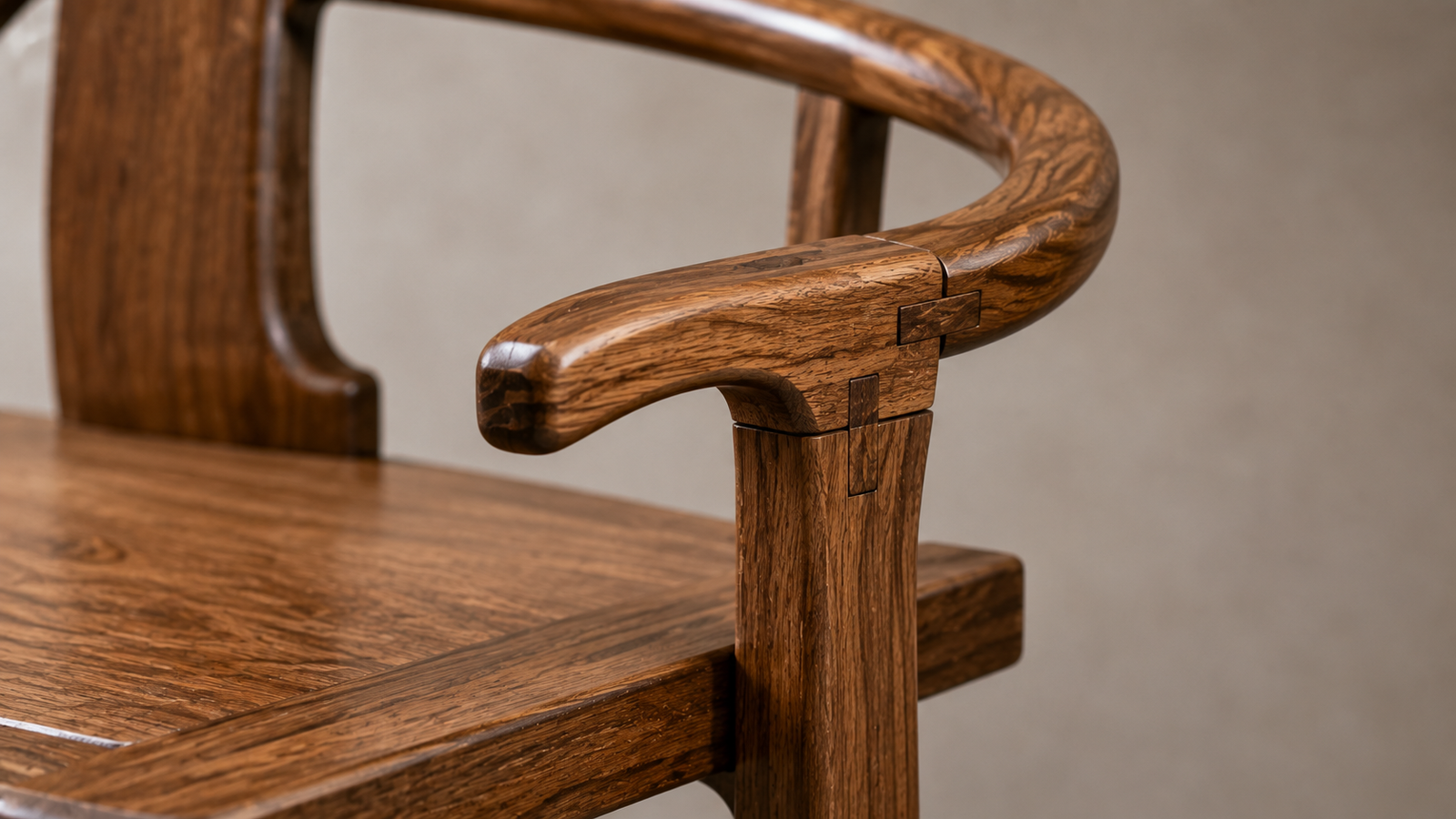
In 1943, Hans Wegner did something that most furniture designers of his era would never have thought to do. He studied Chinese chairs. Specifically, he studied Ming dynasty joinery: the continuous arm-to-leg curves, the yokeback profile, the interlocking mortise-and-tenon construction that held these chairs together without a single nail or drop of glue. What he saw in those centuries-old structures wasn’t decorative tradition. It was structural engineering. That study became the China Chair, one of the most referenced pieces in modern furniture history, and the starting point for the Round Chair and eventually the Wishbone, proof that china chairs have shaped global design far beyond their origins.
The reason that story matters to a commercial buyer in 2026 is this: the principles Wegner recognized in Ming furniture didn’t disappear. They scaled. Guangdong province is now home to the largest concentration of commercial furniture manufacturing in the world, carrying forward centuries of woodworking knowledge into industrial-scale production. Manufacturers like Foshan Yauming Furniture combine that joinery heritage with modern CNC precision and factory-direct economics, supplying hospitality-grade seating to projects across more than 30 countries.
This guide is for buyers who need to source chairs from China for hotels, restaurants, residential developments, or commercial spaces and want to do it without expensive mistakes. You’ll find realistic pricing, lead time expectations, quality control checkpoints, and a clear picture of what importing china chairs actually costs once duties and freight are factored in.
The design legacy that put Chinese chairs on the global map
How a Danish designer changed chair-making history
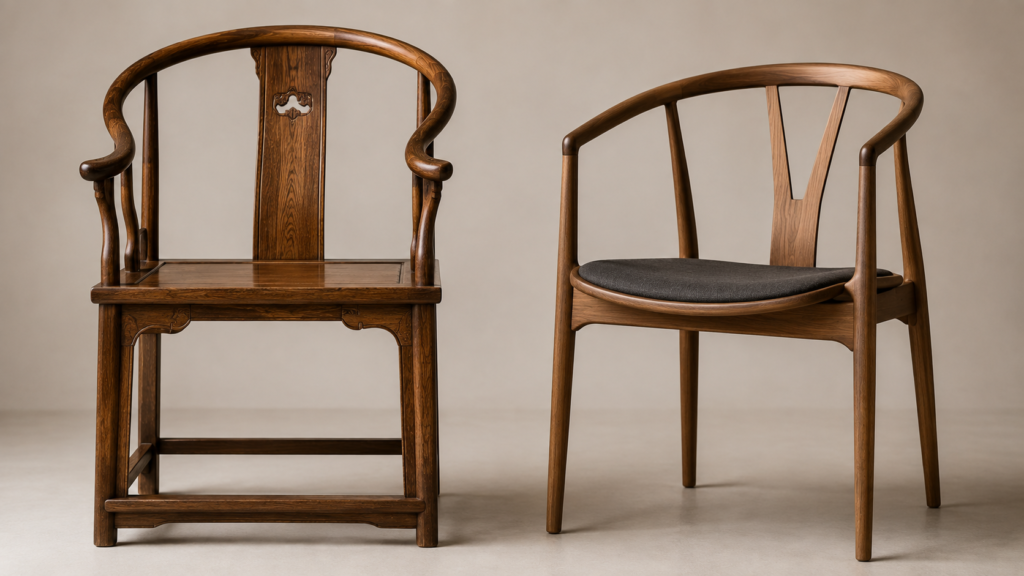
Wegner presented the first version of his designer China chair at the Cabinetmakers’ Guild Autumn Exhibition in 1943. The inspiration came from museum collections and books on Ming dynasty furniture, particularly the round-backed “seat of honor” forms that appeared in portraits of Danish merchants trading with China. His approach wasn’t to copy those chairs. It was to extract their structural logic and translate it into a modern Scandinavian idiom.
The Ming chair’s structural principles that captivated him were specific. The yokeback: a continuous curved crest rail that flows into the rear legs without a visible break. The arm-to-leg joint: a single piece of wood that forms both functions simultaneously, reducing material waste and connection points. The reliance on wood tension and interlocking joinery rather than mechanical fasteners. These weren’t aesthetic choices. They were engineering solutions, and they had held up for centuries of daily use.
Why Ming joinery is still relevant for buyers today
The same structural logic that Wegner identified now informs commercial-grade chair production across China’s furniture manufacturing belt. Factories that have grown from craft workshops into precision manufacturing operations understand frame geometry, joint tolerances, and material behavior at a level that most Western competitors simply can’t replicate at comparable cost. That knowledge base is why China chair manufacturers attract bulk orders from hotel groups, restaurant chains, and international retailers year after year.
For a commercial buyer, this translates to a concrete concern: a chair that won’t wobble, crack at the joints, or fail under daily load after 18 months of heavy use. The engineering heritage embedded in Chinese furniture manufacturing, combined with modern CNC precision and multi-layer quality systems, is what makes that durability achievable at factory-direct pricing, an informed interpretation based on consistent factory-floor performance rather than a single data point.
Foshan: the city that built on that tradition
Foshan, in Guangdong province, is the center of China’s commercial furniture production. The city hosts an extraordinary concentration of specialty manufacturers, material suppliers, foam producers, fabric distributors, metal fabricators, and finishing workshops within a compact geographic radius. That supply-chain density drives down both cost and lead time in ways that manufacturers in other regions can’t easily replicate. Foshan is a major center for upholstered and hospitality-grade chair production in China, and it’s the base from which most serious Chinese furniture exporters operate.
Why China still leads global chair manufacturing in 2026
The scale and specialization gap
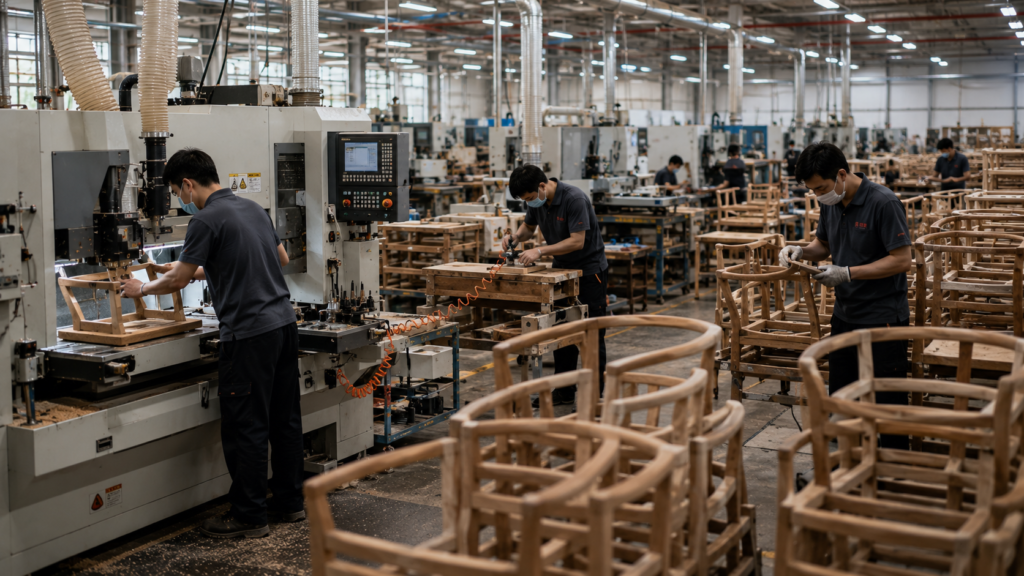
Chinese factories in the commercial seating segment operate with infrastructure that most buyers outside the country don’t fully appreciate until they visit. A mid-to-large hospitality furniture factory runs dozens to hundreds of precision machines across dedicated production lines segmented by chair category: dining, office, banquet, and upholstered. Frame fabrication, foam cutting, upholstery, and finishing each occupy separate controlled environments with their own quality checkpoints.
The supplier ecosystem within Foshan and surrounding Guangdong compounds that cost advantage further. A factory can source solid oak frames, commercial-grade foam, performance fabric, and stainless hardware within a compact geographic radius and still hit a competitive FOB price. That vertical integration is what allows factory-direct pricing that local distributors in North America, Europe, or Australia structurally cannot match, regardless of how efficiently they operate.
Certifications that matter for commercial buyers
When evaluating Chinese chair manufacturers, certifications are screening tools, not quality guarantees. The baseline certifications to look for are ISO 9001 for quality management systems and ISO 14001 for environmental compliance. These tell you the factory operates documented, auditable systems. They don’t tell you every chair is defect-free, which is why active QC oversight remains necessary regardless of what certificates are on file.
For office seating, BIFMA compliance and EN 1335 are the standards that matter for commercial acceptance. For hospitality seating, CQC and SGS certifications are common reference points. The critical rule: always request the actual certificate document showing the company’s legal name, certificate number, scope, and expiry date. Then verify that certificate number directly with the issuing certification body’s public registry. A logo on a website proves nothing.
Where Chinese manufacturers outperform and where they don’t
Chinese factories outperform on price, customization depth, and production capacity. A factory with 70,000 square meters of manufacturing space can run simultaneous production lines for multiple SKUs while meeting a hotel opening deadline. That capability simply doesn’t exist at the same price point through domestic suppliers.
The trade-offs are real and worth stating directly. Chinese production requires more active quality oversight, longer planning horizons, and upfront investment in sample approval before bulk runs. Communication across time zones adds friction. Local suppliers offer shorter lead times and easier access for site visits, but the unit cost premium is significant. On a 200-chair hotel project, the per-unit price difference between a local distributor and a direct Chinese factory often funds the entire logistics budget and still leaves meaningful savings on the table.

China chairs vs. local suppliers: an honest cost comparison
Breaking down the real price differential
A hospitality-grade upholstered dining chair from China runs $35 to $125 FOB depending on frame material, fabric spec, and construction complexity. A comparable specification through a North American distributor typically runs $200 to $400 per unit. On a 200-chair restaurant or hotel project, that differential is $33,000 to $55,000 before logistics costs, enough to fund ocean freight, import duties, and inland delivery with room to spare.
The math holds across categories. Wood dining chairs from Chinese factories run $25 to $70 FOB versus $150 to $300 through domestic channels. Office task chairs run $45 to $260 FOB depending on ergonomic specification. Stacking and banquet chairs come in at $12 to $45 FOB. At volume, the savings are structural, not marginal.
The hidden costs local buyers often forget
The China price doesn’t arrive at your door at FOB. Buyers who skip the landed-cost calculation and compare FOB to local shelf prices are setting themselves up for an unpleasant surprise. The costs that need to be layered in include sample fees and tooling for custom designs, ocean freight, cargo insurance, import duties, customs brokerage, and inland trucking from the port to your delivery address.
For U.S. buyers in 2026, the most significant add-on is the Section 301 tariff: an additional 25% duty on Chinese-origin furniture above the base MFN rate, which is often 0% for HTS 9401 chair lines. Tariff classifications and any temporary measures can shift, so confirm the exact figures for your HTS subheading with a licensed customs broker before committing. Even with those duties applied, the landed cost on China-made chairs typically undercuts local pricing by 40 to 60 percent on volume orders. The key is doing the math before committing, not after the goods arrive at the port.
When local sourcing genuinely makes sense
For orders under 20 units, urgent timelines with no planning buffer, or projects requiring strict domestic content compliance, local sourcing can be the more practical choice. The logistics overhead and minimum order requirements of international sourcing don’t make economic sense at very small quantities. China sourcing wins decisively on volume commercial projects. It’s not the right answer for every situation.
What chairs from China actually cost: FOB, CIF, and landed price breakdown
2026 price ranges by chair category
FOB pricing from Chinese factories in 2026 for standard MOQ runs breaks down as follows across the most common commercial chair types:
| Chair Category | FOB Price | CIF Price |
|---|---|---|
| Wood dining chair | $25 to $70 | $30 to $85 |
| Upholstered dining chair | $35 to $125 | $42 to $145 |
| Office task chair | $45 to $260 | $55 to $310 |
| Stacking or folding chair | $12 to $45 | $18 to $60 |
FOB means the seller covers all costs to the loading port. Your obligations begin when the goods are on board the vessel. CIF adds ocean freight and cargo insurance to the destination port. Neither FOB nor CIF includes U.S. import duties, customs brokerage fees, or inland delivery from the port to your warehouse or project site.
Building the full landed cost for U.S. buyers
Take a mid-range upholstered dining chair at $75 FOB as a worked example. Ocean freight from Guangzhou to the U.S. West Coast in a shared container (LCL) adds approximately $16 to $32 per chair depending on carton density and current market rates. Cargo insurance runs roughly 0.5% of declared value. The base MFN customs duty on HTS 9401 chairs is commonly 0%, and Section 301 adds 25% on the entered value, approximately $18.75 per unit on a $75 chair. The Merchandise Processing Fee runs 0.3464% of entered value, and the Harbor Maintenance Fee adds 0.125% for ocean shipments. Customs brokerage and inland trucking to your delivery address add another $3 to $8 per unit on a volume order.
Total landed cost on that $75 FOB chair: approximately $115 to $135 per unit at the U.S. West Coast. Compare that to a local distributor price of $220 to $350 for equivalent specification. The China advantage holds clearly, but only if you’ve budgeted for the full cost structure from the beginning.
A note on tariff codes and upholstered chairs in 2026
U.S. buyers sourcing upholstered seating need to confirm the exact 10-digit HTS code within the 9401.61 subheading with a licensed customs broker before placing the order. The correct classification determines exactly which additional duties apply. Budget conservatively, confirm the classification early, and don’t rely on the factory’s suggested HTS code without independent verification. This is not a reason to avoid China sourcing. It’s a reason to plan accurately from day one.
Lead times and MOQ: setting realistic expectations before you order
Standard production timelines for common chair types
Standard chair production in China runs 25 to 45 days from order confirmation and material arrival. Custom designs that require new tooling, unique frame profiles, upholstery pattern development, or specialty wood finishes extend that range to 45 to 90 days. Add ocean freight of 4 to 8 weeks depending on origin port and U.S. destination port, and the total end-to-end timeline from order confirmation to delivery runs 8 to 18 weeks for most commercial orders.
West Coast ports (Los Angeles, Long Beach) receive Foshan-origin shipments in approximately 18 to 25 days at sea. East Coast ports via the Panama Canal add another 7 to 10 days. Build these transit times into your project schedule from the moment you issue the purchase order, not after production is complete.
Typical MOQ ranges and what affects them
Custom hospitality-grade chairs typically carry a minimum order quantity of 20 to 50 units per SKU. Standard catalog models from some factories can accept lower quantities, but buyers who want custom frames, proprietary upholstery patterns, or specific finishes should plan at 20 units per SKU as their working floor. Projects that require multiple SKUs, different chair finishes for various restaurant zones or room categories in a hotel, for example, need separate MOQ planning for each variant.
Rush production options and what they actually cost
Rush scheduling can compress production timelines by 20 to 35%, bringing standard production down to 20 to 25 days in some cases. Rush fees typically run 10 to 15% of order value. Expedited samples are available at many factories within 5 to 14 days, sometimes with a 15% surcharge on sample costs.
Air freight is available for genuine emergencies, with transit times of 7 to 12 days globally, but the cost premium is significant compared to ocean freight. Use air for samples and genuine last-resort situations only. Sea freight is always the correct default for bulk orders.
Quality control checkpoints you should never skip
Material verification before production starts
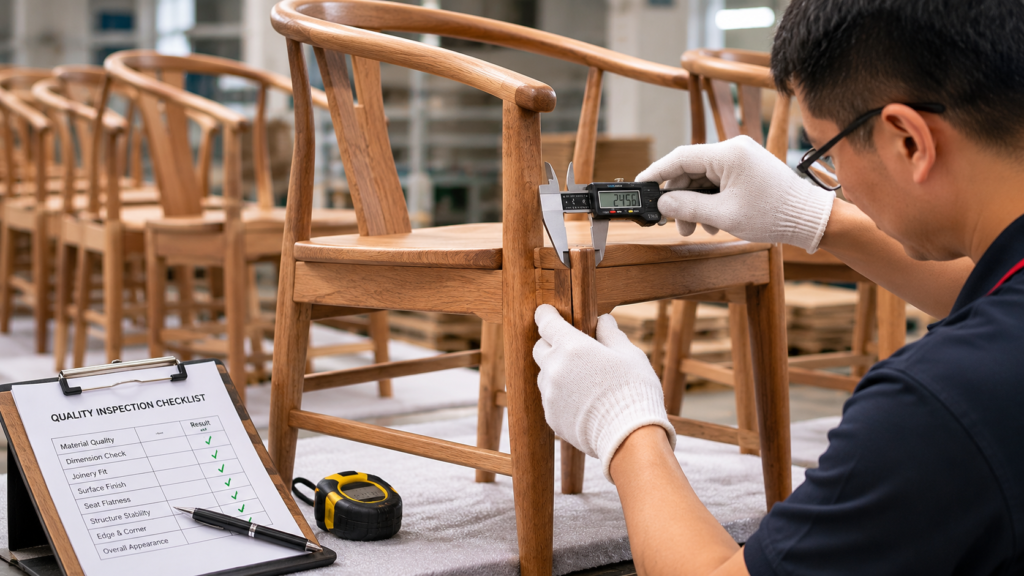
Incoming material verification catches the majority of quality problems before a single chair is assembled. Confirm wood species against the approved sample and reject any substitution. Check moisture content: the target for export furniture destined for North America or Europe is 8 to 12%. High moisture content causes warping and joint failure after delivery. Verify plywood grade and face quality against the specified grade in your purchase order, and check foam density against specification, typically 35 to 45 kg/m³ for commercial upholstered seating.
Fabric verification requires matching the exact fabric code, colorway, fiber content, weight, and weave to the master swatch. Check roll labels, lot numbers, and color consistency before the upholstery process begins. A shade variation caught at the fabric stage costs nothing to fix. The same problem caught at pre-shipment inspection means rework, delay, and cost.
Inline and pre-shipment inspection steps
In-process inspection focuses on what gets hidden by the next production step. Inspect frame joinery, glue lines, dowel placement, and hardware fit before the upholstery goes on. Check that frames are square, fasteners are seated correctly, and foam is correctly positioned and attached. Stitching tension, seam alignment, and cushion shape all need verification before the chair reaches final assembly.
Pre-shipment inspection covers the finished product against technical drawings: overall dimensions, seat height, arm height, finish and color match to approved sample, carton labeling, and packing integrity. Stability tests and load tests should be run on sampled units from the production run, not just on the pre-production sample that was approved months earlier.
The performance tests that protect commercial buyers
Commercial chairs require static load tests, fatigue and cyclic tests, impact tests, and stability tests. Office chairs add swivel, tilt, and caster tests. Hotel and restaurant buyers should specify these tests in the purchase order itself, with defined pass/fail criteria, not request them informally after production is complete. A factory that knows the test requirements from day one will build to meet them. A factory that hears about testing requirements at the pre-shipment stage will find ways to pass them on sampled units only.
Customization options that serious China chair manufacturers offer
OEM and ODM: knowing the difference
OEM means you supply the design and the factory executes it to your specification. ODM means the factory provides existing designs from their own development portfolio, which can be modified within certain parameters. Most hotel and restaurant buyers operate in OEM mode for branded projects where consistency with brand standards is non-negotiable. Chinese factories with in-house CNC capabilities, veneer processing, and upholstery departments can execute complex OEM briefs, including multi-finish frames, proprietary leg profiles, and custom upholstery patterns, at production scale.
ODM works well for projects where the buyer doesn’t have detailed design specifications and needs a starting point that can be adapted. Budget-conscious buyers working on tighter timelines often prefer ODM because tooling costs are lower and sampling cycles are faster when the factory is working from an existing base design.
Material and finish customization for hospitality and commercial use
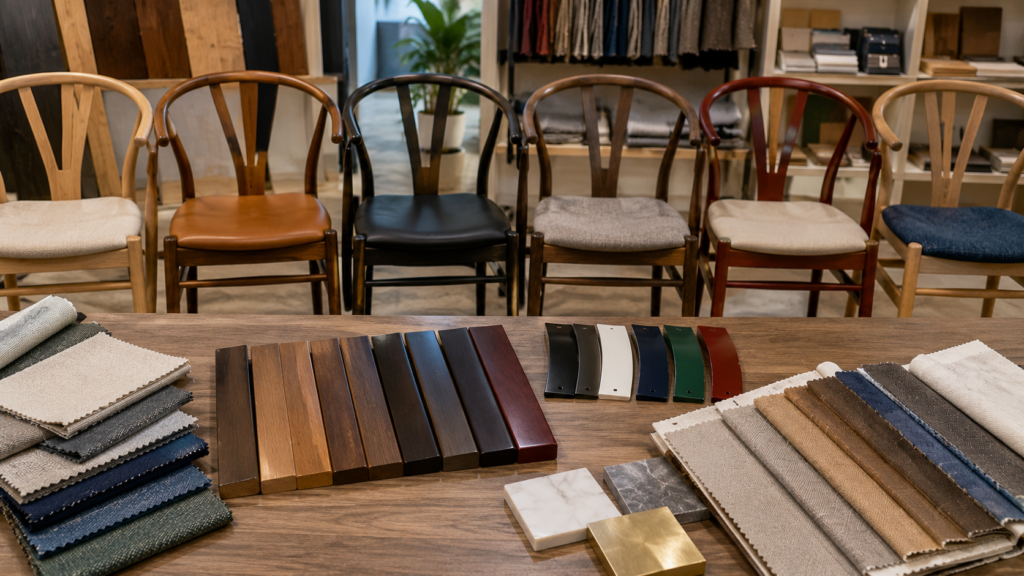
A well-equipped Chinese chair manufacturer can work across a wide material and finish specification range. Wood species options typically include oak, walnut, ash, and beech. Frame finishes cover lacquer, paint in custom RAL colors, stain, and metal powder coat for steel components. Foam specification covers density, ILD firmness rating, and fire-retardant treatment for markets with specific compliance requirements. Fabric options range from performance textiles and leather to COM (customer’s own material), where the buyer ships fabric directly from their approved supplier to the factory.
The critical discipline on customization projects is locking all specifications into the approved sample and finish schedule before bulk production begins. Changes requested after production starts are expensive, slow everything down, and create scope for errors. The approved sample is the legal and operational reference document for the entire production run.
Mock-up rooms and sample approval for large projects
For hotel and restaurant projects ordering 100 or more chairs, the mock-up room process is standard practice among experienced hospitality-grade manufacturers. The factory produces a complete pre-production sample environment with the full furniture specification in place, which the client approves before bulk production begins. This step eliminates the risk of expensive post-production corrections on large runs.
YM Furniture builds this capability into its standard project process. With a 70,000-square-meter facility, 17+ years of export experience, and direct involvement on 1,000+ completed projects across more than 30 countries, the team produces and stages complete mock-up rooms for client approval, covering seating, casegoods, and soft furnishings, before a single bulk-production piece is cut. Buyers should budget sample fees into the project and build the approval cycle into the master schedule from the start.
Shipping, import duties, and U.S. customs: the complete logistics picture
Ocean freight basics for chair importers
The core freight decision is FCL (full container load) versus LCL (less-than-container load). FCL rates are a flat container charge, so per-chair cost drops as you fill more of the container. On orders of roughly 100+ chairs depending on chair density and carton size, FCL typically delivers a lower per-unit freight cost than LCL consolidation. LCL pricing is charged per cubic meter and works better for smaller orders, but adds consolidation and deconsolidation handling fees that erode its apparent rate advantage.
As a general planning guide, shipments below approximately 12 to 15 CBM usually favor LCL. Above that threshold, FCL becomes more cost-effective per unit. On a 20-foot FCL from Guangzhou to a U.S. West Coast port at a current market rate of $2,500 to $5,000 per container, loading 200 chairs brings the ocean freight component down to $12.50 to $25 per chair before local fees, a figure that’s difficult to match on LCL rates of $80 to $160 per CBM.
HTS codes and 2026 duty structure for chairs from China
Chairs import under HTS Chapter 94, specifically the 9401 heading for seats. The exact 10-digit code determines the applicable duty rates. For most Chinese-origin chairs, the base MFN duty is 0%, but Section 301 adds 25% across virtually all Chinese furniture categories. That 25% is calculated on the entered value of the goods, so it’s a material cost that needs to be in your budget from the beginning of the project, not discovered at customs clearance.
Engage a licensed U.S. customs broker before placing your first order. The broker confirms the correct 10-digit HTS classification, identifies any applicable Chapter 99 additional duty codes, calculates the full duty liability, and handles customs entry filing. Broker fees on a standard commercial shipment are modest relative to the risk of misclassification or an unexpected duty assessment.
Documentation every importer needs ready
A complete import documentation package for chairs from China includes the commercial invoice, packing list, bill of lading or air waybill, certificate of origin, and any required compliance certifications. For upholstered seating, fire resistance test reports and formaldehyde emission compliance documentation may be required depending on the destination state or project specification. Missing documentation at the port delays customs clearance and triggers storage and demurrage charges that accumulate quickly. Confirm the full documentation requirement with your customs broker before the factory books the shipment.
How to find and vet a reliable China chair manufacturer
The supplier evaluation checklist
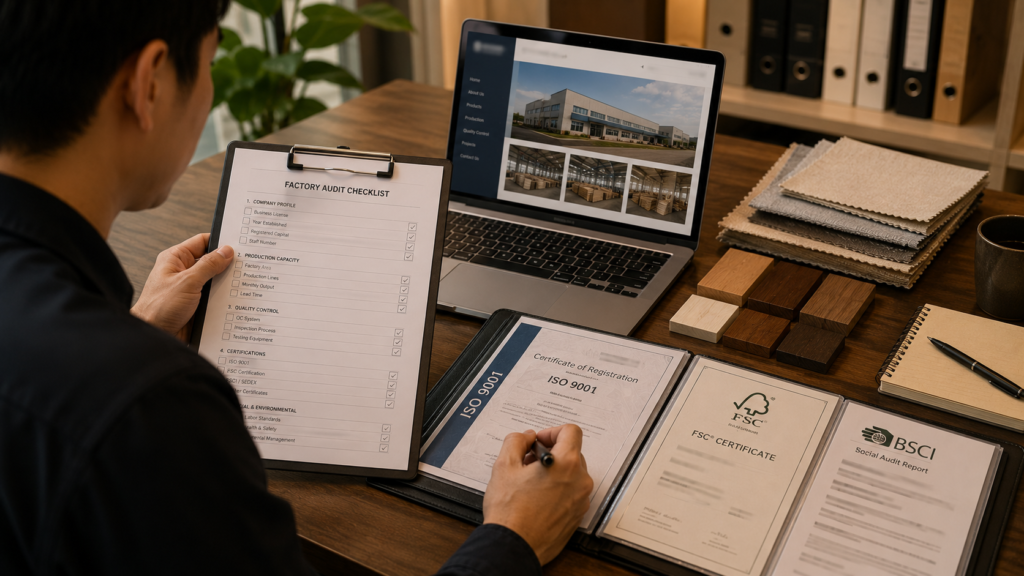
Vetting a Chinese chair manufacturer requires more than reviewing a website and requesting a quote. Start by verifying business registration and export license: the factory should be a legitimate export-authorized entity, not a trading company representing an unknown production facility. Request ISO certificates and product-specific certifications, then verify each certificate number directly with the issuing certification body’s public registry. A certificate that doesn’t appear in the registry is not a valid certificate.
Ask for an audited factory profile and review their project portfolio for chair types similar to your specification. Confirm in-house QC systems: factories that rely entirely on third-party inspection at the end of production have no early-stage quality control. Ask about their export history and which destination markets they serve regularly. A factory with consistent export experience to North America and Europe understands documentation requirements, packaging standards, and compliance expectations that a domestically focused manufacturer may not.
YM Furniture: a factory-direct case study
YM Furniture (Foshan Yauming Furniture and Construction Co., Ltd.) illustrates what a well-structured factory-direct hospitality seating supplier looks like in practice. The company operates from a 70,000-square-meter manufacturing facility and brings 17+ years of export experience to every project, with a completed roster spanning 1,000+ hospitality and residential installations across more than 30 countries. The operational picture: ISO-certified production, rapid mock-up room capability, full OEM and ODM execution, in-house QC systems at every production stage, and end-to-end project coordination from design consultation through on-site installation.
Their project roster includes work for internationally recognized hospitality brands, which signals the quality verification standard and documentation discipline they operate to on every project. For buyers sourcing hospitality-grade Chinese chairs at scale, that track record is the benchmark to measure other factories against. Factory-direct pricing, hospitality-specific expertise, and complete project coordination are what separate a manufacturing partner from a commodity supplier.
Red flags that should end a supplier conversation
Experienced hospitality buyers have learned to watch for specific warning signs that indicate a factory is not suitable for commercial projects. A factory that refuses independent third-party inspection is the most serious: if they won’t allow an inspector, there’s a reason. Suppliers who can only provide ISO certificate logo images instead of actual documents with verifiable certificate numbers are presenting unverifiable claims. MOQs that drop suspiciously low on custom orders, especially well below the 20-unit floor typical for hospitality-grade custom production, often signal that the factory is quoting on standard product it will deliver regardless of your specification.
Quoted lead times that undercut industry norms by more than 30% without explanation warrant direct questioning. Pricing that sits significantly below the market floor for the specified chair type is the clearest signal of all: either the specification will be compromised in production, or the factory is inexperienced enough to underquote and won’t deliver as promised. Each of these red flags deserves a direct question and a satisfactory, verifiable answer before you proceed.
Frequently Asked Questions
How much cheaper are china chairs compared to local suppliers?
A hospitality-grade upholstered dining chair from China runs $35 to $125 FOB, versus $200 to $400 through a North American distributor for a comparable specification. Even after landed costs and Section 301 duties, China-made chairs typically undercut local pricing by 40 to 60 percent on volume orders.
What is the minimum order quantity for china chairs?
Custom hospitality-grade chairs typically carry an MOQ of 20 to 50 units per SKU. Standard catalog models from some factories can accept lower quantities, but buyers wanting custom frames or proprietary upholstery should plan around 20 units per SKU as their working floor.
How long does it take to import chairs from China?
Standard production runs 25 to 45 days, with fully custom designs extending to 45 to 90 days. Add 4 to 8 weeks of ocean freight depending on origin and destination port, bringing the total end-to-end timeline to roughly 8 to 18 weeks for most commercial orders.
Do china chairs meet U.S. safety and compliance standards?
Reputable manufacturers can meet BIFMA, EN 1335, CQC, and SGS standards depending on the application, but certifications should always be verified directly with the issuing body’s public registry rather than taken from a logo on a website.
What import duties apply to china chairs in 2026?
Most chairs fall under HTS 9401, where the base MFN duty is commonly 0%, but Section 301 adds an additional 25% on Chinese-origin furniture. Confirm the exact 10-digit HTS classification with a licensed customs broker before placing an order, since tariff measures can shift.
What sourcing china chairs actually comes down to
Wegner studied Chinese joinery because he recognized that the engineering embedded in Ming dynasty chairs was structurally superior to what European furniture was producing at the time. The principles he identified weren’t cultural artifacts. They were solutions to real mechanical problems, and they held up under scrutiny. Modern Chinese chair manufacturing carries those same principles forward, with the added dimension of industrial-scale production, international certifications, and factory-direct economics that make large commercial projects viable in ways that domestic sourcing can’t match.
The buyer’s job is to find the manufacturers who operate to that standard rather than those who simply trade on low prices. With the right supplier, an honest landed-cost budget that accounts for freight and duties from day one, and disciplined quality control at every production stage, sourcing china chairs delivers genuine, measurable value on commercial and hospitality projects.
Start with a sample order from a factory you’ve vetted through the checklist above, and verify the quality in hand before committing to bulk production. Build the supplier relationship on a foundation of clear specifications, contractual QC terms, and open communication, then scale once you’ve confirmed they can execute to your standard. Sourcing china chairs well requires rigorous vetting, a full landed-cost budget, and disciplined QC, but the savings and scale on volume commercial projects are real and repeatable. The economics are there. The manufacturing capability is there. The only variable is the quality of the partner you choose.