You’ve spent two weeks researching Chinese furniture factories, found one that looks strong, and sent an enquiry for a custom chair design. The quote comes back and everything looks promising until you get to the minimum order quantity. The factory wants 200 units per design. You needed 40. The conversation stalls before it’s even started.
If you’re asking what is the minimum order quantity for custom furniture from a Chinese manufacturer, the honest answer is: it depends on more variables than most buyers expect, and misreading those variables is what stalls most sourcing conversations before they begin. The cost advantage of sourcing furniture from China can be substantial, but that advantage only materialises when you understand the rules of the system you’re buying into.
This article covers everything you need to navigate minimum order quantities with Chinese furniture manufacturers: how factories set them, what typical ranges look like by product type, which factors push numbers higher, how to negotiate effectively, and why buyers working on hotel and villa projects often find the whole conversation shifts at project scale. Factory-direct manufacturers like YM Furniture (Foshan Yauming Furniture & Construction Co., Ltd.) approach custom orders quite differently from generic exporters, and understanding that distinction is worth your time if you’re buying at any meaningful volume.
What is the minimum order quantity for custom furniture from a Chinese manufacturer?
How factories quote minimums: per SKU, not per order
Chinese furniture factories typically quote minimum order quantities by individual SKU, meaning by individual design or model, not by total order value, total piece count, or factory production run. This distinction catches a lot of buyers off guard. If you’re ordering five different chair designs at 20 units each, you have not placed one order of 100 chairs in the factory’s eyes. You’ve placed five separate MOQ commitments, each of which needs to meet the factory’s minimum for that design independently.
The reason for this is straightforward: each SKU carries its own material purchasing requirement, cutting programme, and production setup cost. The factory treats every distinct design as a separate economic unit because the costs attached to it are genuinely separate. Knowing this changes how you approach an order. Consolidating SKU variants early, fewer colours, fewer size options, is one of the most direct levers available to you before you even open a negotiation.
Why MOQ exists: the fixed cost logic
A factory’s minimum order quantity isn’t an arbitrary number someone typed into a price list. It represents the point at which the factory’s fixed production costs for that design are spread across enough units to make the run economically viable. Those fixed costs include material batch minimums from their own suppliers, machine setup time, CNC programming, and finishing line changeovers. Every one of these is a real cost the factory incurs before a single piece comes off the line.
Understanding this logic is the first step to negotiating the minimum order quantity for custom furniture from a Chinese manufacturer effectively. When you argue with an MOQ number without understanding why it’s there, you’re asking the factory to absorb a cost they’ve already calculated. When you address the underlying cost driver directly, through a higher deposit, a phased order commitment, or simplified specifications, you give them a reason to move. The number isn’t the problem; the risk and cost exposure behind it is.
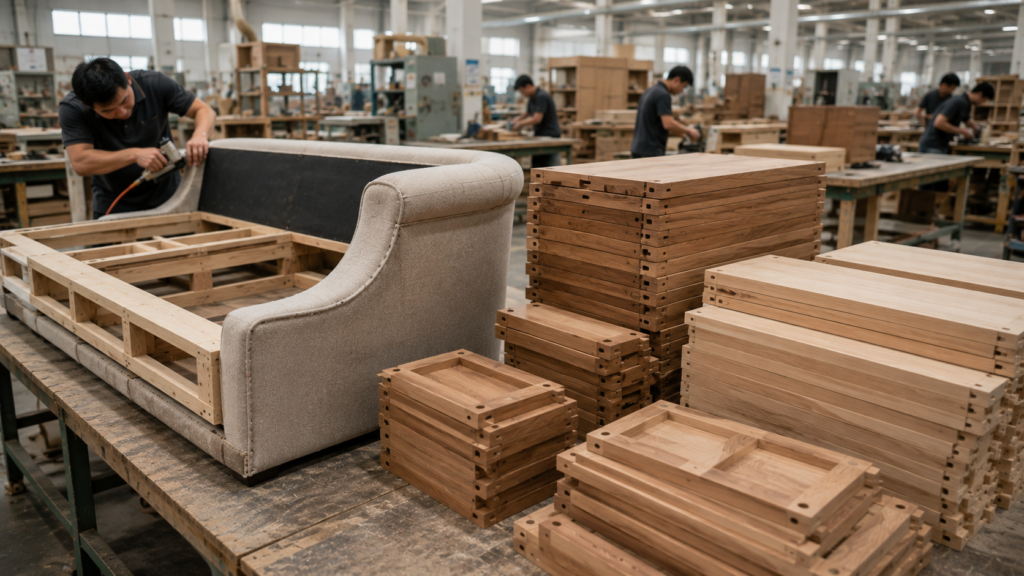
Typical MOQ ranges by furniture type and material
Upholstered furniture: lower floor, more flexibility
For upholstered pieces, the typical MOQ for furniture per SKU from Chinese OEM factories runs between 10 and 100 units, with most custom orders landing in the 20 to 50 unit range. Upholstery allows more flexibility than solid wood furniture because the setup costs are comparatively lower, production batches are easier to run small, and fabric can sometimes be supplied by the buyer rather than sourced by the factory. When the buyer provides their own material (known in the trade as COM, or customer’s own material), the factory’s fabric MOQ problem disappears entirely.
For hospitality buyers ordering custom-upholstered sofas, headboards, or lounge seating, this category is often the most accessible entry point for a trial run. A 20-unit order of a custom sofa design is entirely feasible with the right factory, provided the design doesn’t involve unusual tooling or nonstandard finishes.
Custom wooden case goods: higher minimums
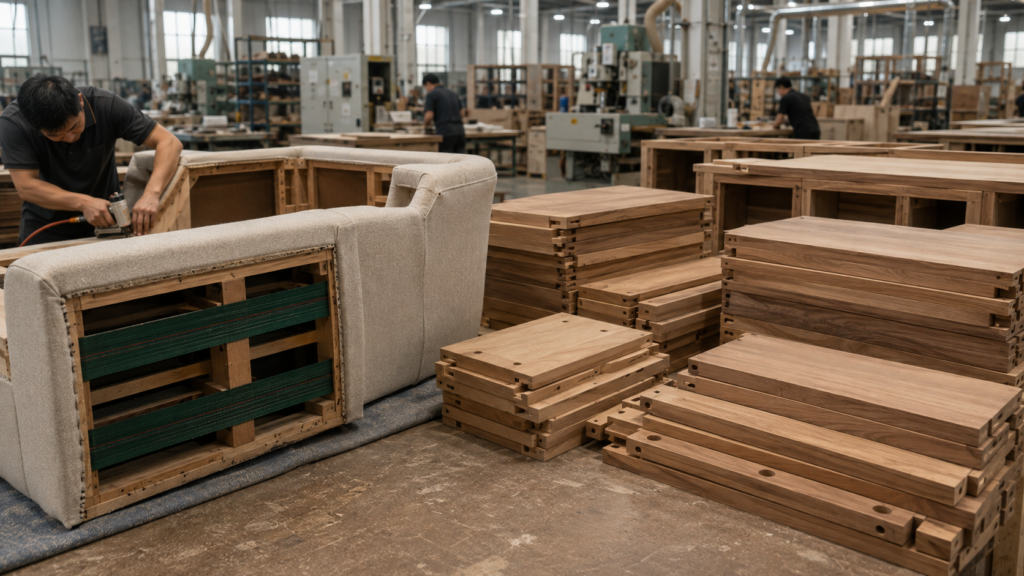
Custom wooden furniture, including wardrobes, TV cabinets, bedside tables, and dining furniture, carries higher MOQs. Expect a range of 50 to 300 units per SKU from most factories, with mid-size manufacturers often requesting 100 to 300 units for solid wood or setup-intensive items. The reason is structural: solid wood furniture requires coordinated cutting schedules, drying, and finishing runs that are proportionally more expensive to set up for small batches.
Complex joinery, bespoke profiles, or carved detailing pushes the number toward the higher end of that range. If your design is relatively straightforward, uses standard dimensions, and relies on materials the factory already stocks, you’re more likely to land toward 50 to 100 units. Add custom elements and that floor moves up quickly.
Fully OEM and bespoke project furniture
For furniture that involves new drawings, custom tooling, or entirely unique construction methods, MOQs typically start at 50 to 200+ units per SKU. Container economics also come into play here: a 20-foot container holds roughly 30 to 35 cubic metres (CBM), and a 40-foot container holds 60 to 65 CBM. Factories are well aware of these numbers, and their MOQs frequently align with what fills a container efficiently, because that’s also when their export and logistics costs make sense.
For buyers placing project-scale orders, these numbers shift considerably in your favour once you’re ordering across multiple SKUs that together fill a container. The per-SKU minimum becomes less of a barrier when the combined volume is already commercially sensible for both parties.
At a glance: MOQ ranges by category
| Furniture Type | Typical MOQ per SKU | Primary Cost Driver | Flexibility |
|---|---|---|---|
| Upholstered (sofas, headboards, lounge seating) | 10 to 100 units | Fabric sourcing, cushion setup | High, especially with COM |
| Custom wooden case goods (wardrobes, cabinets, tables) | 50 to 300 units | Cutting, drying, finishing runs | Moderate |
| Fully OEM / bespoke tooling projects | 50 to 200+ units | New tooling, custom construction | Low until container volume is reached |
The key factors that drive your MOQ higher
Material sourcing, fabric specifications, and supplier minimums
Non-standard materials create a chain reaction that runs upstream before it reaches your order. If you specify a rare veneer, a particular custom fabric, or an unusual hardware finish, the factory must first meet their own material supplier’s minimum before they can produce a single piece for you. This is one of the most overlooked MOQ drivers: the factory’s minimum is sometimes constrained by their supplier’s minimum, not by the factory’s own production capacity.
The practical implication is straightforward: specifying materials from the factory’s existing supply chain keeps your MOQ manageable. If you need a specific fabric, the COM option shifts the material risk to you but removes the factory’s fabric MOQ barrier entirely. It’s a trade-off worth considering for buyers who already have a preferred materials supplier or who want to match an existing specification.
Tooling, production complexity, and nonstandard finishes
Custom tooling is the single strongest individual MOQ driver. New jigs, CNC programmes, custom-cut components, and bespoke hardware create fixed upfront costs that the factory must recover across the production run. The smaller the order, the larger the per-unit share of that tooling cost becomes, which is precisely why factories raise their MOQ when tooling is involved. Tooling costs for furniture projects can range from a few hundred dollars for simple jigs to several thousand for more complex components.
Nonstandard finishes add another layer. Unusual lacquer colours, specialist paint batches, or PVD finishes are often processed separately from the main production run, and the batch minimums for these processes can effectively add 100 to 200 units to your MOQ on their own. The stacking effect is important to understand: a standard design with stock materials and a catalogue finish can carry a much lower MOQ than a fully custom piece where tooling, rare materials, and a specialist finish all combine. Each additional customisation layer compounds the floor, so simplifying your specification in the first order often delivers more MOQ flexibility than any amount of negotiation.
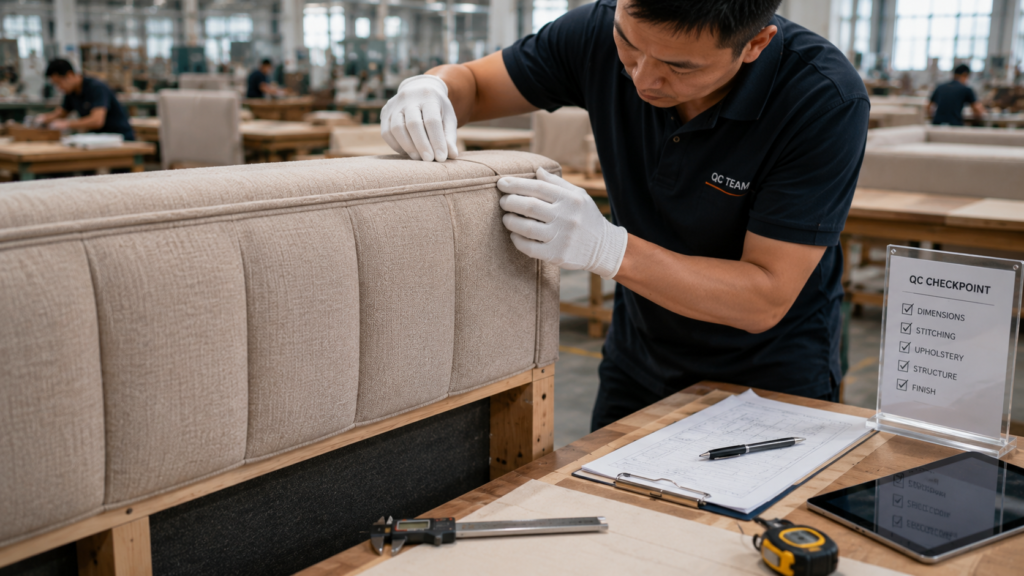
How factory type affects the minimum order requirement
OEM factories vs trading companies: the MOQ gap
There is a meaningful and frequently underestimated difference between ordering from an OEM factory and ordering through a trading company. OEM factories manufacture directly, which means they set their own MOQ based on real production cost logic and can negotiate from that basis. Trading companies act as intermediaries between you and a factory; they add their own margin and may present higher MOQs because of that added margin and less direct control over production economics, which leaves them with limited room to adjust the underlying numbers on your behalf.
Before you enter any discussion about the minimum order quantity for custom furniture from a Chinese manufacturer, confirm whether you’re dealing with a factory or an intermediary. A verifiable factory address, production facility photographs, ISO 9001 certification, and direct access to a production team are common verification steps worth taking. Trading companies often present themselves as manufacturers, but the difference becomes apparent when you ask specific questions about production capacity, tooling, or finish processes and receive vague or non-committal answers.
Integrated manufacturers and why their structure changes the calculation
Large integrated manufacturers, those with in-house design, materials sourcing, production, and logistics, operate with more flexibility than factories dependent on external subcontractors. Each subcontractor in a supply chain brings their own minimum requirements, and those minimums stack. An integrated manufacturer controls the full process internally, which means their MOQ reflects one set of cost logic rather than several.
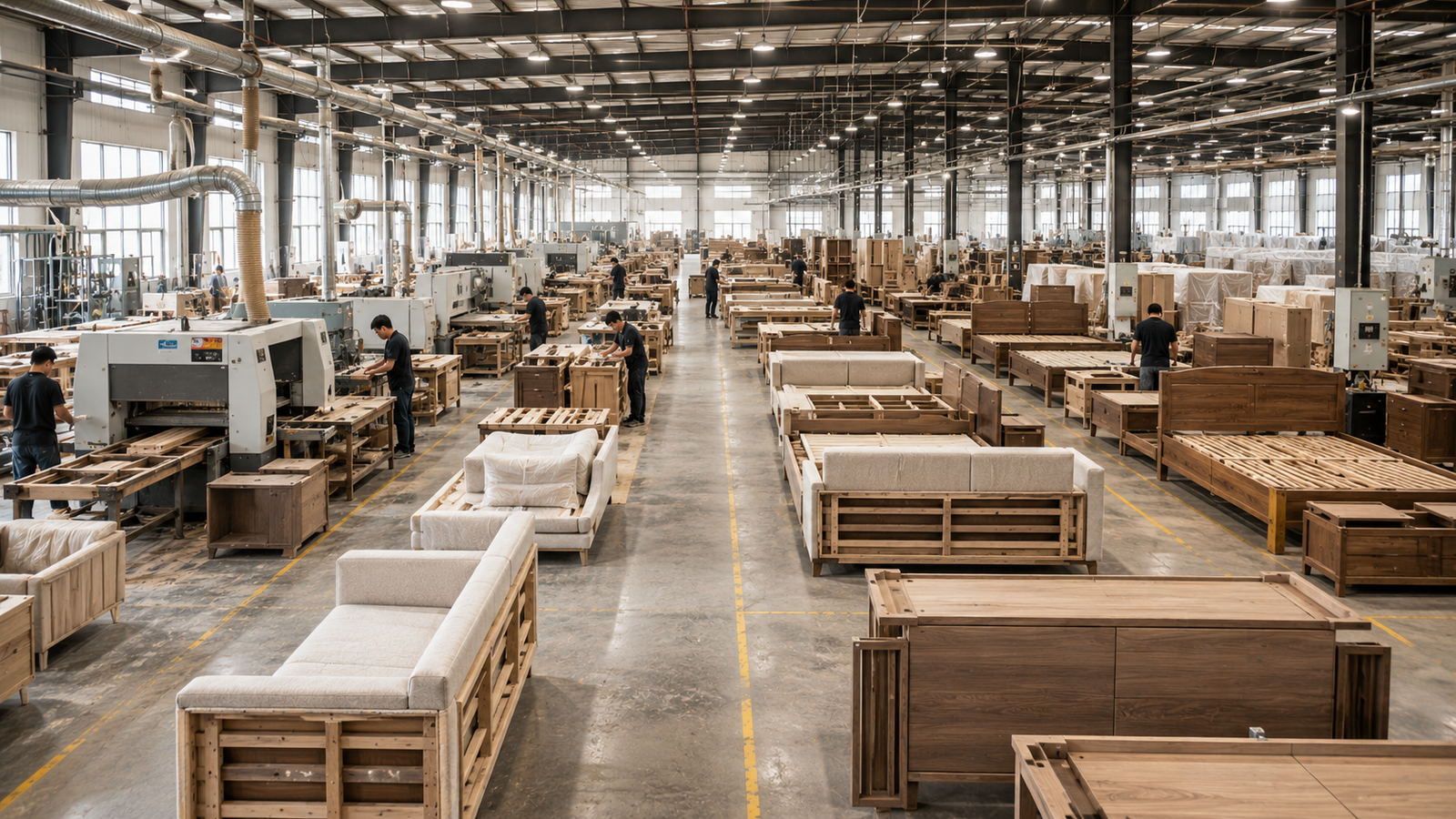
Factory-direct manufacturers like YM Furniture, operating from a large production facility in Foshan, structure their proposals around full-room hospitality and residential projects rather than per-piece SKU minimums. When your scope is an entire guestroom package, including the bed frame, bedside tables, wardrobe, TV cabinet, sofa, and chairs, the per-SKU MOQ conversation shifts significantly in your favour. The volume is already there across the package; the question becomes one of production planning rather than minimum thresholds.
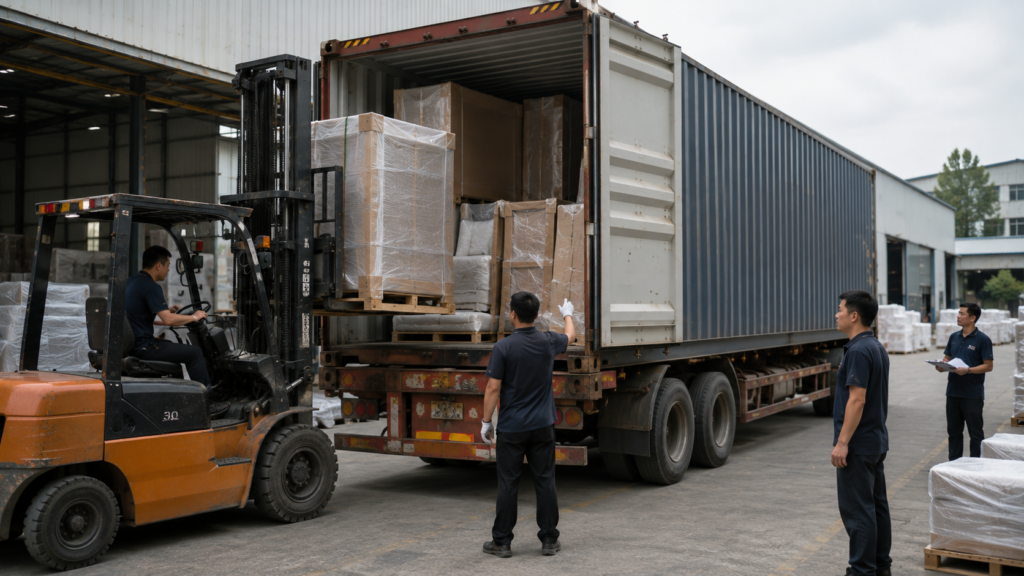
Shipping volume, container economics, and your viable minimum quantity
LCL vs full container load: where the break-even point sits
Less-than-container load (LCL) shipping consolidates your goods with other exporters’ cargo. You pay by CBM, but there are minimum charge floors, and handling costs mean the effective per-CBM rate is higher than for a full container. LCL is the right call for sample orders, trial runs, and initial small shipments where you’re validating quality before committing to volume. For anything under 5 CBM, it’s usually your only sensible option.
Full container load (FCL) means you pay for the entire container regardless of fill. Once your shipment exceeds roughly 10 to 15 CBM, FCL typically becomes cheaper per unit because the fixed freight cost is spread across more pieces. In practice, the break-even point for furniture imports from China typically sits around 13 to 15 CBM; above that threshold, compare both options carefully before assuming LCL is more cost-effective. Above 15 CBM, FCL usually wins on unit cost.
How CBM per unit and packing requirements affect your order floor
Bulky items with large packaging push CBM per unit higher, which raises the effective minimum needed to keep freight efficient. A large wardrobe can occupy 1.5 to 2 CBM on its own; chairs pack more densely and might average 0.3 to 0.5 CBM each. The practical consequence is that your real minimum order isn’t just what the factory requires: it’s the intersection of the factory’s production minimum and the shipping volume that makes the landed cost commercially viable.
Tighter, denser packaging lowers per-unit shipping cost and can make a smaller MOQ viable. Some factories invest in flat-pack or knock-down construction specifically because it reduces CBM per unit and improves shipping economics for both parties. If you’re buying furniture that can be designed or adapted for compact packing, it’s worth raising this directly with the factory during specification discussions.
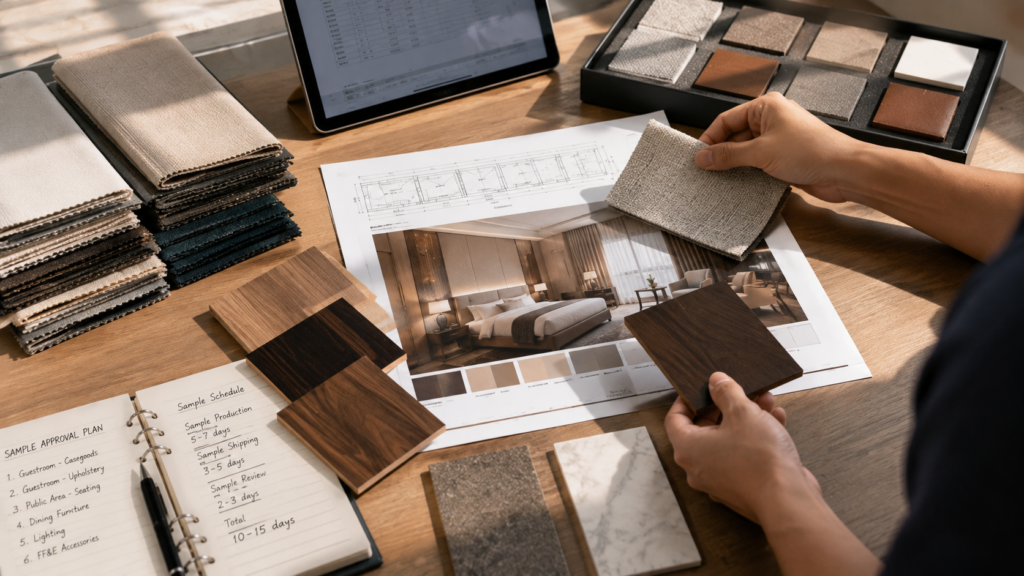
Sample orders: what they cost and how long they take
Realistic sample fees for custom furniture prototypes
Sample fees for custom furniture vary considerably depending on complexity. As a general guide:
- Simple custom samples: typically £40 to £160 (approximately $50 to $200)
- Standard custom furniture prototypes: usually £120 to £400 ($150 to $500)
- Complex bespoke items involving new tooling: £400 to £2,400 or more per piece ($500 to $3,000+)
Tooling is usually quoted separately from the sample fee itself. For OEM furniture projects, tooling costs can add anything from nothing to several thousand dollars depending on the moulds, jigs, and patterns required.
The right framing for sample costs is due diligence spend, not sunk cost. A £300 sample that reveals a quality issue with a joint detail or a finishing process saves you far more than the cost of a 200-unit production run with the same flaw. Treat sampling as the most cost-effective way to validate a supplier’s actual capability before committing to a bulk order.
Lead times from prototype to production approval
Simple custom samples typically take 7 to 14 days from order confirmation. Custom furniture prototypes generally take 2 to 4 weeks. Fully bespoke design-and-prototype cycles, where new drawings and tooling are involved, can run 10 to 18 weeks when design finalisation, material sourcing, and physical construction are all taken into account. Once production begins on an approved prototype, manufacturing lead times typically add a further 30 to 60 days depending on order volume and factory capacity.
Request sample lead times in writing before signing any purchase order. Rushed sampling is one of the most common sources of quality issues that only surface at production scale, because factories under time pressure can make shortcuts during prototyping that don’t survive a full production run. A clear, written timeline agreed upfront gives both parties a documented baseline and protects quality expectations throughout the process.
MOQ negotiation: practical strategies for reducing the minimum order quantity for custom furniture from China
Commercial terms that shift the factory’s risk calculation
The most direct and frequently effective tactic for lowering your MOQ for furniture is offering a higher upfront deposit. Standard payment terms from most Chinese furniture factories run at 30% deposit with 70% before shipment. Offering 50 to 70% upfront reduces the factory’s material and cashflow risk, which is often the real driver behind a high MOQ. The factory’s reluctance isn’t about the number of units; it’s about the exposure of purchasing materials and running a production line for a buyer who might not follow through. A stronger deposit addresses that concern directly.
The phased order approach is the second most powerful lever. Propose a smaller trial run alongside a written commitment to a follow-on order if quality and demand are confirmed. Factories respond to visible future revenue, and putting the commitment in writing shifts the conversation from “can you do this small order?” to “are you the right partner for our ongoing programme?” Ask also whether your order can be consolidated into an existing production batch, which lets the factory spread setup costs across more units without requiring you to hit the full minimum alone. Shared production runs are more common than most buyers realise, particularly for standard materials and finishes.
Reducing complexity to reduce the minimum
Cutting SKU variants directly reduces the factory’s setup burden. Fewer colour options, fewer finishes, fewer size configurations, each one you eliminate removes a separate minimum order commitment. Specifying standard catalogue materials instead of bespoke options removes the supplier-side minimum problem entirely, because the factory draws from stock they already hold rather than placing a new order with their own supplier to meet your specification.
The clearest trade-off is worth stating plainly: the most direct route to a lower MOQ is accepting a slightly higher unit price to compensate the factory for running a smaller batch. This isn’t a failure of negotiation; it’s the economic reality of small-run manufacturing. A factory that agrees to produce 30 units instead of 100 is taking on a proportionally higher setup cost per unit, and pricing that reflects this reality is fair to both sides. If the smaller run’s slightly higher unit cost still delivers a favourable landed cost compared to your domestic alternatives, it’s often the right call.
Why hotel and villa buyers approach MOQs differently
Full-room project orders vs single-SKU sourcing
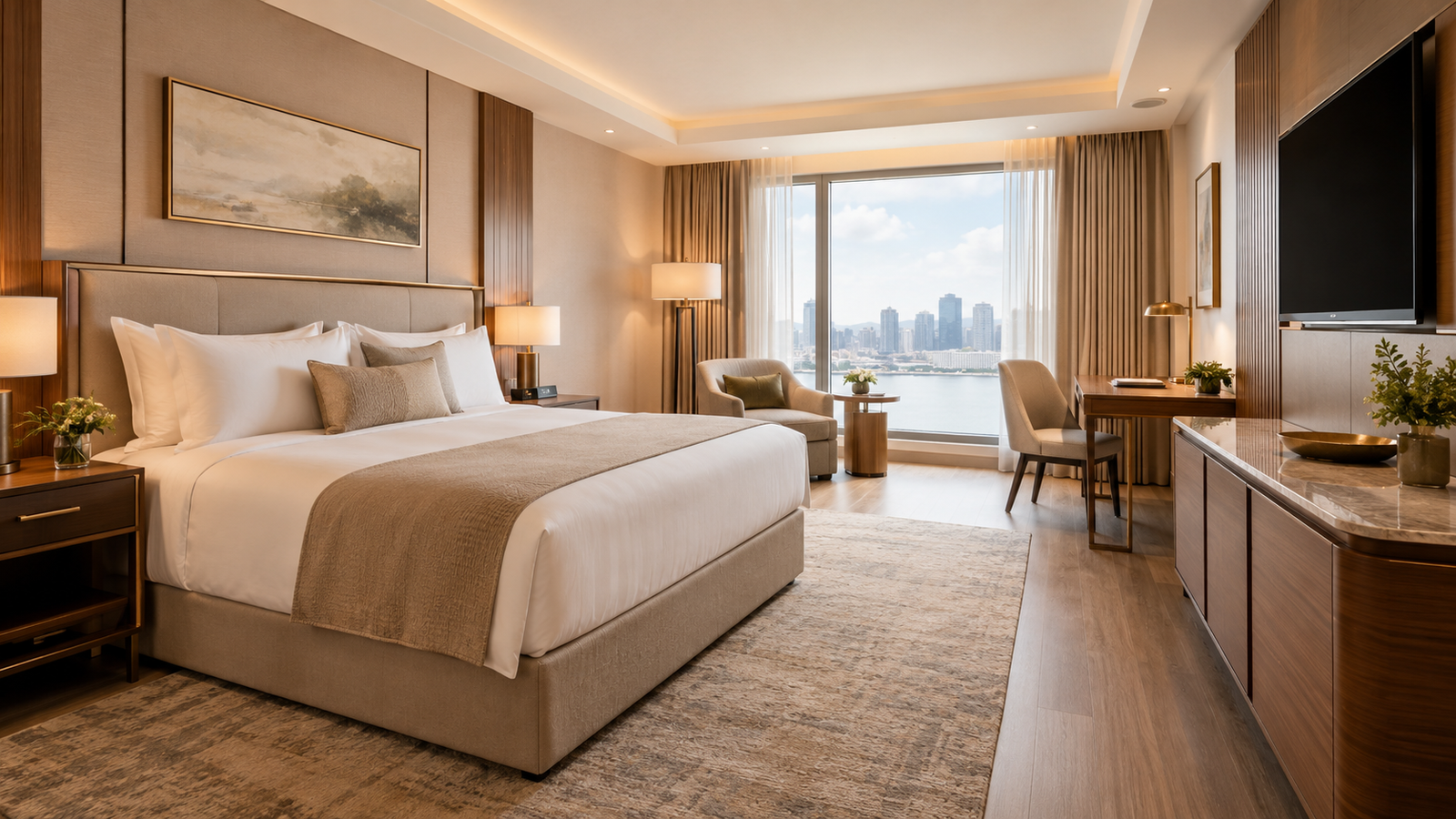
When you’re furnishing 80 hotel guestrooms or a development of 30 luxury villas, you’re not placing a single-SKU order. You’re ordering entire room packages: beds, headboards, bedside tables, sofas, lounge chairs, TV cabinets, wardrobes, and dining sets, all across every unit in the development. At that scale, per-SKU minimums are rarely the binding constraint. The real question becomes whether the manufacturer can handle full-room coordination, consistent quality across all pieces, and integrated logistics, not whether they’ll accept a 30-unit sofa order.
FF&E (furniture, fixtures, and equipment) procurement for hospitality projects benefits structurally from working with a manufacturer who thinks in room sets rather than individual catalogue items. Consistency of finish, matching materials across different piece types, and coordinated delivery schedules are all easier to achieve when a single manufacturer controls the full room package. That’s a fundamentally different procurement relationship from placing separate orders for each furniture category.
Working with a factory-direct manufacturer structured for project-scale orders
Factory-direct manufacturers built for hospitality and residential development projects structure their proposals around complete room packages from the outset. YM Furniture, for example, approaches hotel and villa projects not through individual SKU minimums but through whole-room scope, covering beds, sofas, chairs, tables, cabinets, and stools as a coordinated package. This is how hotel developers and villa builders actually buy, and it removes the per-SKU MOQ conversation almost entirely for buyers operating at that scale.
Practical capabilities make this workable rather than theoretical. YM Furniture’s model room customisation process lets procurement managers and designers review a fully built mock-up in the Foshan showroom before committing to production, an opportunity to see and approve the complete package in physical form rather than making decisions from photographs and samples alone. For buyers managing a hotel build or residential development, that kind of pre-production review represents a meaningful reduction in project risk.
The company’s experience delivering full FF&E packages for internationally recognised hospitality brands across multiple countries serves as useful context for procurement managers evaluating a factory-direct international sourcing decision.
For hotel developers, interior designers working on hospitality briefs, and real estate developers building luxury residential schemes, the minimum order quantity conversation with an integrated factory-direct manufacturer looks entirely different from placing a small order through a trading company intermediary. The volume is already present in the project scope, the logistics are handled as part of the package, and the per-SKU minimum threshold becomes a production planning detail rather than a barrier to entry.
Frequently asked questions
What is a typical minimum order quantity for custom furniture from a Chinese manufacturer?
It depends on the furniture type. Upholstered pieces typically start at 10 to 100 units per SKU, while custom wooden case goods usually run 50 to 300 units per SKU. Fully bespoke items involving new tooling often start at 50 to 200+ units.
Can using my own fabric (COM) lower the MOQ?
Yes. When a buyer supplies customer’s own material (COM), the factory’s fabric sourcing minimum no longer applies, which often removes one of the biggest MOQ constraints on upholstered furniture.
Do hotel and villa developers face the same per-SKU MOQ rules?
Not usually in practice. Project-scale buyers order full room packages across many SKUs at once, so the combined volume typically exceeds any individual SKU minimum, shifting the conversation from MOQ to production planning.
What’s the real difference in MOQ between an OEM factory and a trading company?
OEM factories set MOQs based on their own direct production costs and can negotiate from that basis. Trading companies add a margin layer and often have less flexibility to adjust minimums, since they don’t control the underlying production economics.
How long does it take to get a custom furniture sample before production starts?
Simple samples typically take 7 to 14 days. Standard custom prototypes take 2 to 4 weeks. Fully bespoke designs requiring new tooling can take 10 to 18 weeks from design finalisation to an approved prototype.
What to take away from all of this
MOQs are set per SKU, not per order. They range from around 10 units for simple upholstered pieces to 300+ units for custom wooden case goods, and they’re driven by fixed cost logic that buyers can negotiate once they understand the mechanics. The factory isn’t being difficult; they’re protecting a production economics model you can work with once you know the levers.
Know your factory type before you start negotiating. Confirm you’re dealing directly with a manufacturer, not a trading company adding a layer of margin. Understand your shipping economics: LCL is the right tool for samples and small trial orders, but once you’re moving 13 to 15 CBM or more, compare FCL costs carefully. Use a higher deposit and a phased order commitment as your primary negotiation tools, and simplify your specification as much as the design allows.
In short, when asking what is the minimum order quantity for custom furniture from a Chinese manufacturer, remember that MOQs are set per SKU, shaped by fixed production costs, and more negotiable than they first appear, provided you approach the conversation with the right information. For buyers in hospitality and residential development, the MOQ conversation changes fundamentally at project scale. Full-room orders placed with a factory-direct manufacturer like YM Furniture (Foshan Yauming Furniture & Construction Co., Ltd.) reframe what looks like a sourcing barrier into a straightforward production planning exercise. Before you enter any MOQ negotiations with a supplier, confirm whether you’re talking to a factory or an intermediary. That single distinction will save you time, money, and considerable frustration, and it will shape every conversation that follows.