Major hotel brands don’t specify their guestroom luxury bed by flipping through a retail catalog. They define exact frame materials, headboard upholstery specs, platform construction, and custom dimensions, because in hospitality, the bed is the product. Manufacturers who have spent decades building custom high-end beds for globally recognized hotel brands will tell you the same thing: the difference between a bed that lasts three years and one that lasts fifteen starts long before a guest pulls back the sheets.
This article breaks down exactly what separates a designer bed from a standard one: the frame, the headboard, the platform system, and the construction details that drive price. It also covers how to evaluate retail options versus custom manufacturing when you’re making procurement decisions at scale. By the end, you’ll have a clear framework and a buying checklist to move forward confidently.
1. What frame construction actually reveals about luxury bed quality
Frame construction is the single biggest predictor of long-term durability. Solid hardwoods, including oak, walnut, maple, ash, and beech, are the standard in premium builds because their density resists flexing under repeated load. Softwoods like pine can be finished to look just as refined, but they dent and wear faster in high-rotation environments like hotel guestrooms.
Engineered wood (MDF, plywood, particleboard) appears in hidden structural panels of many well-made frames, which works fine provided the joinery is tight and the load-bearing sections remain solid wood. Steel tube and cast-iron frames are exceptionally rigid, resist flex well, and suit designer or industrial-aesthetic beds where visual weight is part of the concept.
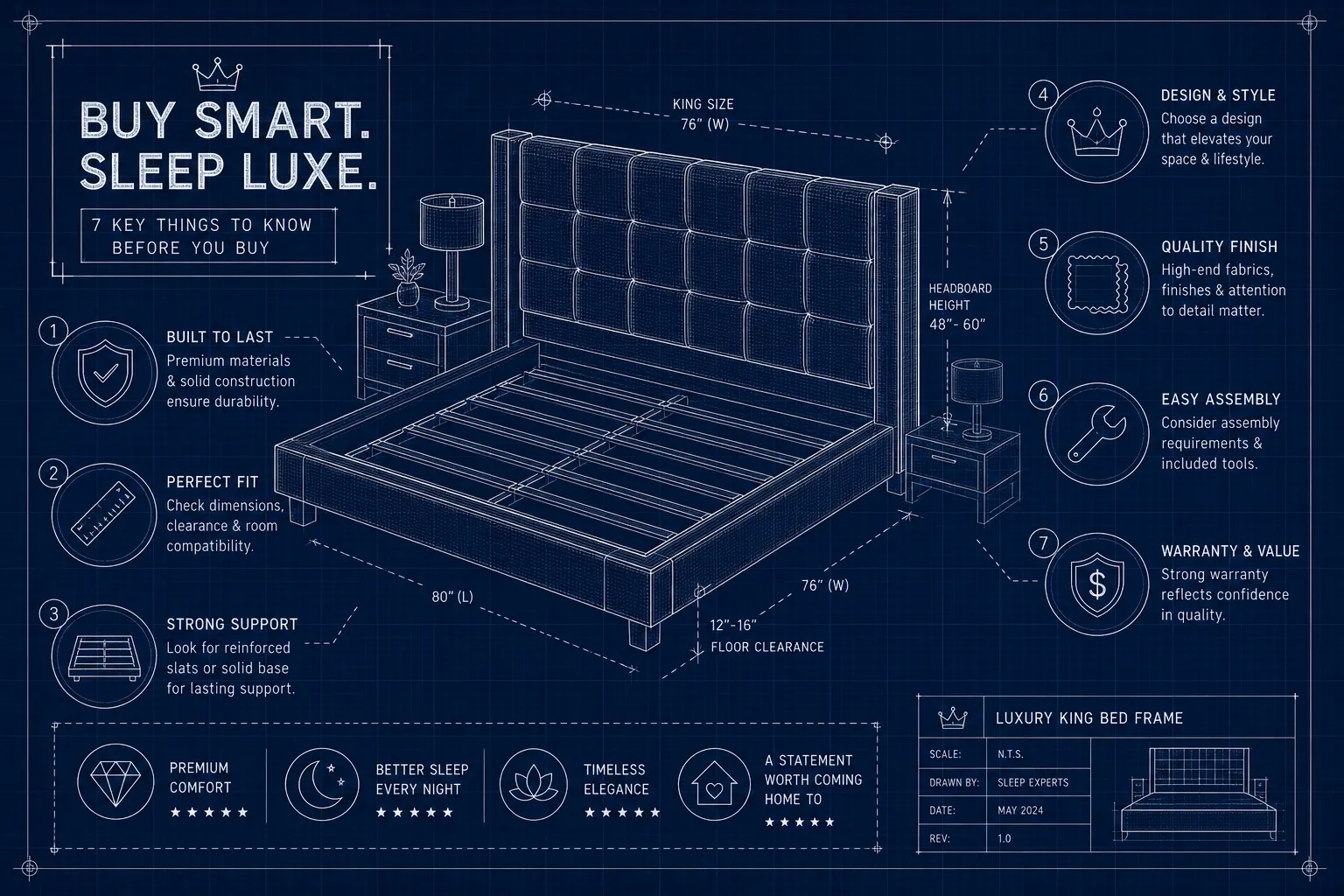
Joinery quality is what separates a furniture-grade upscale bed frame from a decorative one. Mortise-and-tenon, dovetail, and dowel-reinforced joints hold up under years of use without loosening. Beds that rely only on cam locks or basic screws in structural joints show wear much faster. For hotel procurement, verify the stated weight capacity, confirm that center support legs are included for king and split-king sizes, and check that the finish, whether lacquer, veneer, or upholstery wrap, is applied over solid structure rather than treated at the surface only.
2. The luxury headboard: where design meets durability
In any guestroom, the headboard is the visual centerpiece, but in a hotel context it also takes more abuse than almost any other soft surface in the room. Guests lean against it, rest items on it, and housekeeping cleans it repeatedly. Genuine or top-grain leather offers a durable, consistent look across a multi-room installation and holds up to repeated surface cleaning, though it carries a higher cost and specific maintenance requirements compared to performance synthetics.
Performance fabrics and tightly woven polyester blends, ideally meeting at least 30,000 Wyzenbeek double rubs, offer strong stain resistance and are a practical choice for high-turnover rooms. For abrasion resistance in commercial settings, solution-dyed nylon and olefin are among the most reliable options available. Linen and velvet deliver a more refined aesthetic for upscale villa or boutique hotel settings but require more deliberate maintenance protocols to hold up over time. For a deeper look at furnishing upscale villas, see Choosing Luxury Villa Furniture That Elevates Every Space.
A headboard that looks proportionate in a showroom photograph can overwhelm a standard guestroom or disappear in a suite with high ceilings. As a rule, a headboard reaching two-thirds to three-quarters of the wall height creates the most balanced visual proportions. Padding density matters for both comfort and longevity. Too soft and the headboard compresses and loses shape within a year; too firm and it loses the plush quality that makes it feel like a genuine designer piece. A high-density foam core with a quilted or channel-stitched outer layer is a widely recommended construction approach for luxury upholstered headboards in hospitality environments.
3. Mattress platform engineering and what it does for the guest experience
The platform a mattress sits on determines how it performs and how long it lasts. A solid platform provides uniform support with no flex, which is ideal for memory foam and latex mattresses that need consistent base contact to avoid uneven compression. Slatted bases improve airflow under the mattress, which helps with temperature regulation and reduces moisture buildup, a real consideration in humid climates and for properties in the southern United States.
Slat spacing matters more than most buyers realize. For memory foam mattresses, slats should be no more than 3 inches apart to prevent sagging. For hybrid mattresses, the most common choice in luxury hotel builds because of their balance of support and pressure relief, gaps up to 4 inches are generally acceptable, though certain all-foam manufacturers specify solid flat slats regardless of spacing. Pairing an upscale platform bed with the wrong mattress type is a well-documented risk in hotel FF&E procurement. Confirm mattress-platform compatibility in writing before finalizing any bulk order. For guidance on mattress performance specifically with platform beds, review recommendations for the best mattress for a platform bed.
4. What each luxury price tier actually delivers
At the entry-level luxury range of $1,000 to $2,500, buyers move from standard construction into genuinely better materials. Beds at this tier typically feature hybrid or higher-grade innerspring mattresses, improved foam density, and more considered frame construction. Brands like Brooklyn Bedding Aurora Luxe (queen at approximately $1,399) and Leesa Sapira (queen at approximately $1,599) sit in this range. For hotel procurement at volume, this tier works well for select-service properties where the brand standard calls for a clean, comfortable bed rather than a statement piece.
Mid-tier luxury, from about $2,500 to $4,000, introduces advanced cooling technology, more precise coil systems, refined finishes, and better motion isolation, all meaningful in a hotel context where guests notice everything. Note that some well-regarded models, such as the Saatva Classic (queen at approximately $1,853) and WinkBed (queen at approximately $1,799), fall below this range and represent strong construction value at the upper end of the entry tier. Ultra-luxury builds at $4,000 to $6,000 and above use specialty materials: top-grain leather upholstery, 100% organic latex, hand-tufted finishes, and often fully bespoke construction. Brands like Savoir Beds and Vispring, with its 30-year no-prorate warranty on flagship models, operate at this level. If you’re weighing budget allocation, see guidance on how much you should spend on a mattress.
The defining characteristic at the ultra tier is not just materials but craftsmanship and customization capability. A Vispring or Savoir bed is built to a standard that a retail consumer purchases once and keeps for decades. In a hotel application, that construction quality translates into cycle durability, fewer replacements, and a guestroom that holds its look and feel through hundreds of check-ins. For comparisons and selections among top-tier options, editorial roundups of the best luxury mattress models can offer useful context for product-level decisions.
5. Custom luxury beds for hotel procurement: the factory-direct advantage
Retail luxury bed brands are designed for individual consumers, not for procurement teams furnishing 300 guestrooms across three floors. Most retail channels don’t offer custom sizing for non-standard guestroom footprints or adjust upholstery finishes to match a brand’s FF&E specification sheet. Sample lead times through retail showrooms can stretch considerably, and pricing, structured for single-unit sales at full retail margin, doesn’t scale. When a hospitality project calls for consistent, brand-compliant high-end beds across dozens or hundreds of rooms, the math and the process both point toward a custom manufacturer.
YM Furniture (Foshan Yauming Furniture & Construction Co., Ltd.) is a factory-direct custom manufacturer specializing in hotel, villa, and apartment FF&E. Their Foshan, China facility produces solid wood and metal frame beds, leather and fabric upholstered headboards, and engineered platform systems built to client dimensions and finish schedules. Factory-direct sourcing typically delivers significant cost advantages over U.S. local market pricing for comparable construction quality, and their ISO 9001 (quality management), ISO 14001 (environmental management), and ISO 45001 (occupational health and safety) certifications give U.S. procurement teams the documentation they need to sign off with confidence. For a step-by-step approach to procurement from China, consult our guide on How To Source Hotel Furniture From China: Complete 2026 Guide.
One of the more practical programs YM Furniture offers large-scale buyers is a model room customization option. Before committing to a full production run, hospitality buyers and FF&E consultants can review a fully furnished mock-up room, including the bed, headboard, and platform, to confirm proportions, finishes, and material quality against the project spec. This step eliminates the risk that comes with ordering hundreds of units without a physical reference. For U.S. buyers factoring in ocean freight (typically 25 to 40 days from Foshan to U.S. ports), compressing the approval phase without delaying production is a real scheduling advantage.
6. A 7-point buying checklist for sourcing luxury beds at scale
This checklist is built for hospitality buyers and villa developers evaluating custom luxury beds for multi-room projects. Work through each point before finalizing any supplier or production order.
Construction and material verification
- Frame material confirmed. Verify solid hardwood or steel in all load-bearing sections. Ask for the species name, construction method, and joinery type, “solid wood” claims should be verified, since some products use veneers or engineered cores under a solid-appearing surface.
- Headboard upholstery spec matched. Confirm leather grade or fabric weave type, padding density (specify minimum foam density in kg/m³), and cleaning compatibility with your housekeeping protocol. For high-turnover rooms, prioritize fabrics rated at 30,000 Wyzenbeek double rubs or higher.
- Platform type compatible with mattress. Get the slat spacing spec in writing and cross-reference with your mattress manufacturer’s foundation requirements. For memory foam, confirm slats are 3 inches apart or less; for hybrids, confirm 4 inches or less, or solid flat slats if the manufacturer requires them.
- Custom sizing accommodated. Confirm the manufacturer can produce non-standard dimensions if your guestroom footprint falls outside queen and king standards. Standard U.S. hotel frame sizes run approximately 62 to 65 inches by 82 to 85 inches for queen and 78 to 81 inches by 82 to 85 inches for king, but room-specific builds often require adjustments.
Procurement, compliance, and timeline
- Flammability and safety certifications provided. For U.S. projects, request test results confirming compliance with 16 C.F.R. Part 1640 and California TB 117-2013 for upholstered components. Mattress sets are regulated separately under 16 C.F.R. Parts 1632 and 1633. Confirm the manufacturer can supply documentation on demand before production begins. For an overview of furniture flammability safety standards in the United States, consult specialist guidance before final acceptance.
- Model room or sample available before full production. Never commit to a bulk order without a physical reference unit, especially for custom luxury beds where finish and proportion are critical. Resolving specification questions at the sample stage prevents costly corrections once production is underway.
- Lead time mapped to project opening schedule. Custom manufacturing at hotel scale typically runs 60 to 75 days for standard orders and 10 to 12 weeks or more for highly customized builds. Add 25 to 40 days for ocean freight to U.S. ports, plus customs clearance. Build this full timeline into your FF&E procurement calendar from day one.
The bottom line on luxury beds for hotel projects
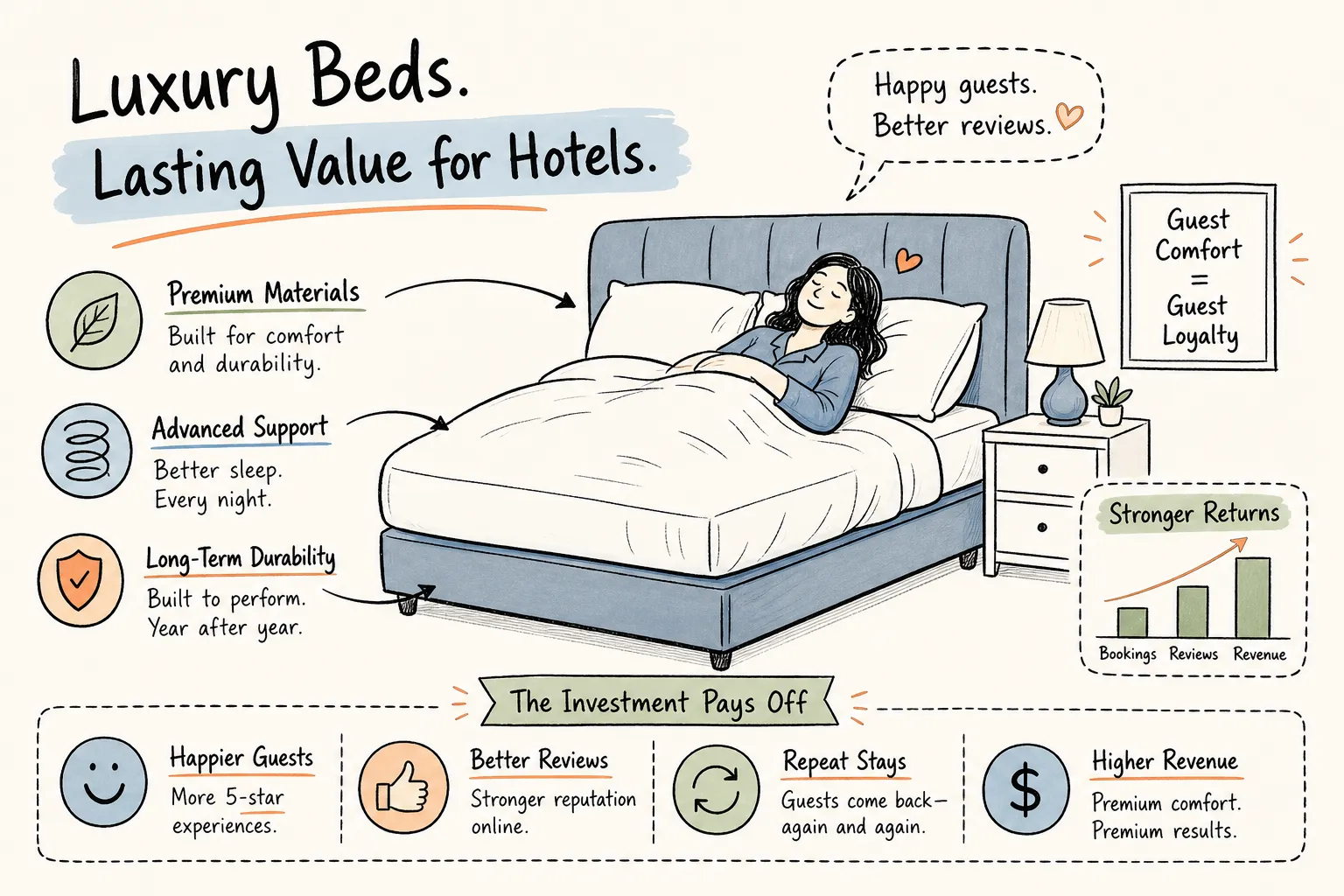
A luxury bed earns its price through construction decisions that most buyers never see: the species of wood in the frame joints, the density of foam behind the headboard fabric, the slat spacing that keeps a premium mattress performing for a decade rather than three years. For individual buyers, retail brands like Saatva, Vispring, and Savoir Beds deliver proven quality with solid warranty and delivery support. For hospitality buyers and villa developers sourcing at scale, those options don’t cover the full picture.
Custom manufacturing through a factory-direct partner is where the real value lives for large hotel projects. The ability to match brand standards exactly, validate finishes and proportions in a model room before production, and access factory-direct pricing on a full guestroom rollout changes the economics of the entire project. The checklist above gives you a clear framework to qualify any manufacturer before committing to production. If you’re evaluating partners for an upcoming hotel or villa development, request YM Furniture’s Furniture Blog for project case studies, and download YM Furniture‘s FF&E spec sheet and model room program details before your shortlist closes.