A luxury king bed frame that photographs beautifully but fails structurally within two years of hotel use is not a luxury purchase, it’s an expensive mistake. For residential buyers, that failure means one replacement. For hospitality teams specifying a single guestroom floor with 30 to 100 identical king beds, that failure multiplies into room-night displacement, labor costs, and procurement chaos. (In poorly constructed models, structural failure can occur well within warranty periods, so verifying manufacturer failure-rate data before committing is essential.)
The stakes are different at scale. The seven points below give buyers, designers, and procurement professionals a clear filter for evaluating any luxury king bed frame before committing to it. Whether you’re furnishing a single primary suite or a 200-room property, these criteria apply. And if you’re sourcing at volume, factory-direct manufacturers like YM Furniture (Foshan Yauming Furniture & Construction Co., Ltd.) offer hospitality teams documented cost compression of 40 to 70 percent alongside full customization capability, advantages that domestic sourcing cannot replicate at comparable scale.
1. Frame construction is the foundation of every luxury king bed frame
The internal structure of a luxury king bed frame determines its lifespan, and it almost never shows in product photography. A king-size frame spans 78 inches or more in width. At that span, a frame without a center support rail and middle legs will allow the platform to flex under combined guest weight over time, regardless of how premium the upholstery looks. Manufacturer specs and structural test documentation are the only reliable way to verify this before purchase.
Corner block reinforcement and joinery method are the details that separate a quality frame from one that fails early. Mortise-and-tenon joinery locks corner connections mechanically; stapled corner blocks rely entirely on adhesive and fastener grip. In a guestroom where that headboard gets leaned against 365 days a year, mechanical joinery consistently outperforms adhesive-reliant construction, a distinction that becomes apparent across repeated seasonal use cycles.
For wood species, research-supported options for 5-star hospitality specs include white oak, hickory, maple, acacia, and rubberwood, all dense hardwoods with documented resistance to dents, warping, and structural fatigue. Rubberwood is a strong mid-range option with practical humidity resistance. When sourcing from any manufacturer, request wood grade documentation, not just marketing copy about “solid hardwood construction.” Species claims without documentation are a red flag at any price point.
2. Upholstered headboard options for luxury king bed frames
Fabric selection and hospitality durability
Velvet headboards are a recurring feature in luxury guestroom photography for good reason: the material reads as premium in every lighting condition. But velvet shows dust, wear marks, and compression from repeated contact faster than almost any other upholstery fabric. In a hospitality environment, that means a headboard that looks tired within 18 months.
Performance leather and genuine leather are consistently more practical for high-use environments because they wipe clean and resist compression. The foam density behind the upholstery panel is the specification most buyers forget to ask for. For hospitality and high-use settings, industry guidance points to foam densities in the 4 to 6 lb per cubic foot range as the appropriate baseline for a headboard that resists flattening under the pressure of guests leaning against it repeatedly. Button or blind-tufting depth and edge finishing quality determine whether seams split over time, so request close-up samples of those details before approving any large order.
Headboard height and proportion
Headboard height is not purely aesthetic. It functions as a noise buffer for wall-mounted reading fixtures and contributes directly to the perceived scale of the space. Panel heights in 4-star and 5-star guestrooms vary by brand standard and room dimensions, so verify against your specific project’s design intent rather than assuming a universal range applies. Headboard width should match or slightly exceed the king frame’s footprint to avoid a proportionally narrow visual against the wall.
3. King vs. California king: dimensions and room clearance
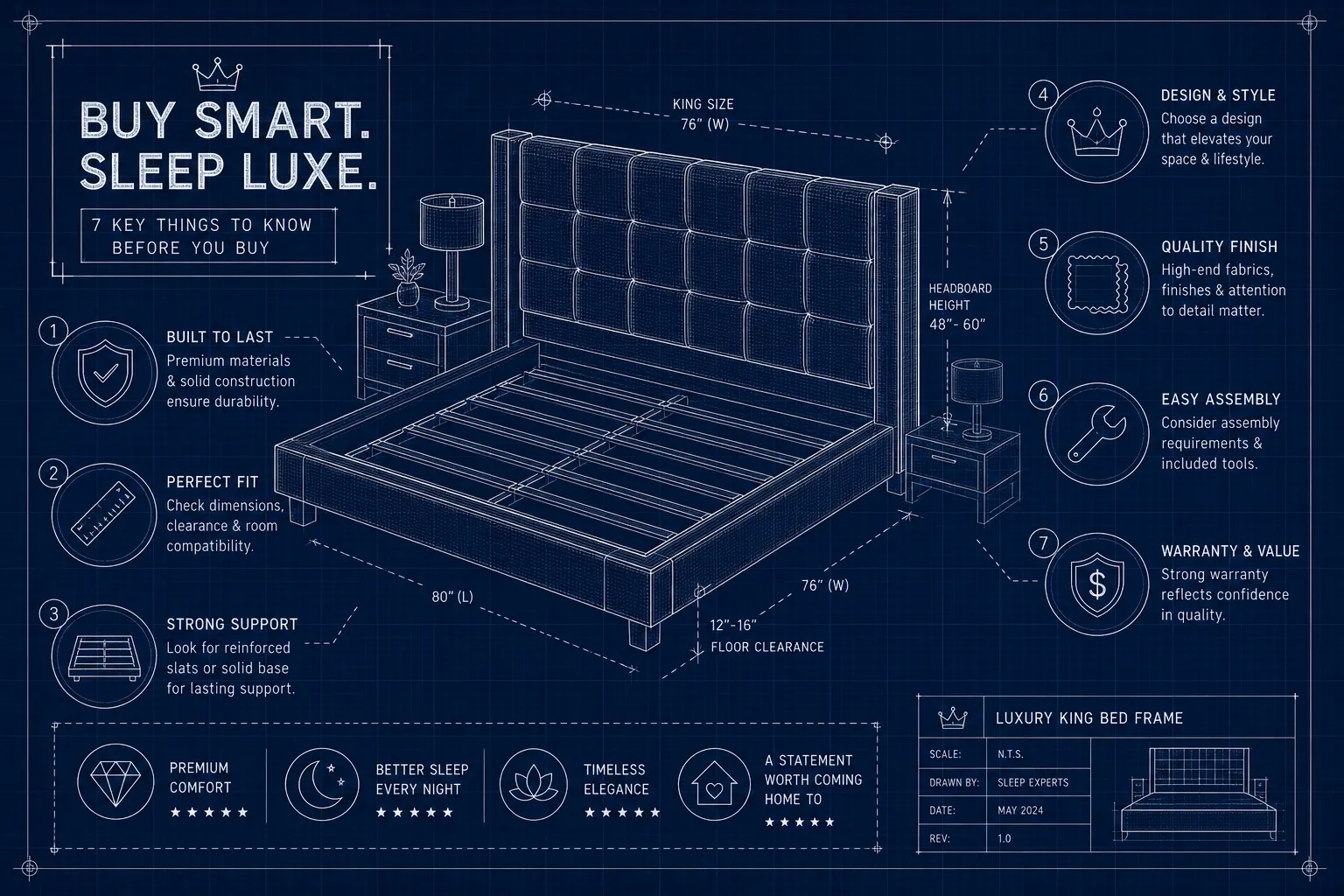
A standard king mattress is 76 by 80 inches. The frame footprint typically runs 78 to 82 inches wide and 81 to 88 inches long. A California king mattress is 72 by 84 inches, with a frame footprint of roughly 74 to 78 inches wide by 86 to 92 inches long. These are not interchangeable formats. A procurement order that mixes both configurations creates a linen and mattress logistics problem that compounds across every room in a property.
California king sizing makes sense for rooms with a longer, narrower floor plan, or for taller guests in a resort setting where that extra four inches of length is a genuine amenity. Standard king sizing fits more rooms and has broader mattress availability. Verify frame compatibility against existing mattress specs before any order is finalized, and document the format decision in the FF&E schedule so it doesn’t become a receiving-dock problem on opening day. For a practical reference on typical frame footprints and clearance needs, consult a detailed guide on king bed frame dimensions.
For room clearance, the functional minimum in a guestroom is 24 to 36 inches of walkway on each accessible side. Frame overhang beyond the mattress edge, storage drawer projection, and nightstand placement all eat into that clearance. Most planning guides cite 12 by 12 feet as the minimum bedroom footprint for a king bed with adequate clearance; 12 by 14 feet provides a more comfortable working margin for both guests and housekeeping staff. Smaller rooms create daily operational friction that no amount of premium specification eliminates.
4. Weight ratings and platform support requirements for luxury king bed frames
Most retail-facing luxury king bed frames do not list explicit load ratings in their marketing materials. That omission matters in hospitality use, where two adults at a combined weight of 400 or more pounds is a routine planning scenario. The typical static load rating for luxury king storage frames clusters around 700 to 850 pounds, with reinforced designs reaching 900 to 2,500 pounds. Ask for the rating in writing from any manufacturer before finalizing a spec.
The specific questions to put to any manufacturer: static load rating for the center rail, dynamic load rating for the platform surface, and whether the product is tested to any recognized structural standard. As a practical rule of thumb, daily dynamic use loads run at roughly 70 to 80 percent of the rated static capacity, so a frame rated at 800 pounds static is working at roughly 560 to 640 pounds under normal overnight use with movement. If you need tools to verify on-paper ratings against expected use, see this practical resource on how to calculate bed frame weight capacity.
Storage-base platform beds introduce additional structural requirements. Hydraulic lift-up platforms offer maximum under-mattress storage but add mechanical components that require periodic maintenance. Drawer-based storage bases eliminate box spring requirements but add structural depth to the overall bed height. Assembly complexity varies considerably. Some drawer-base platforms require cordless drill assembly, which is manageable for a single unit but a significant labor consideration at deployment scale across dozens of guestrooms simultaneously. For a focused review of storage options and their trade-offs, see a roundup of the best bed frames with storage. Fully assembled delivery or white-glove service changes the calculus on total project cost.
5. Finish durability and the real cost of cutting corners
Catalyzed lacquer and polyurethane finishes are the workhorses of hospitality furniture because they cure hard and resist cleaning product damage. UV-cured finishes offer comparable or superior durability and perform well in high-humidity environments where frequent cleaning is routine, though final specification should reflect your specific use conditions and a review of available finish-performance data. The finish is only as good as its substrate: high-density fiberboard veneer substrates perform better than standard MDF in rooms adjacent to bathrooms, where humidity cycles daily.
Edge banding thickness and adhesive quality are where cheaper finishes fail first, and in a guestroom, that failure is immediately visible to every guest who glances at the base of the bed. Exposed edges on bed rails and drawer fronts take more physical contact than most furniture surfaces. Specify edge banding thickness in your procurement documents, and request a physical sample that includes an edge section, not just a face panel.
A guestroom luxury king bed frame that requires refinishing or replacement within three years carries costs well beyond the original purchase price, labor, room-night displacement, and logistics that the per-unit price gap rarely accounts for. The finish specification is a total cost of ownership decision. At any deployment scale, the lifecycle math consistently favors investing in a quality finish upfront over absorbing replacement costs later.
6. What sourcing channel determines about customization and cost
Domestic furniture retailers and contract furniture distributors work on margin stacks that consistently place a luxury king bed frame at $1,800 to $3,700 or more for a single unit, with genuine luxury options available across that range depending on construction specs. At 100 to 300 rooms, that pricing structure creates significant pressure on most development budgets. Factory-direct sourcing from manufacturers in Foshan, China compresses per-unit cost by 40 to 70 percent (exact savings vary by product configuration and order volume) while retaining full customization capability across wood species, upholstery, finish schedule, and headboard dimensions.
Sourcing at that level requires doing the work on compliance. The practical checklist for any US hospitality buyer sourcing a luxury king bed frame directly from a Chinese manufacturer includes:
- ISO 9001 quality management certification from the manufacturer
- California TB 117 flammability compliance documentation for all upholstered components
- Section 301 tariff planning, currently approximately 25 percent for furniture under applicable HTS codes; confirm the specific code and check current tariff status before ordering, as rates can change
- Container freight lead times of 25 to 40 days to US ports, factored into the opening schedule
Experienced project teams treat each of these as a standard line item in the procurement schedule, not an exceptional obstacle. For a practical walkthrough of sourcing logistics and lead-time expectations when importing furniture from China, review YM Furniture’s guidance on Hotel Furniture From China: Costs, Lead Times & QC. Also factor up-to-date tariff planning into your cost model by consulting a current complete guide to Section 301 China tariffs in 2026.
7. Matching your sourcing partner to your project scale
YM Furniture (Foshan Yauming Furniture & Construction Co., Ltd.) is a factory-direct manufacturer with 17-plus years of experience producing custom bed frames for 5-star hotel brands including Marriott and Sheraton properties across more than 30 countries. Their process starts with a brand-standard specification review, moves through a 20-day model room prototype, and scales to full production across 70,000 square meters of manufacturing floor. For a US hotel developer or procurement agent specifying a custom luxury king bed frame, that means documented control over every structural and finish variable, at pricing that domestic sourcing cannot match at comparable volume. Triple ISO certification (9001, 14001, and 45001) plus CQC documentation provides the compliance paper trail that US buyers need before a container ships.
What to do before you finalize any spec sheet
These seven decision points cover the full evaluation range: frame construction and wood species, upholstery specification and headboard details, correct sizing and room clearance, weight ratings and platform support, finish durability and long-term cost, sourcing compliance, and the partner selection that makes the entire specification viable at scale.
For single-unit residential buyers, options across the $1,800 to $3,700 range deliver genuine luxury when the construction specs are verified. For hospitality buyers specifying a luxury king bed frame across multiple rooms, the more cost-effective path is factory-direct manufacturing with a manufacturer who can document every specification, prototype in 20 days, and deliver at project scale without compressing your opening timeline. If you are reviewing single-unit options as part of that assessment, compare offerings in the Luxury KingSize Beds category to see how construction and finish choices affect price and durability.
Before you finalize any luxury king bed frame spec sheet, request a sample finish schedule and load-rating documentation from your supplier. Domestic or overseas, that level of documented detail tells you exactly how seriously they take quality, and it gives you everything you need to commit with confidence. For additional context on long-term value and why higher-spec construction matters in hospitality, read What Makes A Luxury Bed Worth The Investment For Hotels.