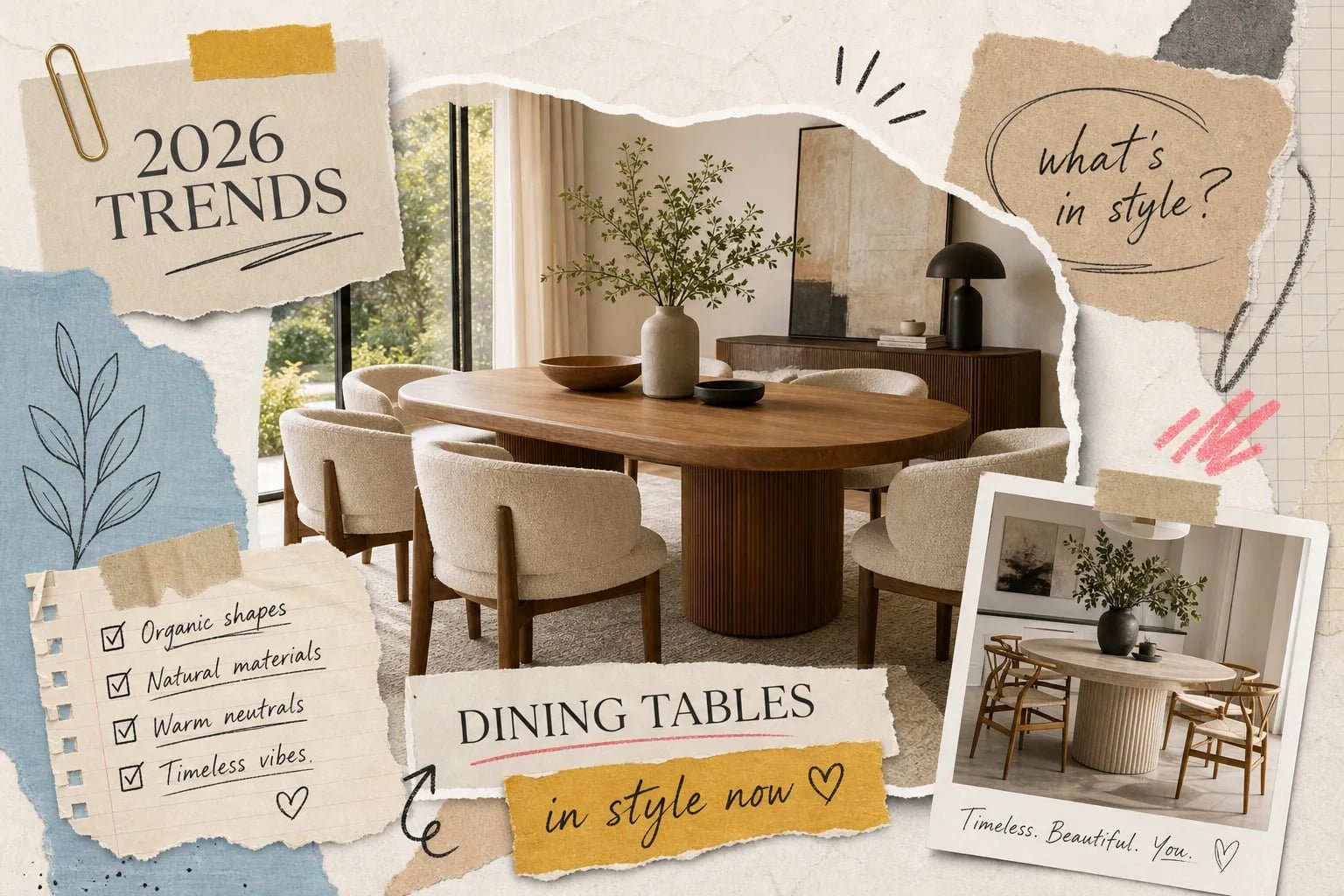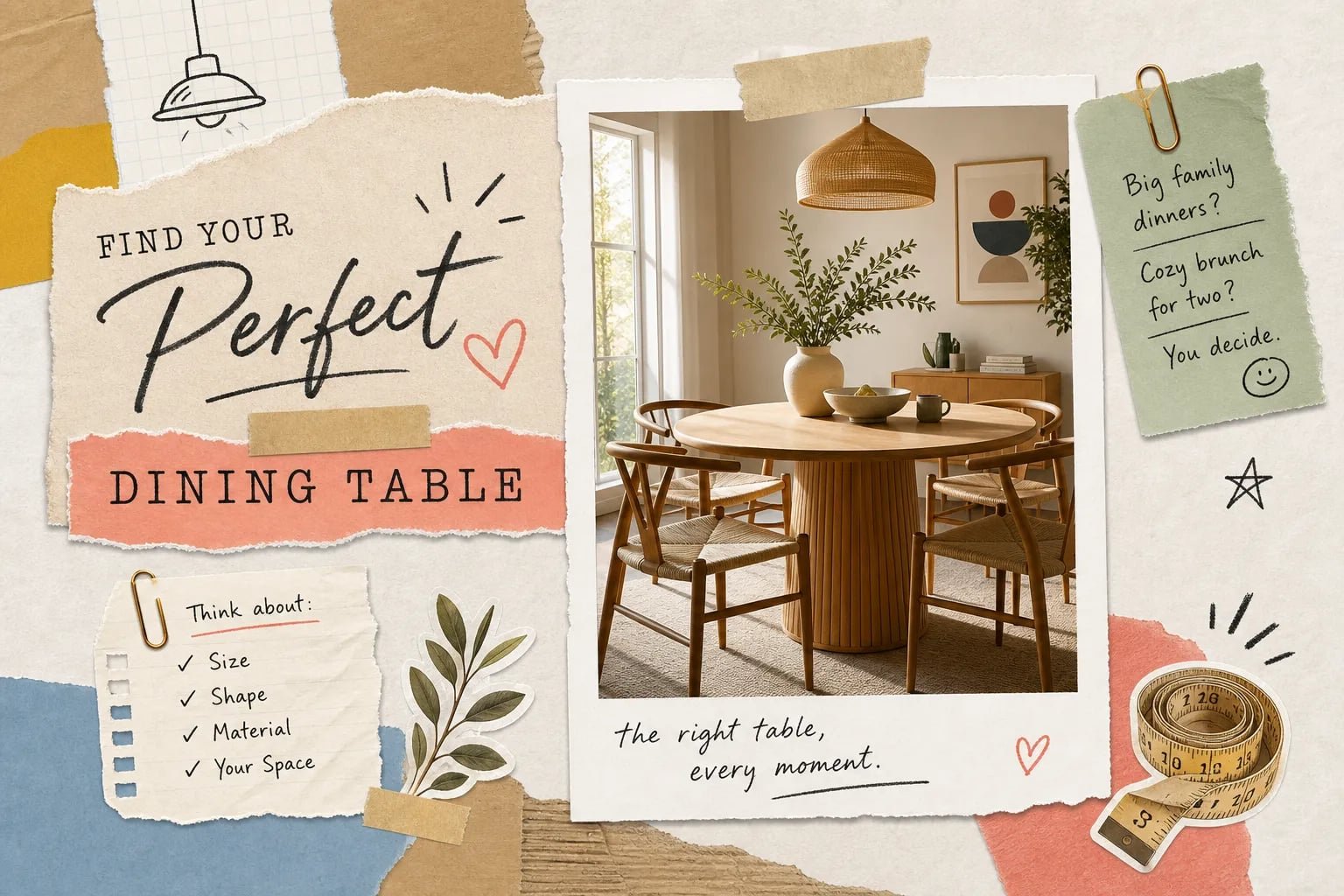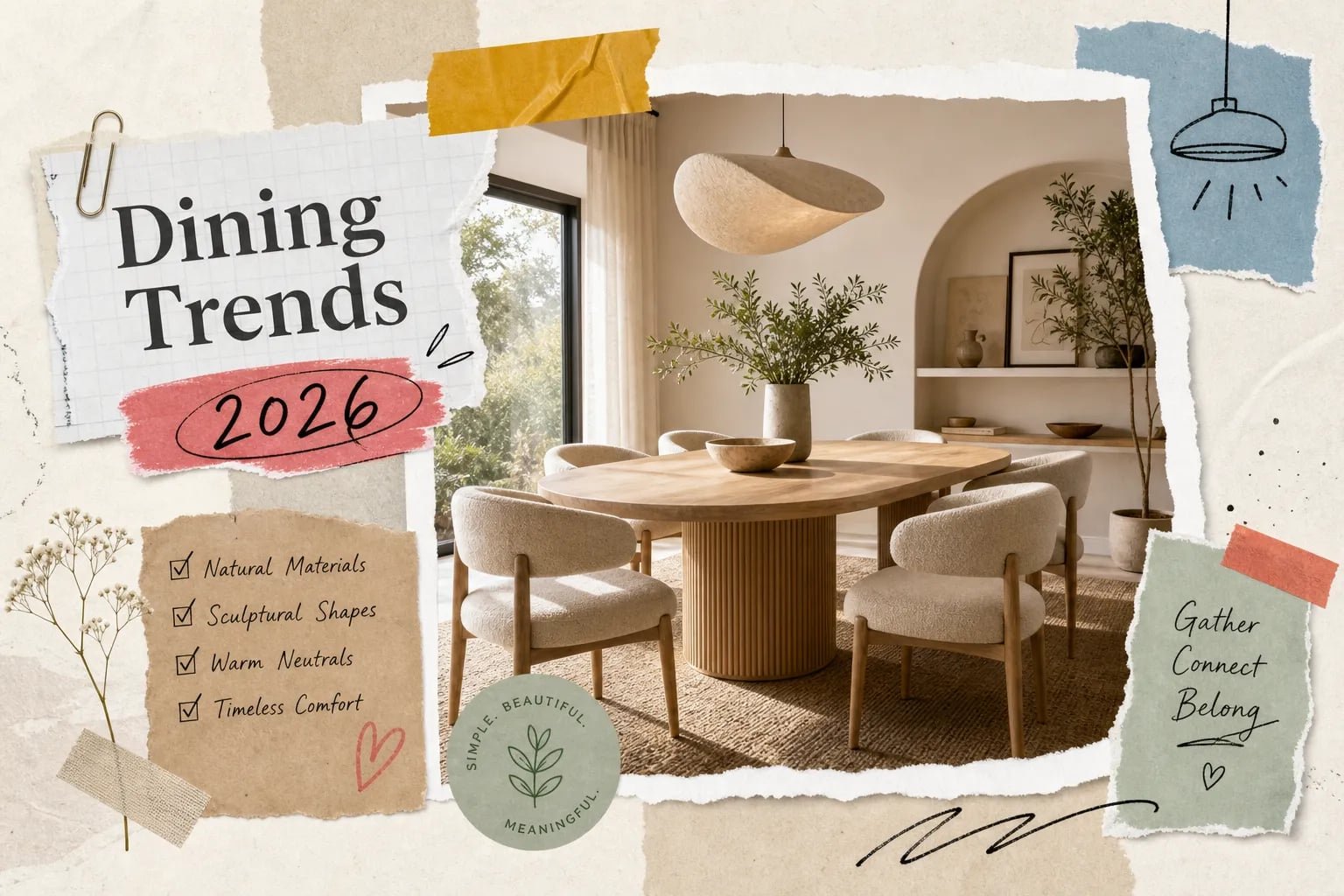
What are the current trends for dining tables in 2026? The short answer is: organic shapes, tactile materials, and a clear rejection of cold, clinical minimalism. But the longer answer is worth understanding before you commit to a purchase, because the shift happening in the dining room right now is more fundamental than a seasonal style update. The dining table has become one of the most design-forward pieces of furniture in the home, and if you’re planning a renovation or a new specification this year, understanding what’s driving that shift will save you from an expensive mistake.
This guide covers the twelve leading trends shaping dining rooms right now, the material and size trade-offs worth understanding before you commit, and practical steps to make sure whatever you choose still looks right five years from now.
Why the dining room is now the most expressive room to design
For years, the dining table was treated as a practical object first and a design statement second. That calculus has flipped. More time spent at home, combined with a broader cultural appetite for interiors that feel warm and considered, has pushed the dining room to the front of renovation budgets. Designers and retailers have noted a marked increase in consumer spend on dining furniture, reflecting a shift in priorities that was once reserved almost exclusively for the kitchen.
The blurring of dining, working, and socialising at the same surface has made buyers far more demanding. A table now needs to handle a Sunday roast, a Tuesday video call, and a dinner party for ten with minimal fuss. That genuine versatility requirement is directly shaping the dining table trends in 2026, in shape, mechanism, and material. Buyers aren’t choosing a table for an occasion any more. They’re choosing one for a life.
Current dining table trends in 2026: shapes, materials, and what’s driving them
Why oval is the shape interior designers favour most
Oval tables are the breakout shape of this cycle. They deliver the sociability of a round table, no “head of the table” hierarchy, whilst seating more people comfortably than an equivalent circle. Many designers favour oval as a shape that works well across a wide range of room proportions, and UK consumer search data supports the momentum: round dining tables attract around 33,100 monthly searches in the UK, with oval close behind at 9,900 and growing steadily.
The practical case for oval is strong. In a room that’s slightly longer than it is wide, a rectangle can feel rigid and an oval softens that tension naturally. It improves traffic flow around the table and, paired with upholstered dining chairs, creates a dining setup that reads as genuinely considered rather than assembled from defaults.
The continued rise of round tables and organic silhouettes
Round tables remain the most searched shape overall, valued for the way they encourage conversation and soften a room’s geometry. Asymmetrical and free-form shapes are also entering the mainstream, influenced by biophilic design’s preference for forms that echo nature rather than the drawing board. These organic silhouettes are particularly effective in open-plan living and dining spaces where a hard rectangular form can feel disconnected from its surroundings.
When rectangular tables still make the most sense
Rectangular tables remain the most widely purchased shape in the UK, and for good reason: they seat the most people per square metre of footprint, suit most room layouts, and anchor a formal dining room naturally. The trend isn’t that rectangular is wrong. It’s that buyers are now far more intentional about the choice rather than defaulting to it automatically. If your room is genuinely long and narrow, a rectangle is still the right answer. The difference in 2026 is that people are asking the question rather than assuming.
Materials worth investing in: marble, sintered stone, and warm timber
Marble and travertine as the statement dining surface
Marble tops have moved from aspirational to achievable, appearing across a wide range of price points, from high-street interpretations through to genuinely slab-cut bespoke pieces. Travertine in particular has a strong hold on the 2026 aesthetic: its natural veining and warm tones work across Japandi, maximalist, and biophilic interiors alike. UK retail pricing for marble-top dining tables typically runs from around £200 to £400 at the budget end, £500 to £900 for mid-range, and £1,000 upwards for premium natural slabs.
The maintenance reality is worth acknowledging plainly. Marble is porous, needs periodic sealing, and requires quick cleanup of acidic spills. Lemon juice, vinegar, and red wine left sitting will etch the surface. That’s not a dealbreaker, but it is a lifestyle consideration worth settling before you commit to a table that will cost several hundred pounds at minimum.
Sintered stone: the practical alternative doing the heavy lifting
For buyers who love the marble aesthetic but need something more forgiving in daily use, sintered stone has become the specification of choice among interior designers and FF&E consultants. It’s made by compacting natural minerals under very high heat and pressure, producing a dense, non-porous slab that is scratch-resistant, heat-resistant, and requires no sealing. It can also be produced in large-format slabs that natural marble physically can’t achieve at the same price point.
UK retail pricing for sintered stone tops starts around £125 to £170 at the budget tier, rises to £170 to £350 mid-range, and goes higher for larger or more complex pieces. For extendable dining tables where structural integrity across the leaf join matters, sintered stone’s consistency of density makes it particularly well suited. It’s the material that gives you the stone look without scheduling your dinner parties around a sealing calendar.
Live-edge and warm-toned timbers reclaiming the spotlight
After years of pale Scandi oak, the pendulum has swung toward richer, warmer timber finishes: walnut, cerused oak, and live-edge slabs that carry the grain and character of the original tree. Solid hardwoods age well and can be refinished, which aligns directly with the growing interest in sustainable, long-lived furniture. UK solid hardwood dining tables typically sit between £300 and £700 at the budget end, £700 to £1,500 mid-range, and £1,500 upwards for premium extending pieces or statement species.
Oil and wax finishes are popular for their natural look and the warmth they bring to a room, though they require more frequent upkeep than lacquer or polyurethane-sealed equivalents. If you want the live-edge aesthetic without the maintenance commitment, a cerused or lightly lacquered oak is a sensible middle ground that still reads as warm and considered.
Sculptural bases and surface finishes doing the visual work
In 2026, the table base is as important as the top. Fluted pedestals, carved trestle legs, and asymmetrical metal bases are giving dining tables a sculptural quality that makes them feel closer to furniture art than purely functional objects. A simple marble or sintered stone top paired with a well-crafted fluted base creates a level of visual interest that no amount of tabletop styling can replicate. The base is no longer an afterthought; it’s often the centrepiece.
Mixed-material pairings are one of the most reliably on-trend choices across multiple style directions: a stone top on a powder-coated steel base, or a walnut top on a brushed brass pedestal, delivers a layered quality that single-material tables simply can’t match. Lacquer finishes are also making a confident return, particularly in maximalist dining rooms where a high-gloss forest green or deep navy table becomes the room’s anchor rather than its background.
Three style directions shaping the 2026 dining room
Japandi: discipline, warmth, and nothing extra
Japandi remains the most enduring design language of this decade. In a dining room context it translates to clean-lined solid wood or veneer tables in walnut or warm oak, paired with understated upholstered chairs and very deliberate decorative choices. Nothing is accidental. The Japandi dining table tends to have a refined base, a beautifully finished top, and absolutely no visual clutter around it. Low-profile furniture, muted warm neutrals, and strong use of negative space define the look at a glance.
If your room has good proportions and natural light, Japandi is one of the most forgiving frameworks to design within: the discipline of the style means each individual piece gets to be appreciated fully. The risk is that it can feel cold if the timber isn’t warm enough or the room lacks soft textiles to balance the hard surfaces.
Biophilic design: where nature meets the table
Biophilic dining rooms bring organic materials, earthy colour palettes, and natural texture into direct contact with the dining experience. Live-edge timber tables, rattan or cane seating, travertine surfaces, and stone or terracotta accessories all fit this direction. The goal is to make the room feel as though it has grown there naturally, with materials that carry visible grain, variation, and imperfection. Large, unobstructed windows and an abundance of living greenery complete the effect.
Where Japandi edits down to essentials, biophilic layers textures deliberately. The two styles share a preference for natural materials and earthy tones, but biophilic is lush where Japandi is spare. If your instinct is to fill a room with plants, ceramics, and woven textiles, biophilic is the framework that makes that impulse coherent rather than cluttered.
Maximalist dining: colour, contrast, and layered confidence
Maximalism has firmly established itself as a serious design choice rather than a reaction. In dining rooms it shows up as bold lacquered table finishes in forest green, deep navy, or burnt terracotta; sculptural oversized pendants; and deliberately mismatched seating that reads as collected rather than chaotic. High visual density, mixed patterns, and statement pieces are the defining characteristics. The key to maximalism done well is coherence: every element is chosen, not accumulated.
A maximalist dining room done well takes confidence and restraint in equal measure. That restraint part surprises people: maximalism isn’t about fitting everything in, it’s about making deliberate choices and then committing fully to them. One strong table, one dramatic light fitting, and a genuinely bold colour on the walls will do more for the look than a room full of competing pieces at different scales.
Extendable dining tables: why flexible seating leads the market this year
Extendable tables now dominate the dining furniture market, particularly in urban UK homes where space is at a premium. Two mechanisms are receiving the strongest buyer feedback in 2026. Butterfly leaf systems store the leaf inside the table and allow it to unfold in a single motion, making them particularly easy for one person to operate without requiring anyone to find and carry a separate board. Telescoping rail mechanisms allow smooth one-person extension as well, and are generally better suited to heavier tops. For sintered stone or marble, rail-based systems that distribute the load evenly across the extension tend to be more stable and more durable over time.
Beyond simple extension, 2026 is also seeing genuine innovation in modular and convertible designs: tables that shift from a compact four-seater to a ten-seat configuration, or from dining table to workspace, with minimal effort. For buyers in compact city flats or open-plan spaces, this functionality is no longer a compromise. Mechanism quality across the sector has improved considerably, and many well-regarded extending models now perform close to fixed-leg alternatives in both feel and finish. The wobble and visual awkwardness that once characterised lower-price-point extending tables have been largely addressed by the better options on the market.
What to budget and how designers are sourcing differently
The UK market divides broadly into three tiers. Budget options sit between £100 and £400 and typically use engineered wood, veneer, or laminate tops. Mid-range pieces run from £400 to £800, offering better construction, more solid-wood content, and broader style choice. Premium dining tables start around £800 and rise steeply: solid hardwoods, ceramic and marble surfaces, and quality extending mechanisms push well-regarded pieces to £1,500 and well beyond.
For individual homeowners, UK retailers are the most practical route. Interior designers and property developers furnishing villa projects, apartment schemes, or boutique hospitality spaces, however, are increasingly working directly with factory-level custom manufacturers. Bespoke marble-top dining tables, live-edge commissions, and leather-edged statement pieces that would cost several thousand pounds per unit through a UK design showroom can be specified and produced to exact drawings at a fraction of that cost. YM Furniture (Foshan Yauming Furniture & Construction Co., Ltd.) is one example of a Foshan-based specialist producing custom high-end dining and hospitality furniture for projects internationally, the kind of manufacturer that professionals with multi-unit briefs are building direct relationships with. For developers fitting out an entire apartment floor or boutique hotel, that pricing difference is significant enough to meaningfully change both the project budget and the quality of finish they can afford to specify.
Matching the right trend to your actual space
Before choosing a table, work through three honest questions. How many people does this space genuinely need to seat on a typical week, not a best-case occasion? How much natural light does the room receive (darker rooms often need warmer materials; brighter rooms can handle cooler stone without feeling clinical)? And how much daily maintenance are you realistically prepared to commit to? A marble table in a household with young children and an aversion to wiping down surfaces after every meal is a recipe for regret, regardless of how beautiful it looks on a mood board.
The most future-proof approach is to invest in shape and material quality, then let the styling around the table carry the trend weight. Choose a silhouette, oval, round, or a well-proportioned rectangle, that suits the room’s actual dimensions rather than the trend cycle. Choose a material you can realistically live with. Then let the chairs, textiles, pendants, and decorative objects do the trend work. That way, when style directions shift, you’re reupholstering chairs rather than replacing a table.
- Oval or round if your room allows it: both improve sociability and soften the space naturally.
- Sintered stone if you want the stone aesthetic with minimal maintenance commitment.
- A quality extending mechanism if you ever need to seat more than six: the convenience compounds over years of use.
- Invest in the base as much as the top: a sculptural base does more for the room’s character than almost any accessory.
The bottom line: what are the current trends for dining tables in 2026?
The direction is consistent: away from cold and generic, toward warm, tactile, and considered. Oval and round shapes are gaining ground over rectangular as the deliberate choice rather than the default, a shift supported by both designer commentary and rising search interest in these forms. Marble and sintered stone are the prestige surface materials, sitting at opposite ends of the maintenance spectrum. Live-edge and warm-toned timber is bringing soul back into the room. And Japandi, biophilic, and maximalist styling each offer a distinct but coherent framework for the whole space rather than a collection of unrelated pieces.
The thread running through all of it is quality: mechanism quality in extending tables, material quality in stone surfaces, and construction quality in sculptural bases. A well-made oval walnut table with a fluted base will outlast three cycles of trend shifts and look better for every year it ages. Whether you’re specifying a single piece for a home renovation or sourcing dining furniture for a large-scale development, choosing on those grounds will serve you far better than chasing whatever is photographed most on interiors accounts this season.
If you’re working on a larger project and want to discuss custom specifications, get in touch with our team to explore what’s possible at factory-direct pricing.